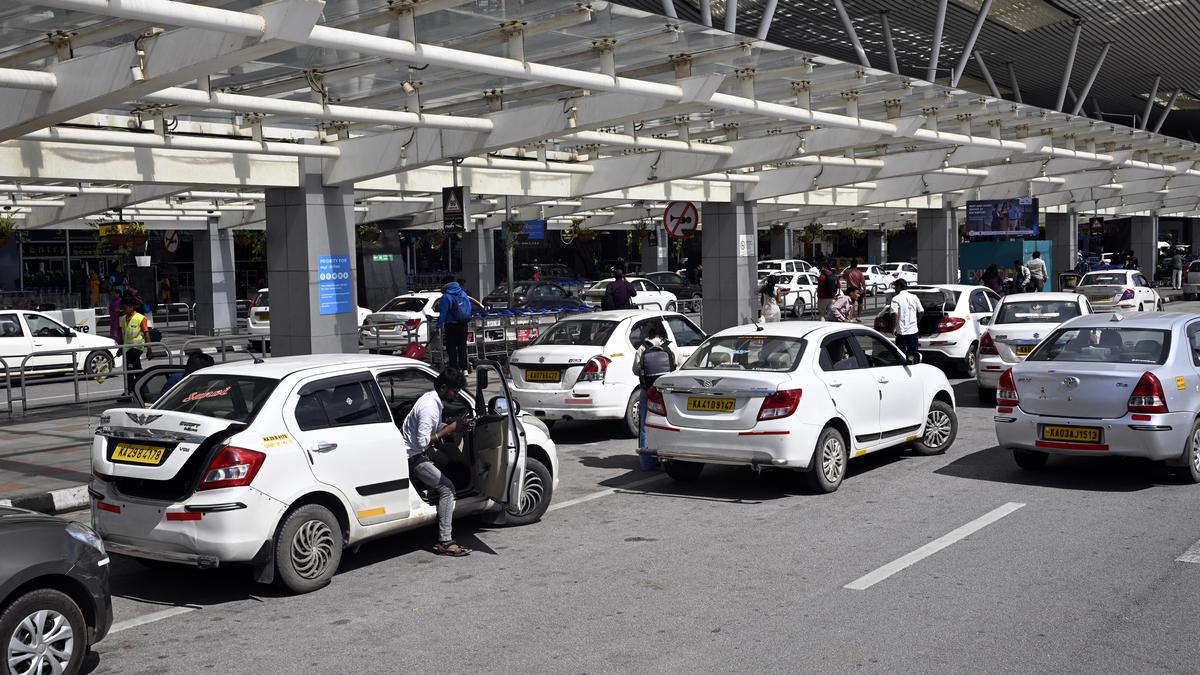
Vehicles at the Kempegowda International Airport.
Cab services to and from Kempegowda International Airport (KIA) were severely disrupted on Tuesday morning after hundreds of cab drivers staged a protest against the new parking and pick-up rules introduced by Bangalore International Airport Limited (BIAL). The agitation led to traffic congestion on the airport approach road, with police resorting to cane the protesters, who blocked the Sadahalli toll gate, to disperse them.
The protest began around 9 a.m. when cab drivers gathered near the toll plaza and blocked vehicular movement, demanding an immediate rollback of BIAL’s newly introduced lane segregation and parking fee system at the airport’s arrival zones. The demonstration resulted in long queues of vehicles and delays for passengers heading to the airport during morning peak hours.
The new lane segregation system at the pick-up zones was implemented at Terminal 2 on December 11 and extended to Terminal 1 from December 13. Under the revised rules, all vehicles are allowed eight minutes of free access to the pick-up zone. A charge of ₹150 is levied for stays between eight and 13 minutes, while vehicles staying between 13 and 18 minutes are charged ₹300. Any vehicle exceeding 18 minutes is liable to be towed to the nearest police station, with additional fines and towing charges imposed.
Cab drivers argue that the time limit is unrealistic and a financial burden to them, particularly given the operational challenges they already face. Speaking to The Hindu, G. Narayanaswamy, president of the Karnataka Chalakara Okkuta, said: “The airport authorities were unfairly penalising drivers who were already struggling with rising fuel costs, toll charges, and high commissions imposed by cab aggregators.”
“The airport is fully aware that 10 minutes is not enough to pick up passengers, especially when flights are delayed or when passengers have luggage or elderly family members. Despite this, these rules have been imposed without consultation. This is harassment of drivers and inconvenience to passengers,” he said.
Warning of further agitation, he added that the protests would continue if BIAL did not either extend the free waiting period or withdraw the new system altogether.
Several drivers also pointed out that they were now being directed to use the P3 and P4 parking zones for pick-ups, which are located at a distance from the terminal. Prakash Kumar, a cab driver, said: “The rules were introduced five days ago, without consulting us. The new rule adds to our losses. We are forced to walk long distances to reach passengers, and the short time window makes it impossible to operate smoothly,” he said, calling the charges unjust and unreasonable.
Passengers, too, expressed dissatisfaction with the new arrangements. Several travellers complained that they were made to walk long distances ranging from 800 metres to over a kilometre with heavy luggage to reach their cabs.
The issue also drew criticism on social media. Gautam Pradhan, a traveller, posted on X: ““@BLRAirport has designed an obstacle course before you can get into your taxi at T1 arrivals. Anyone with baggage, kids or elders will struggle. Don’t create problems! Please go back to the old system!”
Responding to the criticism, BIAL defended the new measures, stating that passenger safety and convenience were the primary objectives. In a statement, a BIAL spokesperson said that with rising passenger and vehicle volumes, it had become necessary to introduce greater discipline at arrival pick-up areas to prevent congestion, unsafe halts and confusion at the kerbside.
“The new pick-up measures are designed to create a safer, smoother and more predictable experience for passengers. Private vehicles have a dedicated pick-up lane with a generous free time window, while commercial vehicles operate from designated and supervised pick-up zones. These systems are standard practice at leading global airports,” the spokesperson said.
Rejecting allegations of revenue-driven enforcement, BIAL maintained that the initiative focused on behaviour change, safety and ensuring the availability of pick-up zones for quick boarding. The airport operator added that the rollout had been accompanied by on-ground guidance, signage and coordination with cab operators.
Published – December 16, 2025 07:44 pm IST