
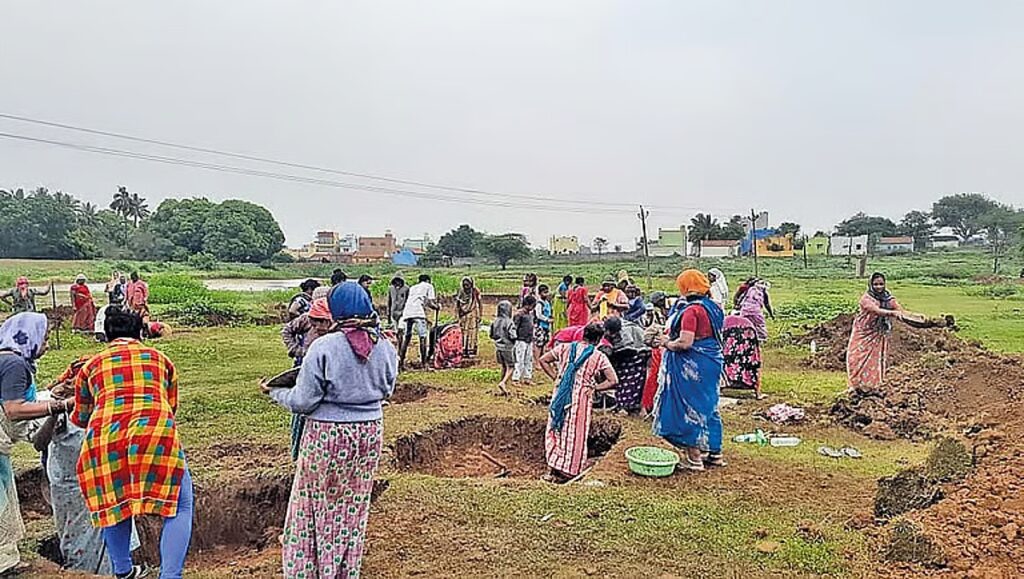
There have been gross irregularities in the implementation of the Mahatma Gandhi National Rural Employment Guarantee Act (MGNREGA) in Odisha, according to the recently released audit of the Comptroller and Auditor General (CAG). Due to these, the programme has not been able to fulfill its original purpose, it added.
“The scheme failed to meet the basic objective of livelihood security, which includes guaranteed employment. The reason for this was the lack of accurate assessment of the time and volume of work,” the audit noted.
In contrast to the provision of 100 days of guaranteed employment to households registered under the law, the audit found that only 6.24 to 11.26 per cent of households were provided 100 days of employment during the financial year 2019-24, while 25.77 lakh (2.577 million) to 44.58 lakh (4.458 million) households demanded work. In the districts that were assessed, this figure ranged between 0.20 and 16.18 per cent.
Low demand for work and consequent less employment opportunities were attributed to non-issuance of job cards on time and not conducting door-to-door surveys to register new families. Non-payment of wages on time, low rate of wages in MGNREGA as compared to the minimum wage rate of the state and also low wage rate of MGNREGA as compared to neighbouring states like Andhra Pradesh were other reasons mentioned during the interviews of 441 beneficiaries. Of these, 117 beneficiaries (27 per cent) said they were not interested in working due to delay in payment of wages, while 234 beneficiaries (53 per cent) said they were not interested in working due to low rate of wages in MGNREGA as compared to works related to other schemes.
Job cards not updated, payments to the dead
During 2019-24, no survey was conducted in the state to identify new and eligible households, add or remove names of members in job cards and rectify anomalies. This shows that there was not enough initiative on part of the state to extend the benefits of the scheme i.e. to include new eligible beneficiaries and update the details of existing beneficiaries. In the absence of surveys to update the job card information, there were cases where payments were made in the name of deceased beneficiaries and wages could not be credited to the bank accounts of actual beneficiaries due to incorrect data.
Of 64.26 lakh (6.426 million) households that applied for job cards during 2019-24 in the five districts assessed, 0.82 lakh households were not issued job cards without any recorded reason. These families were deprived of employment opportunities under MGNREGA.
The CAG also observed that the labour budget had to be prepared and approved by the Gram Sabha at the gram panchayat level, then sent to the Panchayat Samiti and consolidated at the district level. It was then to be submitted to the state government so that it could forward it to the Centre.
The auditor found that of all the 40 gram panchayats examined, no labour budget was prepared by any single one. Instead, a list of projects was prepared and approved by the Gram Sabhas.
Compensation not received
The audit report found that during 2019-24, wage payment of Rs 154.31 crore was delayed by 1.44 crore days. The beneficiaries were entitled to a compensation of Rs 1.03 crore for this delay. However, only Rs 0.01 crore was paid as compensation during 2019-24 and the balance compensation of Rs 1.02 crore was rejected and not paid due to natural calamities, inadequate funds in State Nodal Account, etc.
According to the report, since the beneficiaries were not responsible for any of the above constraints, it was not appropriate to reject the compensation. Further, non-payment of compensation defeated the very objective of the scheme to provide livelihood support through guaranteed employment.