
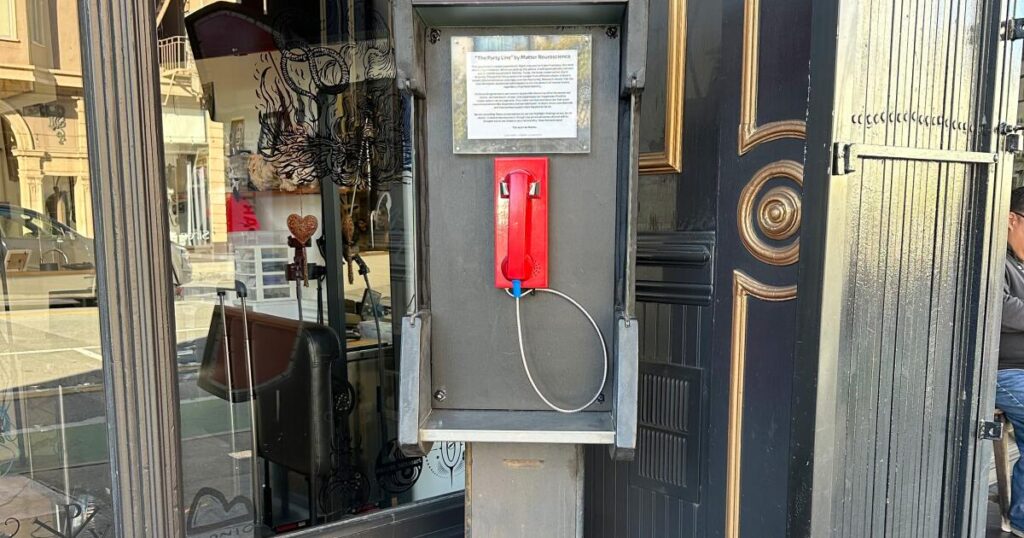
A rather peculiar red phone booth appeared outside a San Francisco tattoo parlor this week, urging residents in one of America’s most liberal cities to “call a Republican.”
Its counterpart, a blue phone booth, sits outside a bookshop in the staunchly conservative town of Abilene, Texas, where it encourages locals to “call a Democrat.”
Together, the phone booths form a social experiment: When someone picks up the line in San Francisco, it rings in Texas, and vice versa, cultivating a unique opportunity for passersby to chat with a stranger who holds a vastly different outlook on politics and life.
The initiative, dubbed the Party Line project, is the brainchild of Matter Neuroscience, a mental health startup focused on researching the science behind happiness and creating tools to battle major depressive disorders.
The “Call a Democrat” pay phone sits outside of Seven and One Books in Abilene, Texas.
(Logan Ivey / Matter Neuroscience)
Neuroscientists know that fighting with people who hold different views leads to the release of cortisol in the brain, which increases stress, Matter co-founder Ben Goldhirsh explained. On the other hand, engaging in non-hateful, human-to-human conversation activates happiness-boosting neurotransmitters such as dopamine and cannabinoids, he said.
“We wanted to see what would happen when people had the chance to connect with people directly — would they choose to argue and fight, or would they choose to find common ground?” Goldhirsh said. “[Would they choose] the release of cortisol or the release of cannabinoids?”
Much to researchers’ delight, the vast majority of callers have chosen to seek common ground. The project launched lateSunday afternoon, and by Thursday evening researchers had recorded more than 150 conversations and voicemails.
So far the topics callers have discussed have run the gamut, including hobbies, culture and world events, Goldhirsh said. Many callers are rejecting the dichotomy of Republican and Democratic labels and are finding they have similar concerns about the state of the nation and economy.
In one recording, Steve — a San Francisco man who identifies as a liberal — asks, “Are you a Republican?” to a mother of four in Abilene.
She quickly responds “Yes, I am,” but then a moment later says, “Well, no, hmm, ummm, [I’m] probably an independent I would say as I’ve gotten older.”
Steve then asks her if she sees the world as being as crazy as he does, to which she says, “I do. It’s really worse and worse every day.”
“See? We have so much in common!” he responds.
This type of dialogue doesn’t surprise UCLA political science professor Chris Tausanovitch, who wrote a book on the polarization in American politics.
He said that while people often assume they won’t get along with a member of the opposite political party, the average American holds more moderate political views than their elected representatives.
“A lot of the dislike of the other party arises because we don’t like the public stances of whichever party we’re not aligned with,” he said. “If you’re a Democrat, you associate Republicans with the stances of people like Donald Trump, but it turns out that most people are not as extreme as the stereotype of their political party would suggest.”
Addressing the problem of polarization in politics will require significant effort from both parties, Tausanovitch said, but experiments like the phone booth are a fantastic way to get people talking across the aisle.
“There’s a good feeling from talking to another human and realizing they’re human,” he said, “and you actually can learn that there’s a tendency for people not to be as different as you assume that they are in terms of real policy and beliefs.”
From a mental health expert’s perspective, Goldhirsh said he was not surprised that the majority of the conversations have been positive, inquisitive and often led to heartwarming discoveries of shared interests and experiences.
“People are complex, nuanced individuals,” Goldhirsh said, “and really enjoy engaging as such and do it with a real sort of kindness and curiosity when given that chance.”
In one dialogue shared on Matter Neuroscience’s Instagram, Shane, a correctional officer in Texas, chats with Chris, who works at sandwich shop and DJ studio in San Francisco.
Shane opens up about the good and bad aspects of his job, sharing the horror of watching an inmate be murdered and the fulfillment he recently found chatting with inmates about the Bible.
The pair quickly find common ground — Shane’s brother is called Chris and Chris’ mother lives in San Antonio.
“I love this experiment here,” Shane says at the end of the conversation. “We’re already connected, dude,” Chris adds.
The San Francisco phone booth is set up outside of Black Serum Tattoo studio in the Mission District. Owner Brucius von Xylander said he agreed to let Matter Neuroscience set up the phone outside of his studio because he thought it would be a great medium for people across the political spectrum to engage in civil discourse.
“It seemed like a good idea to me, because it’s fun connecting with a stranger somewhere knowing that they might talk about something that is hard to speak about on social media or elsewhere,” Von Xylander said.
Von Xylander said the response to the phone had been overwhelmingly positive both online and in person.
Meanwhile, some 1,600 miles away in Abilene, the owner of Seven and One Books, Arlene Kasselman, also has been delighted with the response to the phone outside her store.
When she first saw the bright blue phone with the “Call a Democrat” sign, she was a little nervous about how the conversations would go. But so far they have been amazing, she said, as people discuss baking, basketball, politics and more.
From her perspective, the goal is to see what it looks like to “not just be a keyboard warrior in the comments section, but to view people as human.”
“We are certainly biologically more similar than dissimilar,” she added. “So how can we reach across the aisle?”
In our increasingly polarized society, Kasselman said she’s excited to facilitate an experience in which people can have positive interactions with strangers from different backgrounds.
Tausanovitch believes meaningful conversations across party lines, in which people connect over shared interests, can wake voters up to the price they are paying because of our extreme political climate. He said everyone suffers when parties are more focused on winning an election than they are on working together on policies that benefit all Americans.
“This kind of thing can help people see that [polarization] is a race to the bottom and a problem that is worthy of being addressed directly,” he said.
Goldhirsh also is delighted with the initial response and said Matter Neuroscience had been flooded with requests to bring the phone booths to other parts of America. For example, Los Angeles rapper the Game sent a message saying the team should install phones in Bloods and Crips territories, allowing members of the enemy gangs to converse.
“We’re going to continue pushing for dialogue,” Goldhirsh said, “because connecting on common ground is better for happiness than, you know, finding joy in the cortisol of the fight-or-flight experience.”