‘This report is from this week’s CNBC’s “Inside India” newsletter which brings you timely, insightful news and market commentary on the emerging powerhouse. Subscribe here.
The big story
Last month, Indian airports descended into chaos as hundreds of flights were cancelled by the country’s largest airline, Indigo, upending travel plans for thousands of passengers.
Its closest competitor, Air India, has been dealing with troubles of its own. In 2025, one of its London-bound planes crashed in a tragic accident, killing all but one of its 242 passengers on board. And more recently, Canadian authorities ordered the airline to investigate a pilot who failed two breathalyzer tests before a scheduled departure.
The Tata Group, which owns Air India alongside Singapore Airlines, is reportedly considering replacing Chief Executive Campbell Wilson to accelerate the airline’s turnaround.
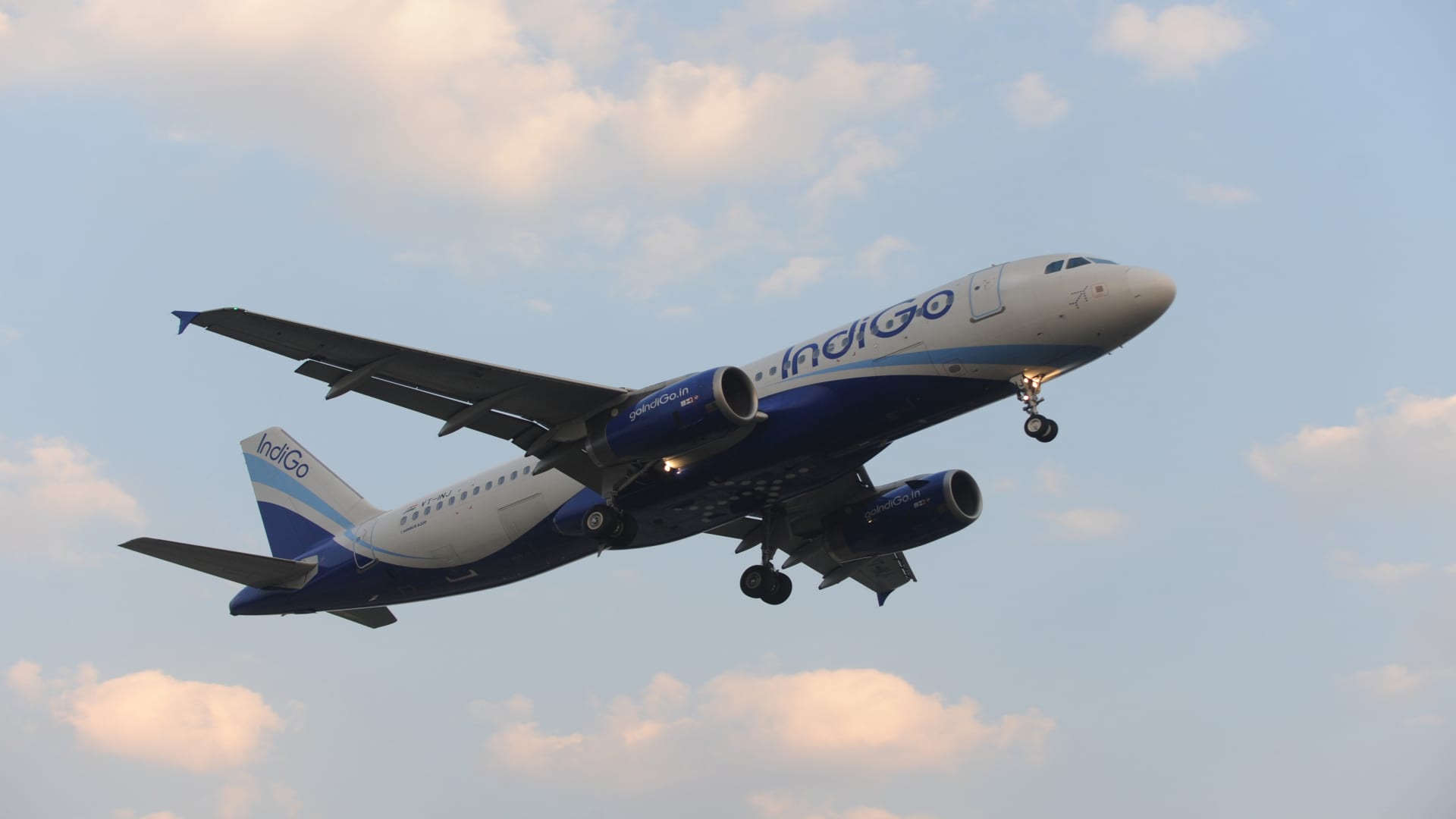
An Indigo Airlines plane approaches Ahmedabad airport, India
Sam Panthaky | AFP | Getty Images
A two-cornered fight
Indigo commands nearly 65% of market share in India, while Air India holds about 27%, according to data from the country’s aviation regulator, the Directorate General of Civil Aviation. That leaves India’s airline industry effectively a duopoly.
India is already one of the world’s fastest-growing aviation markets, though estimates of the size vary depending on how passenger trips are counted. The government says Indian airlines carried about 350 million passengers in 2024, a figure that includes multiple trips by the same traveler.
By contrast, passenger traffic totaled 174.1 million, according to a June 2025 report by the International Air Transport Association, which measures origin-destination travel. The government expects total passenger numbers to rise to 1.1 billion by 2040.
Speaking in parliament on Dec. 8, India’s civil aviation minister Kinjarapu Rammohan Naidu said the country has the demand to sustain “five big airlines,” adding that his government wants more players in this industry and that it is the “best time to start an airline in India.”
Industry experts are not convinced.
Adding new airlines, they argue, will not resolve structural issues, such as the cost and revenue pressures specific to Indian airlines.
A brutal market
More than a decade ago, India had a vibrant aviation sector, with multiple carriers engaging in fierce competition. Many, however, were unable to sustain because of mounting costs and eventually became overburdened with debt.
“In the last three decades in India, many big players like Jet Airways, Kingfisher, Sahara Airlines, Deccan, GoAir, ModiLuft, and many other closed down after incurring heavy losses,” said Jayant Krishna, senior fellow with the Chair on India and Emerging Asia Economics at the Center for Strategic and International Studies.
Indigo, he said, managed to last by sticking rigidly to a low-cost model, remaining lean. That discipline eventually helped it to capture two-thirds of the market.
Air India’s path was markedly different. Until 2022, the airline was state-owned, with taxpayer funds covering years of losses. After its privatization, Tata Group and Singapore Airlines launched a “multi-year transformation programme” at Air India.
SpiceJet, another domestic carrier with a 2.7% market share, has repeatedly flirted with bankruptcy several times since its inception.
“The Indian airline market has been difficult to operate in, as evidenced by multiple airline entries and exits, including more than 15 airline bankruptcies over the past two decades,” said Alan Lim, director of Alton Aviation Consultancy.
Costs and revenue squeeze
Pressure on both costs and revenues remains the sector’s major obstacle.
Major Indian airlines get nearly 65% of their revenue from domestic travel, for which passengers pay in Indian rupees, explains Mark Martin, founder and CEO of aviation consulting firm Martin Consulting.
A much smaller portion of airline revenue in India is dollar-based, he said, adding that most expenses are paid in U.S. dollars. These include lease rentals, aircraft maintenance, and the purchase of spare parts, leaving airlines vulnerable to currency swings.
With the Indian rupee emerging as Asia’s worst-performing currency in 2025 against the dollar and expected to weaken further, operating costs are likely to rise.
High fuel costs add to the strain. They make up 40%-50% of airline costs in India, according to Alton Consulting, well above the global average of around 30%, due to high state-level taxes on aviation turbine fuel.
However, even in the face of rising costs, there is little room for airlines to pass them on to passengers without seeing a dip in demand.
“There is a strong threshold of 5,000 rupees ($55) when it comes to air fares in India,” Harsh Vardhan, chairman of New Delhi-based Starair Consulting, told me. Vardhan is referring to the price of domestic routes.
Even in a near-monopoly market, airlines struggle to raise fares, he said.
Airport charges are also rising as many terminals across the country are being built or upgraded.
India currently has 163 airports, but it hopes to more than double that number up to 400 by 2047, as part of Prime Minister Narendra Modi’s UDAN scheme, which aims to make air travel accessible and affordable to more Indian citizens.
The government scheme, launched in 2016, focuses on building regional connectivity in smaller cities and remote areas by connecting underserved airports and introducing subsidized fares on select routes.
That said, “viability is becoming a big question” for airlines, said Vardhan of Starair Consulting.
With the exception of Indigo, every other operator has struggled to stay profitable, he said, pointing to prohibitive costs as a key reason major airlines in India, such as Jet Airways and Go Air, have collapsed.
Given the difficulty of sustaining airlines and the fragile finances of those still operating, India’s ambition of making flying routine for ordinary citizens may prove harder to lift off than policymakers expect.
Top TV picks on CNBC
India’s Communications Minister Jyotiraditya Scindia said that India will lead the world in 6G on satellite spectrum allocation, adding that it has already given three licenses to OneWeb, Reliance, and Starlink.

Saurabh Mukherjea, founder of Marcellus Investment Managers, said the downward pressure on the Indian rupee will persist unless the U.S. and India can reach a free trade agreement, which he does not think is likely given domestic politics stateside.

Sumit Ritolia, lead research analyst at Kpler, said the recent U.S. moves in Venezuela could have positive implications for Indian oil refiners in the longer term if sanctions get lifted and production recovers.
Need to know
India’s state-owned refiners buying Russian oil. The demand from state-owned refiners is driven by domestic fuel demand and pricing economics. This is leading to a redistribution of Russian oil supply, rather than a collapse in demand.
India’s economy is projected to grow 7.4% in the fiscal year ending March 2026. The Indian economy is expected to grow at a faster rate than in the last fiscal year, supported by government spending and a steady pace of private consumption.
KFC and Pizza Hut Indian operators Devyani and Sapphire Foods to merge operations. The deal would combine the two major franchisee operators for Yum! Brands in India into a single entity. Devyani will issue 117 shares for every 100 equity shares of Sapphire Foods.
Quote of the week
The performance of the Indian stock market has actually been pretty mediocre over the last year, when you compare it to other areas, principally because of the weakening in the currency. And I think that is something which is going to continue to weigh on international investors minds.
— David Roche, Strategist, Quantum Strategy
In the markets
Indian equities extended losses on Thursday, adding to a weak start to the year for the country’s benchmark stock indexes. The Nifty 50 fell 0.84%, while the BSE Sensex slipped 0.82% Thursday, marking a fourth straight session of declines for both benchmarks.
Both indexes are set to snap a two-week winning streak. For the week, the Nifty 50 is down 1.62%, while the Sensex has lost 1.73%.
In the bond market, India’s 10-year government bond yield edged up 0.02% to 6.63%.

— Nur Hikmah Md Ali
Coming up
Jan. 12: CPI inflation data for December; German Chancellor Friedrich Merz meets PM Modi in Ahmedabad
Jan. 15: Unemployment rate for December
Each weekday, CNBC’s “Inside India” news show gives you news and market commentary on the emerging powerhouse businesses, and the people behind its rise. Livestream the show on YouTube and catch highlights here.
SHOWTIMES:
U.S.: Sunday-Thursday, 23:00-0000 ET
Asia: Monday-Friday, 11:00-12:00 SIN/HK, 08:30-09:30 India
Europe: Monday-Friday, 0500-06:00 CET