When DLF was exiled from Delhi and made Haryana its happy hunting grounds (This was after one of the three members of the Planning Committee disclosed to the DLF which areas were being proposed for ‘urbanisation’, and in a lightning swoop they bought up the villages which later were named Greater Kailash 1 and 2, and Hauz Khas and other areas in west and east Delhi), DDA took its place as a giant landlord. Instead of “rebuilding” Shahjahanabad, the DDA’s achievements in the late 1970s were two — a 23-storey office (from where the Vice-Chairman could look down on the Jama Masjid), which was to set a fashion for monument-mania, and a proliferation of ‘Resettlement Colonies’ (oddly called Jhuggi-Jhompri Colonies) to house the poor, after demolishing their old dilapidated homes from where they could hear the azaan. On Vana Mahotsav Day 1984, our Conservation Society went to Madangir to plant roadside trees, only to find the roads had no pavements! Later in the day, I was in the upper-class area of Anandlok, which also had no pavements — but for a different reason — the houseowners had extended their territories. Something inside me broke at that point…and reminded me of Le Corbusier’s dictum — “A test of an architect is his ability to build the smallest house, not one who builds a lavish one”.
An unequal city
A persistent characteristic of every Delhi has been social hierarchy — from the gradations in the imperial cantonment of the 1850s, the imperial capital of 1911, DDA’s Delhi after 1962 — the hierarchy of A, B and C-type houses, MIG\LIG colonies (incidentally the use of the term ‘colony’ for housing estates is not British, but DDA!), the embarrassing Man/ Shan /Vinay and Seva Nagars, MIG/ LIG/ Janata housing. It was only the outrage of the Vinay Nagar residents that led to them being renamed after “freedom fighters”. The obsession with size and location is Delhi-wide. The inhabitants change, new neighbourhoods emerge, but the stereotypes continue. In the 1980s, Jug Suraiya, who had relocated from Kolkata to Delhi, retailed an anecdote. At a Delhi gathering, someone asked him “Where are you putting up?” He was tempted to retort “Right now I am putting up with you”! Every citizen has not only a sense of his place in the urban fabric, but also how much he can get away with. As part of this, he sees individuals, not institutions. In public discourse, blame/praise is apportioned to political parties, to officials, to institutions. All this makes for a cacophony, but for little measurable action. Reports invariably talk of letters “going unanswered”. In the present crisis, is there a single person standing up, owning responsibility or offering time-bound action?
Some recommendations from a Delhite
Looking back, a century after British New Delhi came into being, I feel the following have happened:
a) Many monumental structures have been built to house democratic and research offices, but maintenance is often abysmal.
b) There has been a great increase in dwelling units.
c) There has been an increase in thoroughfares, but little concern for pedestrians’ rights.
d) There have been plans for more of all these.
e) There has been a vast increase in private and public vehicles.
And there are reasons for alarm. Delhi, like any city, has had crises, brought on by social conflict, natural disasters and inadequate administrative controls.
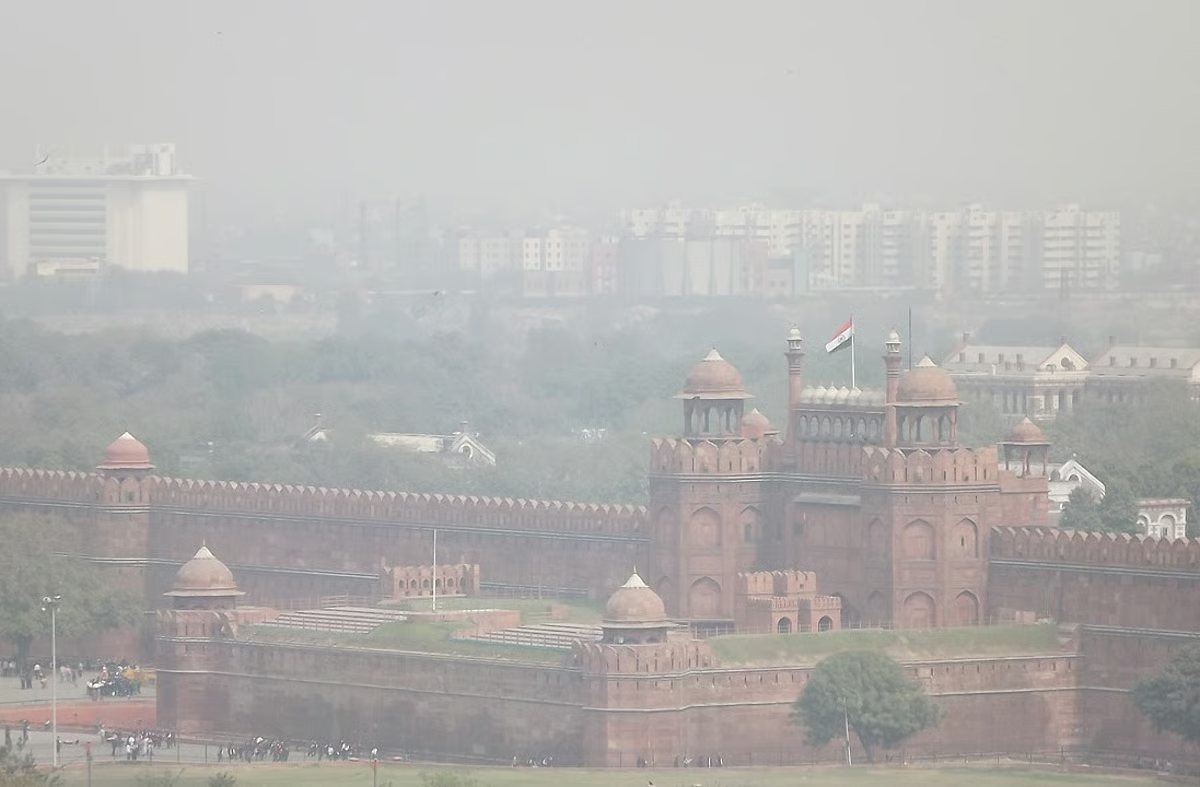
Today, India’s capital faces an environmental crisis which is being exasperatingly addressed in cliché political terms.
Shifting the capital to another site is no solution. We are not in 1912.
Can anything be done then to salvage this great megapolis?
Obviously, the first step is to rubbish all the mud-slinging and make Parliament dignified. Form a national government, and enlist hydraulic engineers and architectural thinkers to work on a priority plan to address Delhi’s ecological problems.
Second, see what Delhi can shed. For instance, there are plans to demolish the Nehru Stadium and build a sports city in Delhi. There should be no demolition.
Here, I recall Syed Shafi’s suggestion, made over 30 years ago to list all corporate offices based in Delhi, and relocate them, not to other metros but to Tier-B towns not too close to Delhi (recalling the very sensible ring-towns proposal of 1955).
South Africa has three capitals: Cape Town (Legislative), Pretoria (Executive) and Bloemfontein (Judicial). Is there a template for India too in this?
Schools should not present general theses on pollution to children. Rather, they should involve them in data collection. They will transform the city. Likewise with communities and RWAs.
Finally, can Delhi have a rethink about the 5,000 farmhouses that Ford Foundation experts in 1955 smuggled into the Master Plan?