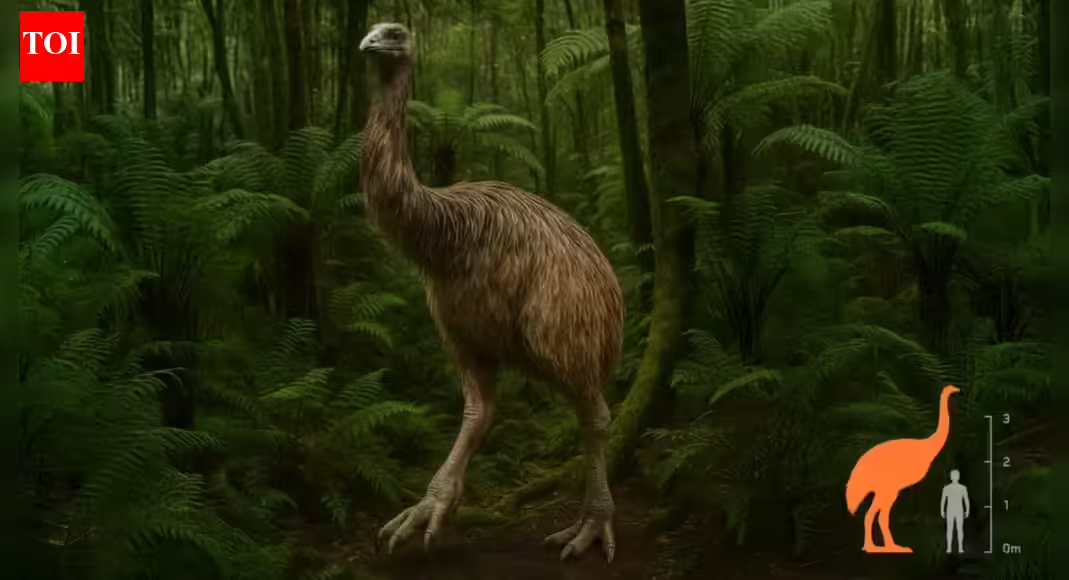
The moa were a group of giant flightless birds that lived in New Zealand. They disappeared from Earth about 600 years ago, not long after humans settled the islands and radically changed the ecosystems. The largest species were more than three meters tall and had a major ecological role long before the Polynesian hunters caused their extinction. The idea of these giant birds has become relevant again through the lens of state, of, the, art genetic science. Some companies are now suggesting that advanced techniques be used to not only reconstruct the DNA of the moa but also to reintroduce birds that are similar to the moa. This idea is a merger between rapidly evolving fields of genome editing, ancient DNA research, and conservation biology. It has thus become a subject of debate, both scientific and cultural, as to whether or not it is possible to restore the existence of species that have been extinct for centuries.
How close are scientists to decoding the moa’s DNA
The fundamental step for any deextinction project is the ability to produce a genetic map of a given species. In the case of moa, researchers need to extract DNA from fossilised bones and sequence it. However, these bones have been exposed to the elements for centuries, and the DNA inside is very likely severely degraded. Ancient DNA is usually very fragmentary and chemically modified, which makes the recovery extremely difficult. A company called Colossal Biosciences, based in Texas, has declared that it will create a complete genome for the nine different species of moa by comparing the sequences obtained from the fossils with those of the closest living relatives, such as emu and tinamou. To complete the moa genome, some parts of modern genomes are allowed to serve as a scaffold for scientists to estimate the original genetic sequence of the moa. Only after a draft genome is made can gene editing technologies like CRISPR be employed to transfer moa-specific genetic sequences to the germline cells of a compatible living bird species. The reconstructed DNA is thus introduced into embryos of the closest relatives with the anticipation that the new organism will exhibit characteristics of the extinct bird. These types of experiments still harbour big issues in spite of the most sophisticated technology available, since the ancestors of the moa branched off from the closest living ones several million years ago, and the exact nature of the moa development is still a mystery.
What challenges do eggs and surrogates pose in bringing back the moa
Mammals might be complicated enough to bring back from extinction using cloning, but birds have a completely different set of problems. Scientists have cloned mammals by using somatic cell nuclear transfer on an experimental basis, but birds lay eggs, and so the process needs to be fundamentally different. It also means that the gene-edited bird embryo will have to be put inside an egg and then let the egg develop naturally, partly in a surrogate incubator and partly in a surrogate species, which will provide the necessary environment for development. Since the moa’s developmental biology is very different from that of the modern birds, the researchers will have to solve the issues of embryonic growth, egg structure, and reproductive timing in order to have the possibility of viable moa, like chicks. Furthermore, the huge difference in size between the extinct moa and its closest living relatives adds to the difficulty of the process. Scientists will have to be absolutely sure that any genetically reconstructed bird is not only the carrier of the genetic traits of the moa but that it can also grow to a similar size physically without causing any serious health problems. These kinds of technical challenges are one of the reasons why those who support and those who are against this kind of work both agree that the resulting organisms may turn out to be hybrids or engineered analogue species rather than exact copies of the original moa.
Could revived moa restore lost ecosystems in New Zealand?
Moa were the dominant herbivores in New Zealand’s forests and shrublands, feeding on vegetation and dispersing seeds in ways that fundamentally shaped plant communities for thousands of years. Their loss caused a series of ecological effects, such as the decline of plants that had evolved alongside moa grazing and the disappearance of prey for top predators like Haast’s eagle. Bringing back birds similar to moa might be able to help re, establish these lost interactions and thus support biodiversity. However, the environment today is still significantly different from that of the pre-human era. Introduced mammals, land use changes, and altered climate patterns have transformed New Zealand’s ecosystems. It is doubtful whether a reintroduced bird could live and perform its ecological role in nature outside a reserve. Researchers need to think if habitat restoration might result in sustainable conditions for the existence of moa analogues or if their presence could endanger the species that have occupied the ecological niches once held by moa. These doubts underline the problem of going from genetic success to ecological integration.
How are Māori communities shaping moa revival efforts?
The moa was not only a biological keystone for these islands but also a major source of inspiration and of the values still ingrained to this day in the Mori communities, whose oral histories and archaeological remains mirror the birds oncecentral role in the environment and traditions of the islands. Nowadays, deextinction proposals feature dialogue and collaborations with Indigenous groups, such as the strategic partnership between Colossal Biosciences and the Ngi Tahu Research Centre, representing the Māori tribe of New Zealand’s South Island. This interaction is a preliminary step to understanding the cultural perspectives of science and also to ensuring that scientific progress is in accordance with the community’s values and heritage. The involvement of indigenous peoples helps to deeply understand the moa’s role in the broader story of New Zealand’s natural history, as well as provides insights into past ecosystems that genetics alone cannot reveal. Furthermore, it puts forth a set of thought-provoking questions, for instance, about how the sharing of responsibilities for extinct species should be once given, and how cultural aspects intertwine with scientific ambitions. The conversations around this topic, which is deextinction, being recognised as something beyond the lab, involving societal aspects like ethics, history, and identity as much as technology, are a reflection of this reality.
Is reviving extinct species worth the scientific effort and cost?
The debate around de, extinction is far from settled among scientists, and opinions about whether it is worth spending money on such projects vary. Some researchers claim that the technologies used cannot create exact copies of extinct organisms and that the newly engineered species may not have the behavioural, ecological, and genetic traits of their ancestors. Moreover, there is a risk that the focus of the public on de, extinction and the funding devoted to it may result in fewer resources being available for the conservation of species that are already endangered. Critics argue that the large expenses and uncertain results of projects like the moa revival make it difficult to justify them when there are so many living species that are in danger of extinction. Supporters argue that the research done for the purpose of de, extinction can be a starting point to develop new conservation techniques that can help the preservation of biodiversity, such as by enabling genetic diversity in endangered populations or by making them more resistant to diseases. They also believe that such challenges can attract the interest of the public, especially young people, and can consequently increase their enthusiasm for science and environmental protection. The extinction debate reflects the changing nature of conservation science and the difficult decisions that are involved in determining the future of the Earth’s biodiversity, regardless of the arguments presented by either side.Also Read | A rare space image links Earth’s glow with the Andromeda Galaxy