
- Gender-responsive technologies and climate-smart practices can reduce labour burdens and emissions, but risk deepening inequalities without supportive policies and alternative livelihoods for women.
- Apart from land rights and access to information, it is vital to consider women as key decision-makers in policies.
- Experts stress that centring women as decision-makers, not just beneficiaries, is essential for building climate resilience and equitable food systems.
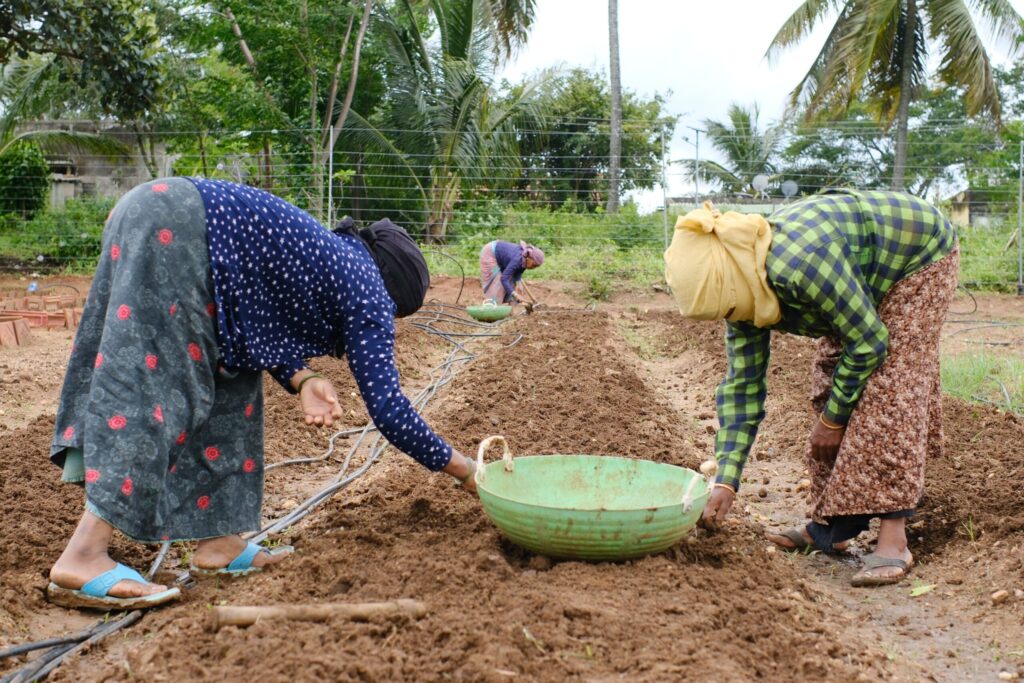
When Shilpa talks about her work at the community-supported agriculture initiative, Kai Thota (‘home garden’ in Kannada), her pride is palpable. “I was at home before this, but for the last three years, I have been taking good care of the vegetables. There are six of us here and we do everything from planting, watering, weeding, adding manure and harvesting. Everything is organically grown, and we don’t use any plastic,” says Shilpa.
In her brief stint in this patch of land on the outskirts of Bengaluru, Shilpa has witnessed the vagaries of climate impacts, like excessive heat and unseasonal rains, affecting their labour day to day. “But, I really like what I do. I am happy to see these plants grow under our care,” she adds.
Kai Thota’s community-supported agriculture model ensures that women like Shilpa get a consistent source of income. More importantly, she is recognised for her work and learns and grows in this model of agriculture, which ensures healthy soils and local biodiversity.
According to the Ministry of Labour and Environment, women make up 62.9% of India’s agricultural workforce. Despite this significant contribution, they own only 12.8% of the land, and nearly 50% of them are unpaid labourers. To top it all, reports reveal how climate change disproportionately impacts women in low and middle-income countries, with female-led households losing $37 billion a year to heat stress and $16 billion a year to flooding. The agricultural sector is particularly vulnerable to climate impacts, as 82% of the country’s farmers are smallholder farmers from marginal communities.
Independent consultant Reema Sathe, who specialises in gender inclusion and community-centred rural development, says that supporting women farmers to build climate resilience is no longer a “good-to-have” but a “must-have” option. With increasing pressures of climate change on agriculture and the resulting outmigration of men, women farmers are playing a prominent role in agriculture, whether by choice or by force. “As someone working at the nexus of climate change and gender inclusion, I find it very perplexing that women are often addressed as a vulnerable population with no agency,” she says, adding: “The vocabulary of climate policies needs to change and show women as subjects who can make a difference and exhibit leadership both in governance and at the grassroots level.”
Several recent reports have examined policies and processes that counter gender disparity and climate impacts on India’s fields, revealing some of the systemic issues with agriculture in the country. Experts highlight that technologies and climate-smart agricultural practices that prioritise gender are “win-win” scenarios that need further policy support and a greater understanding of the on-ground challenges that women farmers face.
Technology changes implications
One of the key areas where gender inclusion and climate mitigation have been analysed together is paddy cultivation. In a 2020 study, researchers examined the effects of changing the method of transplanting rice seedlings on both women’s labour and greenhouse gas (GHG) emissions across paddy fields in the country. Globally, 48% of GHG emissions from croplands are contributed by paddy, and in an earlier report, Mongabay-India highlighted some of the physical challenges that women farmers in paddy cultivation face. From skin issues, dehydration, to allergies and waterborne diseases, women bear numerous hardships while contributing to some of the most physically challenging tasks, such as transplanting, weeding, harvesting and post-harvest processing of seeds.
The 2020 study found that when conventional paddy cultivation is replaced by direct-seeded rice (DSR) (where seedlings are directly transplanted in the fields instead of saplings being raised in a nursery) or mechanically transplanted rice, the changes reduce both women’s labour and GHG emissions. While 814 million women labour-days are needed to transplant rice manually, changing the process can reduce this to 610 or 745 million labour days, depending on the technology, with a corresponding 5-25% reduction in emissions. In doing so, the study highlights the importance of examining the nexus of gender-agriculture-emissions to devise better processes.
While these technologies offer multiple benefits, a larger understanding of how their implementation will impact agricultural communities is crucial, explains Hom Nath Gartaula, senior scientist, Gender and Social Research at the International Rice Research Institute (IRRI), Philippines. Gartaula is the first author of the 2020 study. “As we highlight in the paper, most of the women dependent on rice transplantation for livelihoods come from marginalised backgrounds. In terms of reducing emissions or saving labour, these are good technologies. As a farmer, I would opt for DSR, but we also need to look at how these activities provide income support. Such changes must be supported with policy interventions where women are trained or hired for other opportunities,” he shares.
Gartaula’s concerns have been documented by the International Food Policy Research Institute (IFPRI), South Asia, in a recent study. Examining the impacts of DSR in Odisha, the researchers highlight that the technology disproportionately benefits large landowners who have the means to hire labour and own machinery. Landless labourers, especially women, are negatively impacted by the change as they lose an essential source of income and do not have the means to lease land, access machinery, or develop skills for the limited number of non-agricultural jobs. The study estimates a 40% reduction in demand for women’s labour, reducing their income by ₹3,720 per acre of farmland, on average.
To counter these disparities, both Gartaula and Prapti Barooah, senior research analyst, IFPRI, New Delhi, and lead author of the Odisha study share that intentional framing of gender and climate-based technological interventions is vital. Gartaula gives the example of West Bengal-based nonprofit organisation, Satmile Satish Club ‘O’ Pathagar or SSCOP’s initiative in collaboration with the International Maize and Wheat Improvement Centre (CIMMYT), where women farmers are trained in sustainable and environment-friendly agricultural practices through self-help groups (SHGs). Further, some of the women have also started rice seedling enterprises, providing seedlings for mechanically transplanted rice, thus earning more stable incomes through their endeavours.
“When we talk about women in agriculture, we are still talking about them in manual labour and production tasks. We don’t see them across the value chain. We need policies and processes that can encourage women to participate in the higher value segments of the agricultural value chain,” says Barooah.


Start from the basics
“The bigger issue is that most of our subsidy delivery mechanisms, our schemes and policies are geared towards the landowner. This is only getting worse with digitisation of land records. The majority of women working in the fields don’t own the land. So there is very little recognition for them,” shares Muzna Alvi, research fellow at IFPRI, New Delhi. In a 2023 research paper, Barooah and Alvi, along with researchers from IFPRI, Washington DC, USA and the All India Disaster Mitigation Institute (AIDMI), Ahmedabad, analysed India’s climate-smart agricultural (CSA) policies and conducted focus group discussions with farmers in Gujarat to understand how conducive these processes are for women farmers.
“We also found that information is a first-order constraint,” adds Alvi. “There are a lot of things that women just don’t know — schemes that they are eligible for, forms that give them access to a particular subsidy. Even climate information services do not reach rural women that easily. When there is a generic alert sent out about temperatures soaring beyond 45 degrees, what does that mean for a woman farmer? What action should she take? We need to solve this before talking about accessible seeds, credit and machinery,” she adds.
Sugandha Munshi, senior associate scientist, International Rice Research Institute (IRRI), New Delhi, shares that both structural and behavioural changes are needed for climate mitigation and gender equality. “Recognising women as farmers and agri-entrepreneurs is crucial. The ecosystem needs to be gender responsive right from designing, implementation and impact evaluation of any project, policy or intervention aiming towards achieving these dual goals,” adds Munshi.
In December 2025, the Government of Odisha in collaboration with IFPRI, launched a one-of-its-kind Gender Responsive Cell (GRC) in the state’s capital city of Bhubaneswar. Similar to what Munshi said, the cell will work towards including gender considerations in planning and designing policies and monitoring outcomes, thus ensuring actionable results based on the needs of women farmers.

Monitoring policies and gender-intentional crop traits
The Government of India has established several schemes and policies to improve climate resilience in the country’s agricultural practices. The National Action Plan on Climate Change, 2008 and the National Mission for Sustainable Agriculture, which has been operational since FY 2014-15, are significant steps in this regard. Initiatives like the PMKSY-PDMC (Pradhan Mantri Krishi Sinchayee Yojana – Per Drop More Crop) which falls under NMSA and the National Mission on Agriculture Extension and Technology (NMAET), work to encourage sustainable water management and technological adoption, serve as examples of specific schemes. However, as Barooah and Alvi’s analysis reveals, there is limited focus on small and marginal farmers and understanding the barriers to adopting these schemes by women farmers.
Alvi and Munshi also emphasise the need to bolster formal self-help groups, agricultural extension systems and cooperatives, and informal village communities and networks to improve women’s access to knowledge and technological innovations. “The policies need to acknowledge the multidimensional nature of women’s identities while accounting for factors like caste, class, religion, and geography that may have a significant impact on their access to climate-resilient resources and farming practices,” shares Munshi. Alvi adds that with a growing digital culture, a “phygital” (physical+digital) approach, where extension workers provide the human interface between farmers and digital tools, can aid in empowering women and marginal farmers.
Apart from devising conducive policies and schemes, the experts all emphasise the need for constant monitoring to see how these changes enable women farmers. “Right now, the focus is on participation. What is more crucial to gauge is what happens after that. For example, are the women going to make use of the training they have been provided, and do they have enough decision-making power? Frameworks like the Reach, Benefit, Empower, Transform (RBET) are important as they go beyond counts and examine how women benefit and are empowered by these changes,” explains Gartaula.
Globally, inclusive measures have led to plant breeding experiments to produce varieties that benefit women farmers and respond to the demands of climate change. CIMMYT’s Accelerating Genetic Gains in Maize and Wheat for Improved Livelihoods (AGG) program, led by Kevin Pixley, is an example of such an initiative. The researcher explains that including a good gender balance of farmers in the evaluation of candidate varieties and providing feedback to scientists about their preferences is a crucial part of this process. “Farmers respond by growing the varieties that they know and like. This often goes beyond the crop and considers the cropping system. A gender-intentional pigeon pea variety might be the variety that can be easily planted at the same time as a maize variety with which it’s inter-cropped, thus avoiding additional labour for soil preparation, planting and weeding,” shares Pixley.
He further adds that scientists have invested a lot of time in identifying gender-intentional traits that can be bred into new varieties. “While there are a few traits that are consistently prioritised by women more than men, like processability (e.g. flour extraction rate), cooking time, or storability, in general, women and men benefit from varieties that require less labour to cultivate, offer both food and feed, and are resistant to climate-aggravated stresses like heat and diseases,” he adds.
Read more: Farms turn femme but women still plough through power centres
Banner image: Seeds being sown by Kai Thota workers. Kai Thota’s model ensures that women farmers get a consistent source of income, while ensuring healthy soil ecosystems and promoting local biodiversity. Image courtesy of Kai Thota.

