
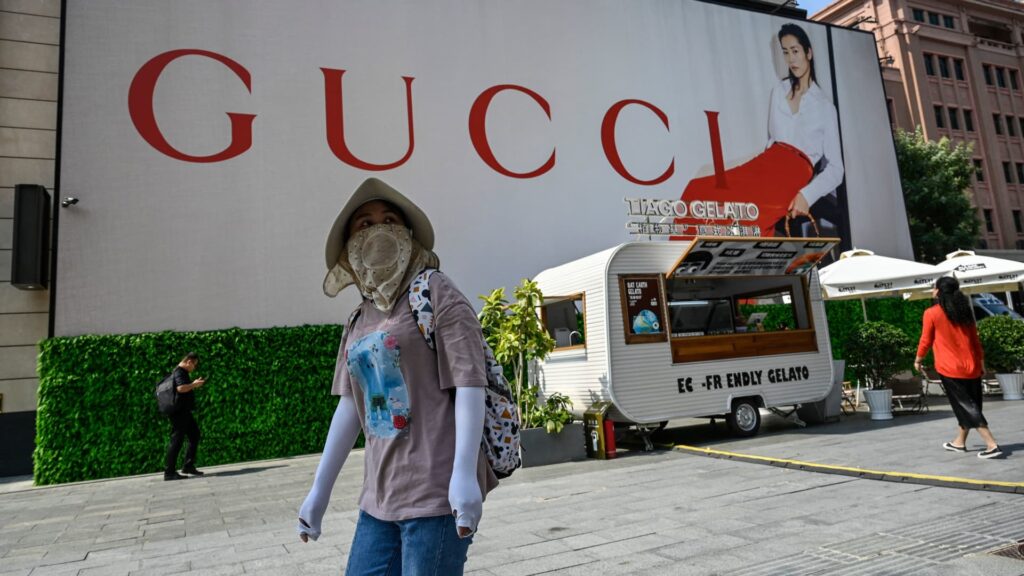
Chinese consumers are experiencing “luxury shame” similar to what happened in the U.S. during the 2008-09 financial crisis, according to a June Bain and Company report.
Jade Gao | Afp | Getty Images
China’s consumer inflation rose less than expected in January while the deflation in producer prices persisted, in a sign of continued deflationary pressure in the absence of stronger stimulus.
The consumer price index rose 0.2% in January from a year earlier, China’s National Bureau of Statistics data showed on Wednesday, below economists’ forecast of 0.4% increase in a Reuters poll. That followed a 0.8% growth in December, its highest level in nearly three years.
Prices rose 0.2% month-on-month, below economists’ forecast of a 0.3% increase.
Core CPI, which strips out volatile food and energy prices, jumped 0.8% from a year earlier, easing from the 1.2% in December.
China’s producer price index declined 1.4% from a year ago, better than economists’ expectations of a 1.5% drop, official data showed, moderating from a 1.9% drop in December. On a month-on-month basis, producer inflation rose 0.4%, improving for a fourth straight month, partly driven by the surge in global gold prices in recent months.
Zhiwei Zhang, president and chief economist at Pinpoint Asset Management, said the data was distorted by the timing of the Lunar New Year, which falls in mid-February this year after taking place in January last year. “This mismatch makes interpretation of macro data difficult,” Zhang said.
Zavier Wong, market analyst at eToro, echoed the view on holiday-related distortions, noting that “last January had more holiday-related price strength baked in, whereas this January does not.”
“It makes far more sense to treat January and February as a combined read rather than dissecting them individually,” Wong noted.
The deflation in factory-gate prices has persisted for more than three years, weighing on the profitability of manufacturers who have weathered tepid consumer confidence and production disruptions stemming from U.S. trade policies for much of last year.
The world’s second-largest economy grew 5% last year, in line with Beijing’s official target, thanks to resilient export growth to non-U.S. markets.
China has struggled to shake deflationary pressure since the end of the pandemic, weighed down by a prolonged property downturn and uncertain job-market prospects. Authorities have sought to curb price wars across industries, where overcapacity has fueled a glut of goods and forced companies to cut prices.
Policymakers prefer investments to be the key growth driver while considering stimulus measures to support consumption as a “one-time boost” that adds to their debt burden, Chetan Ahya, chief Asia economist at Morgan Stanley, said in a note Wednesday.
The deflationary pressure and property slump have led China’s fiscal revenue-to-GDP ratio to decline by 4.8 percentage points since 2021, to 17.2%. Meanwhile, the public debt-to-GDP ratio has expanded by 40 percentage points since 2019, to 116% in 2025, according to the Wall Street bank.
That is still lower than the U.S. federal debt-to-GDP ratio of 124% in 2025, according to official data.
Top policymakers are expected to unveil economic targets for the year at a parliamentary meeting next month.
In a policy report on Tuesday, the People’s Bank of China reiterated its determination to implement “appropriately loose” monetary policies to shore up the economy and guide prices towards “a reasonable recovery.”