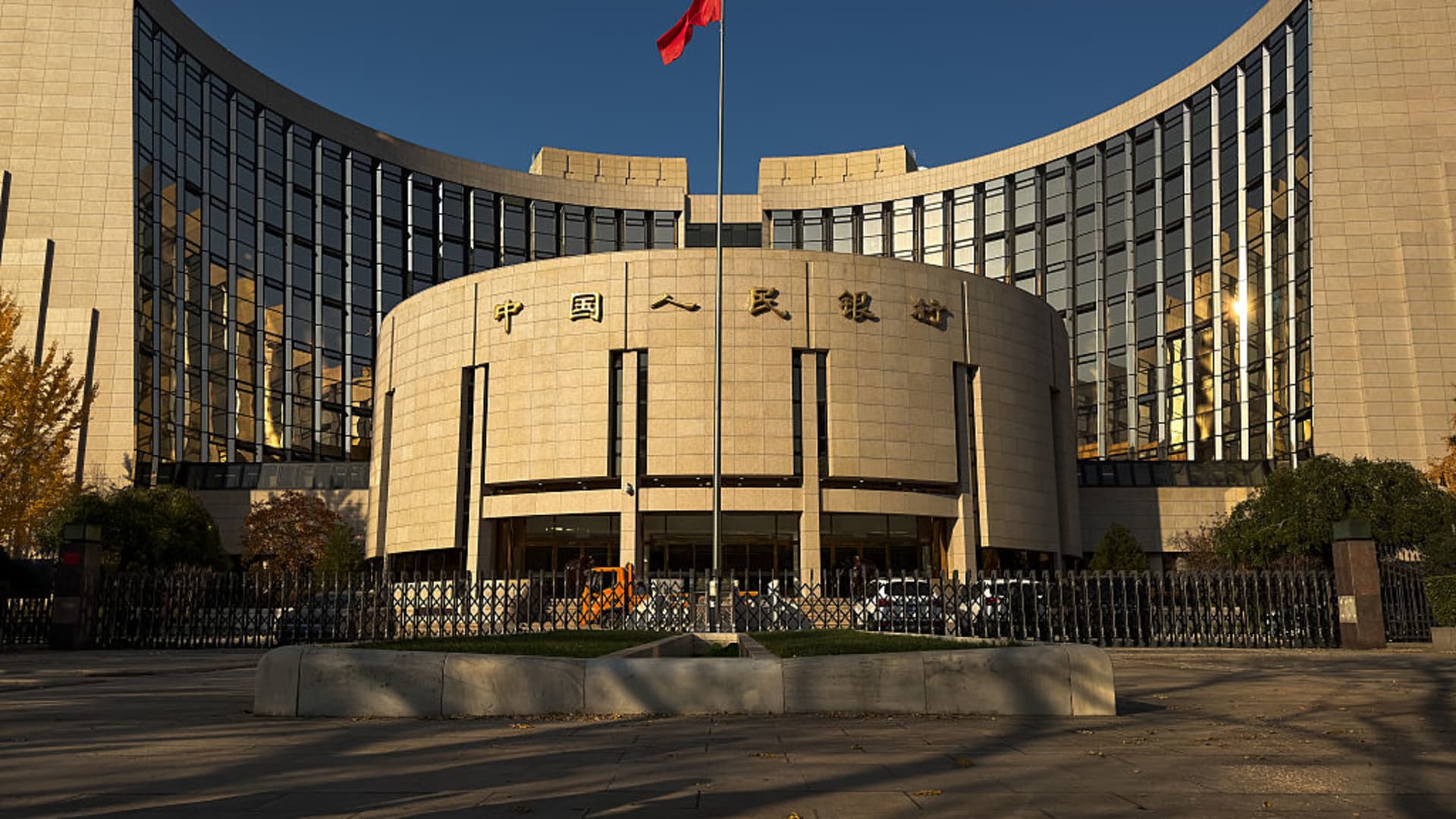
BEIJING, CHINA – NOVEMBER 11: The national flag of China flies in front of the headquarters of the People’s Bank of China (PBOC) on November 11, 2025, in Beijing, China. The PBOC serves as the country’s central bank, overseeing monetary policy, financial regulation, and currency issuance. (Photo by Cheng Xin/Getty Images)
Cheng Xin | Getty Images News | Getty Images
China’s central bank kept its loan prime rates steady on Monday, even as the world’s second largest economy has seen weak economic data and an extended slump in its property sector.
The People’s Bank of China kept its 1-year and 5-year loan prime rates unchanged at 3% and 3.5% respectively, holding them for a seventh straight meeting, in line with a Reuters survey.
The 1-year rate acts as a benchmark for new loans, while the 5-year helps peg mortgage rates.
The PBOC’s decision comes amid downbeat economic data from China in November, including lower-than-expected retail sales and industrial output.
Retail sales rose 1.3% last month from a year earlier, sharply missing Reuters’ median forecast for a 2.8% growth, and slowing from 2.9% rise in the prior month.
Industrial production also missed expectations, climbing 4.8% in November from a year earlier compared with estimates for a 5% jump, and marking its weakest growth since August 2024.
China continues to reel from a protracted slump in its real estate sector. Investment in fixed assets, which includes property, contracted 2.6% over the January through November period compared with a year earlier, sharper than the 2.3% drop estimated by economists.
Prices of new homes also also continued to decline in November, showing persistent weakness in China’s property sector.
New home prices fell 1.2% in tier-1 cities including Beijing, Guangzhou and Shenzhen while resale home prices dropped 5.8% from a year earlier.
Earlier this month, China’s finance ministry said it planned to issue ultra-long-term special government bonds next year to fund construction of key projects and new infrastructure projects.
The country has been contending with deflationary pressures, and policymakers have vowed to “vigorously support the implementation of special actions to boost consumption.”
An interim trade deal with the Washington that saw a suspension of prohibitive levels of tariffs on Chinese exports, however, could boost shipments to the U.S. and help the country realize its “around 5%” economic growth target for 2025.
— CNBC’s Anniek Bao contributed to this report.