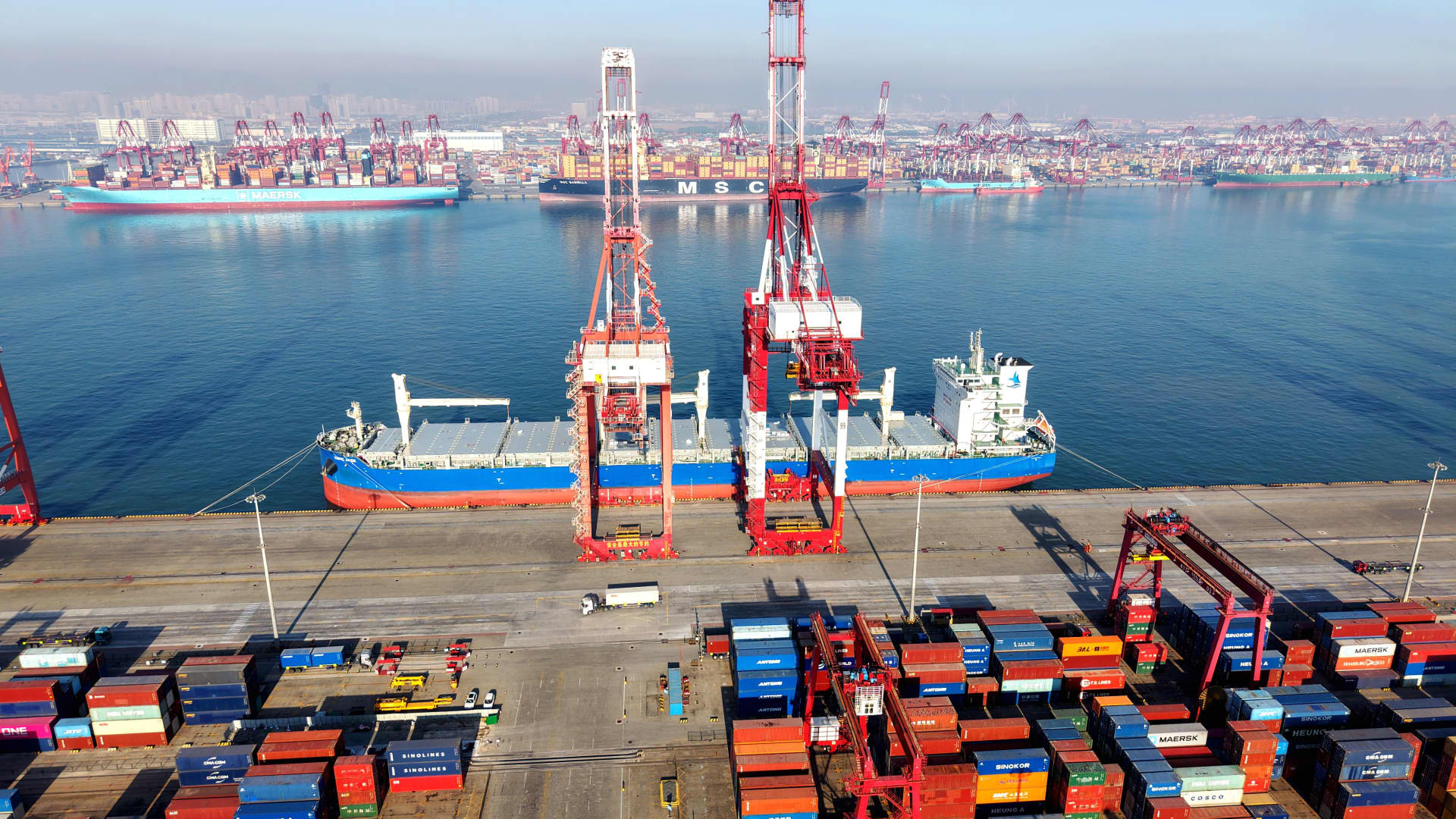
QINGDAO, CHINA – JANUARY 13, 2026 – The cargo ship is loading and unloading foreign trade containers at Qingdao Port in Qingdao City, Shandong Province, China on January 13, 2026.
Cfoto | Future Publishing | Getty Images
China’s exports growth in December sharply beat expectations, catapulting the annual trade surplus to a record high, while imports rose at their fastest pace in three months.
Exports surged 6.6% in U.S. dollar terms last month from a year earlier, Chinese customs data showed Wednesday, topping analysts’ median estimate for a 3% growth and accelerating from a 5.9% jump in November.
Imports rose 5.7% in December from a year earlier, topping expectations for a 0.9% growth — strongest since September last year when they climbed 7.4%, according to LSEG data.
China’s exports for the full year grew 5.5% while imports stayed flat, taking Beijing’s trade surplus to $1.19 trillion, up 20% from 2024.
Shipments to the U.S. plunged 30% in December from a year ago — declining for a ninth straight month — while imports from the country dropped 29%, customs data showed.
Signaling a sharp drop in trade with the U.S. in 2025 amid tariff tensions, China’s exports to the country dropped 20% while imports declined 14.6%.
Lv Daliang, spokesperson for China’s customs authority, told reporters Wednesday that bilateral trade relations should be “mutually-beneficial.”
As Chinese exporters have ramped up shipments to non-U.S. markets, the growing trade imbalance has prompted concerns from major trading partners, including the European Union.
International Monetary Fund Managing Director Kristalina Georgieva in a December press conference urged Beijing to shift away from relying on exports for growth and accelerate its push to boost domestic consumption.
China’s trade surplus is going to have “as destructive an impact on the global trading system as Trump’s tariffs,” said Eswar Prasad, a senior fellow at Brookings Institution, as the country’s sluggish domestic demand drags down global growth.
Nations around the world are likely to seek protection for their own economies by erecting trade barriers, Prasad cautioned.
Chinese officials in December pledged to expand imports and work toward balancing trade.
China’s exports to the European Union and the Association of Southeast Asian Nations rose 12% and 11%, respectively, in December, while imports from the European nations expanded 18% and fell 5% from Southeast Asian countries.
Zhiwei Zhang, president and chief economist at Pinpoint Asset Management, expects Beijing to keep the macro policy stance unchanged at least in the first quarter, as strong export growth helps mitigate soft domestic demand and trade tensions with the U.S. have eased.
China and U.S. in October agreed to roll back a series of export-control measures and higher tariffs in a 1-year trade truce, following a meeting between Chinese President Xi Jinping and his American counterpart Donald Trump.
China is set to release next Monday its annual and fourth-quarter gross domestic product data. Economists polled by Reuters expected the world’s second largest economy to have expanded 4.5% in the final quarter. Beijing had set it growth target for 2025 at around 5%.
The nearly $19 trillion economy has struggled to shake off deflationary pressure as a deepening real estate collapse has weighed on household demand and a weak job market has clouded consumer confidence. Consumer prices in the country stayed flat in 2025, missing the official target of around 2% increase.