
- A study across 20 dengue-endemic countries found that higher ambient PM2.5 exposure significantly increases dengue mortality.
- The study noted that a country’s economic condition and the state of medical facilities play a prominent role in shaping the fatality rate.
- Sustained surveillance, flexible outbreak preparedness, improved clinical care, and air quality improvement remain essential, the authors note.
- However, the study has some limitations, including the likely underreporting of dengue cases and the lack of data about primary and secondary infections.
In 2024, an unprecedented high of over 14 million dengue cases and more than 11,000 dengue-related deaths were reported globally. While the roles played by climate change and rapid urbanisation in the recent amplification of dengue transmission, are recognised, increased exposure to air pollution is also a corollary of these two burgeoning factors, finds a recent study.
The study’s authors wanted to understand if long-term exposure to ambient fine particulate matter (PM2.5) contributes to increased fatality rates in dengue. In collaboration with researchers from Japan, Bangladesh, and the United Kingdom, the study led by Sakirul Khan from the Research Center for Global and Local Infectious Diseases, Oita University, Japan, reports that higher ambient PM2.5 exposure significantly increases dengue mortality.
Conducted across 20 dengue-endemic countries including India, in Asia, Africa, and Latin America conducted during the period 2020–2024, the study found that countries with annual mean particulate matter (PM2.5) over 35 μg/m3 had three to five times higher dengue fatality rates than countries with mean PM2.5 below 15 µg/m³.
Weakening the host’s system
The 2025 report on the state of global air found that air pollution led to almost 8 million deaths worldwide in 2023 and 4.5 million deaths were attributable to ambient PM2.5 exposure.
Air pollution is known to jeopardise the immune system and vascular passageways that ensure smooth communications to secure the fort of human health. Studies have found that chronic exposure to PM2.5therefore causes inflammation and functional problems in the inner cellular lining of the blood vessels , i.e., endothelial dysfunction, which eventually affects the immune, cardiovascular and respiratory systems. A key feature of dengue is endothelial dysfunction, leading to undesired blood leakage and shock response. “Long-term pollution exposure can impair immune responses and vascular integrity, potentially increasing the severity of dengue once infection occurs during the monsoon season, even if air pollution levels temporarily decline,” Khan says.
Investigating long-term air pollution data and infection records, two separate regional studies in the southern tropical cities of Taiwan and the tropical city-state of Singapore have also reported a strong association between air pollution and dengue suggesting the effect of the former on the life cycle of mosquito vectors, dengue virus and human immunity.
Limitations of the study
There are also reservations about the interpretation of the study and linking air pollution directly to dengue severity. Sujatha Sunil, the group leader for vector-borne diseases at the International Centre for Genetic Engineering and Biotechnology, New Delhi, studies the infections caused by arboviruses like chikungunya and dengue. While acknowledging the “compelling results” and that it opens up new avenues for further critical studies, Sunil points out that the countries taken in the study have poorer health infrastructure and clinical monitoring. “I am also not sure how good their diagnostics are. Most importantly, in most of these countries, including India, underreporting of dengue cases, non-availability of primary vs secondary dengue status represent important confounders that drive severe dengue outcomes. And these aspects are not governed by pollution levels,” she notes.
“While dengue cases are underreported, dengue deaths are usually not and hence the CFRs (Case Fatality Rates) will get artificially inflated and need not be the correct representation of the reality,” Sunil explains.
She also argues that dengue surveillance efforts and reporting systems vary substantially across regions.
In the study led by Khan, the researchers shortlisted countries with consistent reporting of dengue data through reliable national or WHO (World Health Organization)-affiliated platforms, and with more than 50,000 dengue cases during 2020–2024, and also without missing data for an entire year. They also considered the effect of factors such as total rainfall, mean temperature, and demographic and socioeconomic factors such as urban population, population density, diabetes, hypertension, COVID-19 and GDP (Gross Domestic Product). Even then PM2.5 stood out as a strong predictor of dengue fatality.
Interestingly, Khan’s team noted negative correlation between PM2.5 and urban population as well as population density. Khan, however, asks to interpret these cautiously. “At a global, country-level scale, some highly urbanised or densely populated countries also have stronger air quality regulations, cleaner energy transitions, or better monitoring and reporting systems, which can result in lower annual mean PM2.5 levels.”
He adds, “Conversely, several less urbanised or lower-density countries experience high PM2.5 due to biomass burning, dust, and weak pollution control.”


Economy and health
Aided by climate change, urban expansion and increased travels, while Aedes aegypti, the vector mosquito of dengue, is extending its frontier to developed nations today, historically dengue remains a neglected tropical disease of the developing nations.
Khan’s team noted that countries with higher GDP per capita had a protective effect leading to some 35% reduction in fatality. “Our findings suggest that countries with lower GDP often face a dual burden—chronic exposure to high pollution levels and relatively weaker healthcare systems—which together may contribute to higher dengue case fatality rates.” says Khan.
For example, when the researchers studied the scenario within Bangladesh, despite a similar level of PM2.5 level across different divisions, Dhaka showed the highest mortality rate. Authors explained that this might be due to extensive pressure on the medical facilities caused by the extreme population density of this division. Therefore, they classified healthcare capacity and population characteristics as two critical modifiers of fatality.
India sits among the top five countries with high air pollution levels globally and as per the State of Global Air 2025 Report, India recorded more than two million deaths due to air pollution in 2023.
Lagging far behind the National Health Policy 2017’s target of at least 2.5% (still far lower in terms of global standards), India spends less than 2% of GDP on public health. This leads to a dominance of private health care providers, high out of pocket expenditure by citizens and crunch in funding for public health management efforts.
According to the statistics published by the National Centre for Vector Borne Diseases Control for the year 2025, however, India has been able to reduce its cases and fatalities significantly in 2025 compared to the previous years, suggesting effective vector control measures. (The data posted are up to November 2025 and West Bengal data is not reported.)
Khan, however, notes that increasing climate variability and unpredictable rainfall patterns mean that dengue-endemic countries cannot afford complacency. “Sustained surveillance, flexible outbreak preparedness, improved clinical care, and long-term environmental interventions — including air quality improvement — remain essential,” he notes.

Air quality control
Environmental exposures such as air pollution should be considered part of the broader syndemic framework linking climate change, urbanisation, inequality, and infectious disease outcomes, notes Khan. “Our study highlights the importance of looking beyond traditional vector-centric explanations of dengue severity.”
He also states that integrating air quality management with public health preparedness, especially in dengue-endemic and highly polluted countries such as Bangladesh, India, Nepal, and Indonesia, could help reduce severe outcomes.
Sunil also argues that any kind of intervention aimed at managing air quality is welcome and worthwhile as once air quality improves, all associated health issues such as cardiovascular disease and chronic respiratory disease will reduce. That in turn may result in healthier individuals who are able to fight dengue or any other infectious disease better.
However, she also flags a concern. “If we integrate air pollution control as part of dengue control strategy, it means we are diverting critical resources meant for vector control, which is much more critical and important for dengue management. Not to mention reduced funding for dengue diagnostics.”
According to Sunil, air pollution requires prolonged efforts and should be dealt with as a separate issue with parallel policy tracks, and not be integrated with other disease programmes, which might dilute both the issues. “Integration at the level of broad health system strengthening is reasonable, but programmatic merger at the operational level would likely weaken rather than reinforce both efforts.” Sunil adds.
Some recent studies have linked the entomological processes of mosquito development with temperature, humidity or rainfall and built climate sensitive dengue models for forecasting outbreaks. “I would assume that air pollution would impact mosquito physiology also and if that plays any role on the disease transmission.” Sunil remarks, adding, “I am interested to know the role of air pollution on vector population which is the most critical aspect for dengue.”
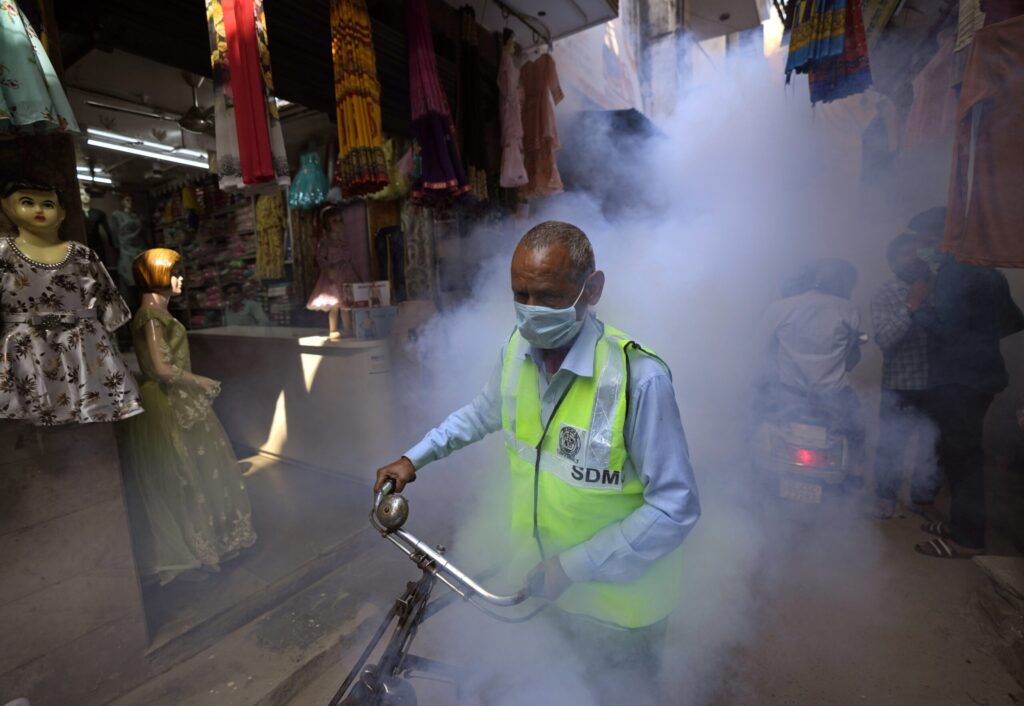
Banner image: A municipal worker fumigates a densely populated area in New Delhi. (AP Photo/Manish Swarup)

