
This year’s winter in Bihar has been marked by sharp and unusual swings. In the second week of January 2026, a cold wave affected 30 districts, with the India Meteorological Department (IMD) issuing warnings for dense fog and low temperatures.
But by late February and early March, temperatures rose rapidly. In some areas, the maximum temperature reached 32 degrees Celsius (°C) in February — a level experts say signals an early end to winter.
‘Winter doesn’t last anymore’
For many residents, the shift is deeply felt.
Rajendra Jha, 94, a retired teacher from Gaighat block in Muzaffarpur district, says winters are no longer what they used to be.
“Earlier, winter would arrive properly and leave gradually. Now it begins in December and fades by the end of January,” he says. “As soon as Phalgun (February-March) begins, the heat arrives. What used to be a gentle spring breeze now feels like summer heat.”
His words echo a wider concern among older residents across north Bihar, who say the seasonal rhythm they grew up with is changing.
The effects are also being seen in people’s health. Mahavir Prasad from Patepur in Vaishali district says the sudden shifts have taken a toll on him.
“Since early February, my health has worsened. I’ve had cough, phlegm, swelling in my feet, and trouble digesting food,” he says. “It feels hot during the day and cold at night — this fluctuation has affected me badly.
Crops hit, livelihoods strained
Farmers say the warmer winter has damaged crops and disrupted work patterns. Parmanand Rai from Musrigharari in Samastipur district says late-sown crops suffered the most.
“The sudden rise in temperature damaged late-sown crops like potatoes and oilseeds,” he says. “Our second potato crop, planted in late November or early December, was completely ruined.”
Where one kattha of land would earlier yield 3-4 quintals of potatoes, this year it produced only 1-1.5 quintals, which is not enough to recover cultivation costs. Mustard crops were also harvested about 20 days early, before the grains had fully developed.
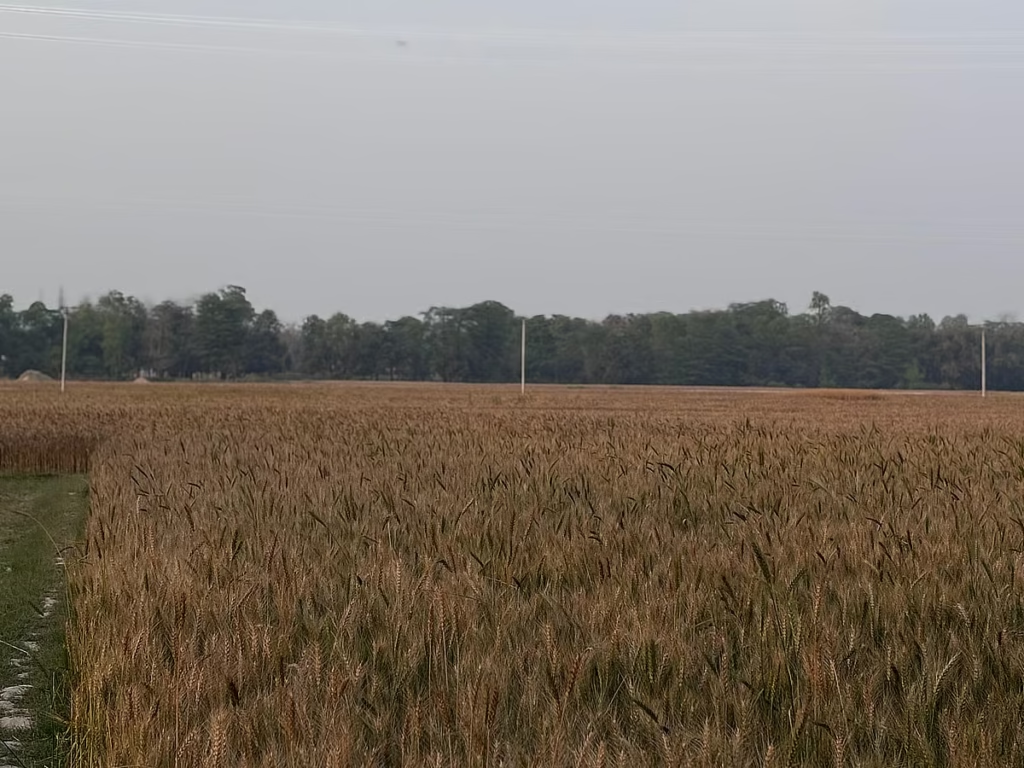
Prakash Ranjan from Vaishali says wheat and vegetables have also been affected. “Wheat yields could drop from 70-100 kilogrammes (kg) per kattha to 40-50 kg,” he says. “There was no fog this year, which is important for wheat. Garlic crops failed to form proper bulbs, and farmers have had to use more water.”
The sudden heat in February and March disrupted the Rabi cycle, with crops like potatoes and mustard ripening too early or failing to mature properly. For many farmers, this has meant financial losses and uncertainty about the year ahead.
Why is winter changing?
Scientists say a mix of atmospheric changes and long-term warming is behind the shift. Partha Sarathi, president of the Central University of South Bihar and head of the Indian Meteorological Society’s Patna chapter, says the January cold wave was linked to winds from near Siberia moving closer to the Himalayas.
However, the expected western disturbances — weather systems that bring rain and cooler temperatures — did not arrive in February.
“Normally, we see three to four western disturbances each month in winter,” he says. “This year, their absence meant temperatures rose quickly.” These disturbances are a type of cyclone that forms in western India and moves eastward, passing through Delhi, Haryana, Punjab, western and eastern Uttar Pradesh, Bihar, Bengal, and Assam. When active, they bring cloudy skies and rainfall across these regions.
Without them, heat built up earlier than usual.
The result has been a sharp contrast between day and night temperatures — sometimes a difference of around 20°C — which experts say can affect human health, leading to an increase in viral infections, colds and coughs.
What the data shows
Official figures underline how unusual this winter has been.
A report from IMD’s Patna Regional Centre shows that Bihar received 99 per cent less rainfall than normal in January 2026. February recorded no rainfall at all, against a normal average of 10.4 millimetres.
There were six severe cold days, eight cold days and one cold wave during January — but these were followed by a rapid rise in temperatures.
The IMD weather outlook suggests temperatures will remain above normal from March to May 2026. In several districts, maximum temperatures have already crossed 38°C in early March — significantly higher than the usual 32-34°C for this time of year.
Authorities have advised the state government to implement heat action plans as early heatwave conditions become more likely.
A sign of things to come?
Prabhu CN, joint director (Technical) at the Bihar Meteorological Service Centre, says the lack of winter rain has affected both weather patterns and agriculture.
“This year, the cold was less intense and there was little moisture in the air, so temperatures stayed 3-4°C above normal,” he says. “Global warming is also playing a role, increasing local variability in weather patterns.”
He adds that advisories are now being issued regularly to farmers based on daily weather updates. “The heat set in as early as February 15 this year. In response, we have issued an agricultural advisory and begun providing daily weather updates, a process that is currently underway.”
This year’s shortened winter may not be an isolated event. If such patterns continue, they could reshape Bihar’s agricultural cycles, strain rural livelihoods and pose new risks to public health in the years ahead.