
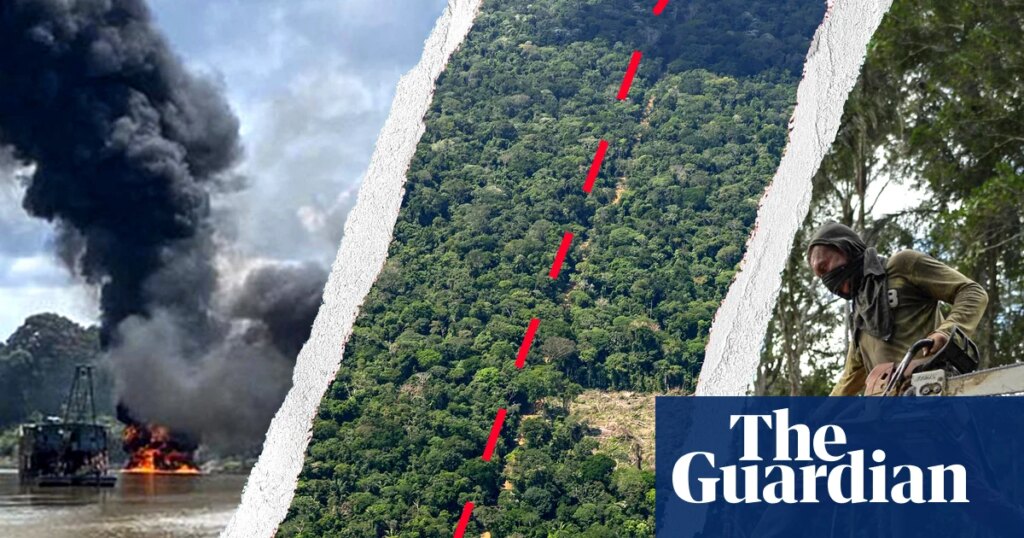
High above the Colombian Amazon, Rodrigo Botero peers out of a small aircraft as the rainforest canopy unfolds below – an endless sea of green interrupted by stark, widening patches of brown. As director of the Foundation for Conservation and Sustainable Development (FCDS), he has spent years mapping the transformation of this fragile landscape from the air.
His team has logged more than 150 overflights, covering 30,000 miles (50,000km) to track deforestation advancing along the roads, illicit crops and the shifting frontiers of human settlement. “We now have the highest road density in the entire Amazon,” says Botero.
Yet the infrastructure he describes is not necessarily a sign of progress or social development, but mostly a network of illegal routes expanding in southern Colombia across the Amazon forest, which covers 42% of the country. Since 2018, various armed groups have built more than 8,000km of roads there, spreading like arteries through the jungle.
The layout of this new network almost exclusively benefits organised criminals, who control the vast region and use the roads to export illicit goods, which also add to the environmental devastation.
“Outside Colombia, there is demand for cocaine, gold and meat; the Amazon supplies that demand. In our environmental deterioration, there is an international shared responsibility,” says Botero.
In its report, Amazon in dispute, the FCDS says the north-western region of the Amazon – which has 17 illegal groups operating in nearly 70% of its municipalities – has one of the world’s highest numbers of socio-environmental conflicts.
The report states: “It is a problem of macro-criminality that connects armed groups, gangs and cartels with political intermediaries and business conglomerates that, in addition to taking over natural resources and destroying ecosystems, seek to exercise territorial and population control over the region.”
Another thinktank, the Ideas for Peace Foundation, also notes shifts among the factions operating in the country.
“The distinction between insurgent actors and organised crime groups has become increasingly blurred,” it says in a report. “The structures have shifted from hierarchical models, such as the major drug cartels of the 1980s and 1990s, to more federated organisations with dynamic interactions that have formed a complex criminal network.”
This degradation intensified after the 2016 peace agreement signed between the government and the Revolutionary Armed Forces of Colombia (Farc), which used the jungle as a hideout and protected it for strategic convenience. New groups emerged, often with more local than national ambitions and in conflict with each other.
The current list, in addition to the old National Liberation Army (ELN), includes the Gaitanistas (also known as the Gulf Clan, Urabeños, and Gaitanist Self-Defence Forces of Colombia, or AGC), Central General Staff (EMC), General Staff of Blocks and Front (EMBF), Second Marquetalia and Border Command (CDF), among others.
“When the peace was signed, several Farc dissidents announced they would not surrender their weapons, and immediately an increase in deforestation became evident: 150,000 hectares [370,000 acres] in 2018,” says Botero. Now 700,000 hectares have been devastated.
According to Global Forest Watch, Colombia lost about 56,000 sq km (21,000 sq miles) of total tree cover and about 21,000 sq km of primary rainforest between 2001 and 2024. A large portion of that land, in the north-western Amazonian arc, is now used for cattle, whose numbers have also increased – doubling from 1,600,000 to 3,200,000 in the last eight years.
Several experts attribute the current crisis to the missteps of the leftist president Gustavo Petro, a leader who promised to bring peace to a country long torn apart by civil war, and to protect the environment. His critics argue that Petro was unable to extend state control over remote areas of Colombian territory or prevent the withdrawal of the Farc leading to the emergence of splinter guerrilla groups and new criminal cartels that now dominate the cocaine market.
Kyle Johnson, a researcher at the Bogotá-based Conflict Responses Foundation (Core), says it is not just a failure of this administration. “The figures show that the last two governments had very different approaches to the problem, and neither worked. The lack of implementation of the peace agreement is the main cause behind the growth of armed groups in the Amazon.”
The peace agreement promised comprehensive rural reform, including an agrarian development plan and access to land for farmers. It also proposed a strategy to sustainably replace illicit crops such as coca.
In its promise to democratise access to land in Colombia, the Petro government has allocated 15,000 sq km to farmers. Still, inequality persists: the wealthiest 1% owns 47% of private rural land, according to the Agustín Codazzi Geographic Institute, Colombia’s state cartographical agency.
Johnson believes that “Total Peace”, Petro’s ambitious initiative to disarm all groups across the country, would have fared better if it had focused on fulfilling the peace agreement with the Farc.
“That agreement has tools to advance peacebuilding, and by applying it, the government sends a message to the new groups. They may think that if the government doesn’t implement the previous agreement, there’s no guarantee it will do so with the new ones,” Johnson says.
He says the breach of the armistice with the Farc is the main argument used by emerging groups to remain armed. They also denounce more than 400 murders of ex-combatants of that guerrilla group.
But the underlying reason is that the Amazon holds vast resources for the factions that exploit it.
Along the rivers and deep in the jungle, in hard-to-reach areas dominated by armed groups, everyone must pay tribute to these de facto powers: merchants, transporters, cattle ranchers, farmers and anyone in commercial activities. Some groups have conducted detailed censuses in the areas they control and know how each hectare is used so they can profit from those activities – and threaten those who resist extortion.
The government has promoted the Forest Development Centres, a programme that seeks to turn deforestation hotspots into areas with environmental market potential. But the institutional response remains insufficient. In many areas of the Colombian Amazon, armed men prohibit officials from the environment ministry and the Codazzi Geographic Institute from entering.
This limits the information the government can obtain from disputed territories and hinders the implementation of public policies aimed at their inhabitants.
Sebastián Gómez, an adviser to the country’s Peace Agreement Implementation Unit, acknowledges failures in the approach. “From the start, the government insisted that coca-growing families eradicate their crops without offering them alternatives. And soon they replanted,” he admits.
In 2017, several Amazon regions experienced a crisis in the coca economy. According to Gómez, this allowed the entry of international criminal networks from Mexico and Europe, fostering new illicit economies such as extensive cattle ranching and mining – two major drivers of deforestation and river pollution. Increasing amounts of cocaine, meat, timber, gold and other valuable minerals such as coltan are exported along the jungle’s illegal roads.
For Gómez, the solution to this expanding illegal market is complex, and goes beyond military intervention. “More than a punitive approach, what is needed is one that transforms local economies. We have to build a special agricultural economic proposal for this region, one compatible with forest preservation,” he says.
For millennia, Indigenous communities in the Amazon survived in the jungle and benefited from it – a balance disrupted by the large-scale arrival of settlers seeking profit.
A study published by the Rio de Janeiro-based Igarapé Institute and the Amazon Investor Coalition confirms that the rising demand for commodities exacerbates environmental and security risks in the Amazon. The report recommends joint action by the governments of the nine countries that share the territory to “strengthen territorial governance, empower local communities and align political ambition”.
Land ownership is central to the problem. The exploitation of timber, cattle, coca and minerals generates a steady cashflow for criminal cartels, which they use to expand their operations by recruiting more people and weaponry. But in the longer term, wealth lies in owning land.
“Bringing all those deforested hectares into the market means the land gains value with cattle, water and power lines. Ultimately, the state finances a speculative land market. That’s the backdrop: land is the big business,” says Botero.
Johnson remains pessimistic. “In the short term, there is no solution. The state must offer those men options other than money – ones that are attractive enough to encourage demobilisation.
“We must identify other incentives: family, peace of mind, the desire to retire and the desire to see their children,” he suggests. “They are criminals, but they are also people. In the Colombian Amazon, we must blend the environment with peace.”