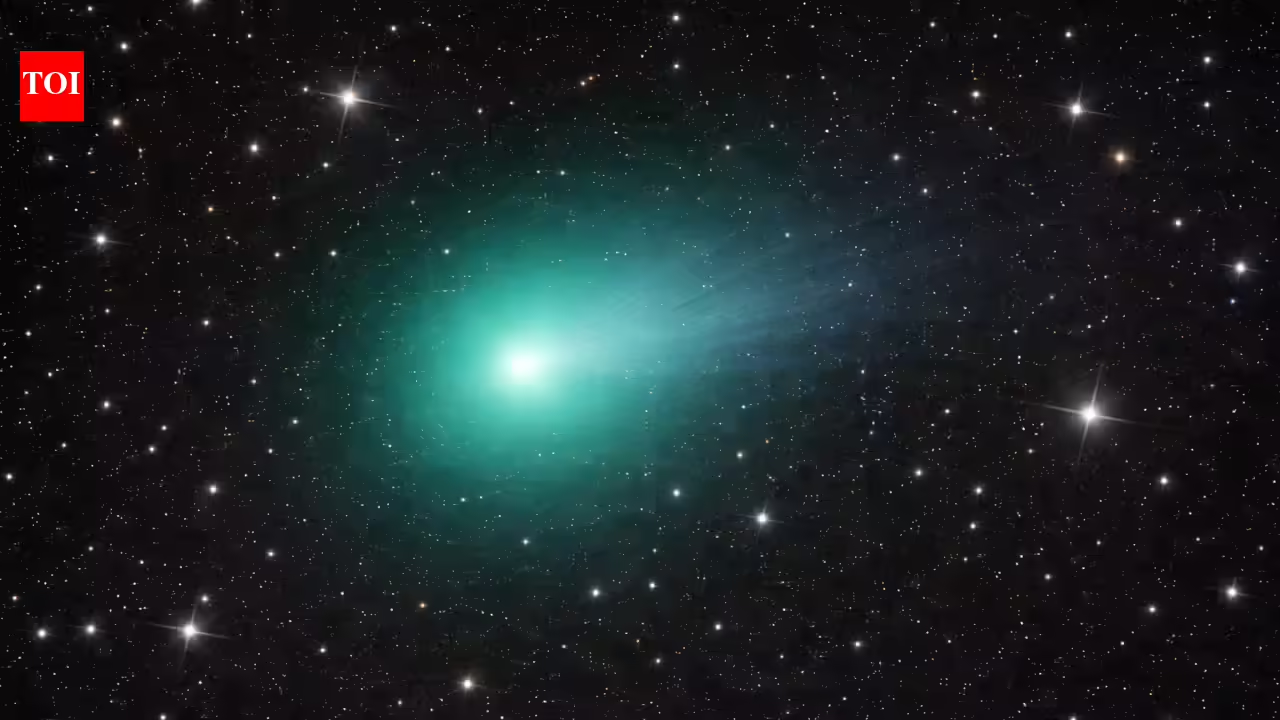
Astronomers have observed a rare event in the solar system, a comet slowing its rotation and then spinning in the opposite direction.Comet 41P/Tuttle-Giacobini-Kresák, a small icy body about 0.6 miles across, displayed this unusual behaviour as it approached the sun in 2017. David Jewitt, an astronomer at the University of California, Los Angeles, studied images taken by the Hubble Space Telescope. “We’ve seen changes in spin on a comet before,” Jewitt said, “but not this big and so quick”, The New York Times reported.Like planets, moons, and asteroids, comets spin naturally. Astronomers had already noticed that 41P’s spin was slowing before Hubble observations revealed it was spinning in the opposite direction.Comets are chunks of rock and ice that originate in the outer solar system, left over from the formation of planets. Occasionally, they are nudged into the inner solar system and swing past the sun. As they heat up, their ice turns into gas, forming visible tails. Often, comets are shrouded in a dense cloud of dust and gas, called a coma, around the solid nucleus.Some comets experience stronger events where material shoots out from the surface like a rocket. “We don’t really understand that,” said Dennis Bodewits, an astronomer at Auburn University. But the force of these jets can be enough to change the comet’s spin — a process happening on 41P in an extreme form.As 41P neared the sun in 2017, Bodewits and his team used NASA’s Swift telescope to monitor changes in its brightness. Between March and May, the comet’s rotation slowed from 20 hours to 46 hours per spin. Observations were not possible after May because the comet was too close to the sun to be seen.When it reappeared in December 2017, Hubble revealed that its spin had quickened to about 14 hours. “Slowed down to zero, and then kept going in the opposite direction,” Jewitt said. Jane Luu of the University of Oslo added, “People have thought this should happen, but as far as I know this is the first observation to catch a comet doing that in the act.”Jewitt suggested that jets like these may explain why smaller comets are rare. “There’s some other process that destroys the comets, and I think it’s rotation,” he said. Comet 41P is expected to swing past the sun again in early 2028, and astronomers hope that new telescopes such as the Vera C. Rubin Observatory will reveal more comets undergoing chaotic changes.
Comet 41P’s rotation slowed dramatically before it likely reversed, astronomers observe |
 1770914952 photo.jpg
Thank you for reading this post, don't forget to subscribe!