
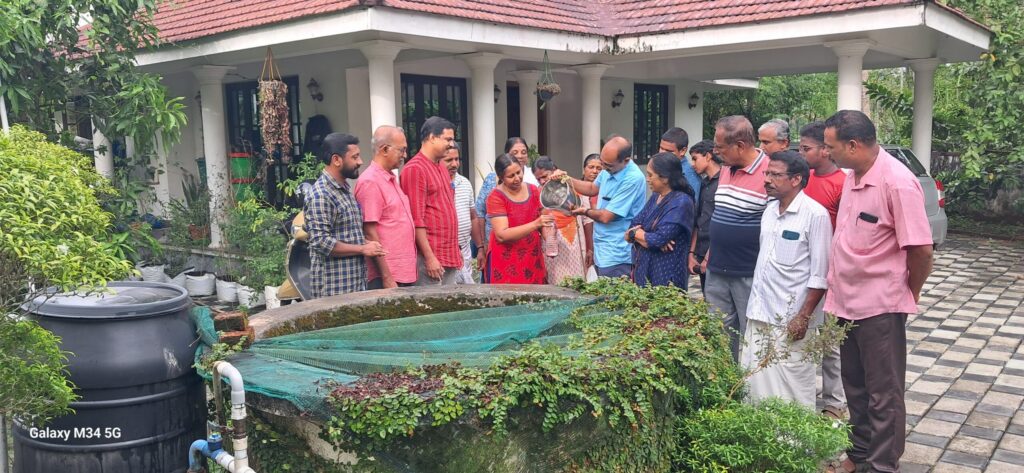
- In Thuruthikkara, a village in Kerala’s Ernakulam district, residents have combined rainwater harvesting, groundwater recharge, and water-quality testing to address seasonal water scarcity.
- Low-cost rooftop rainwater harvesting systems installed in homes and public institutions channel filtered rainwater into open wells, reducing the need to purchase water.
- Residents also set up a science and technology centre in the village which has become a hub for water-related initiatives.
On a January morning in Thuruthikkara, a village in Kerala’s Ernakulam district, 53-year-old Vidhya Manjush stands beside her open well, checking the water level. Unlike in previous years, the water level remains steady. A community-driven push for rainwater harvesting and water testing ensures that the water from Manjush’s roof is filtered and directed into the well, helping recharge groundwater throughout the year.
A few years ago, this wasn’t the case. As soon as the rains would end, groundwater recharge would slow down and the wells in the village would start drying up. The people would have to wait two to three days for a tanker to bring drinking water, Manjush recalls. And even then, it wouldn’t be potable. “The water often had black particles. I filtered it through a cloth and boiled it every time,” she says.
The Ernakulam district typically receives very high rainfall, about 3000 mm annually, primarily between March and October. However, in Thuruthikkara, soon after the rains, the wells begin drying up and run dry by January, forcing households to depend on water tankers.
To overcome this seasonal dependence on tankers, the village residents set up systems for rainwater harvesting, rainfall tracking and water quality testing, to make better use of the rainfall and reduce their water woes.
When the residents came together
Thuruthikkara falls under the Mulanthuruthy grama panchayat and is bordered on one side by the Muvattupuzha river. Agriculture and allied activities remain the primary livelihoods here.
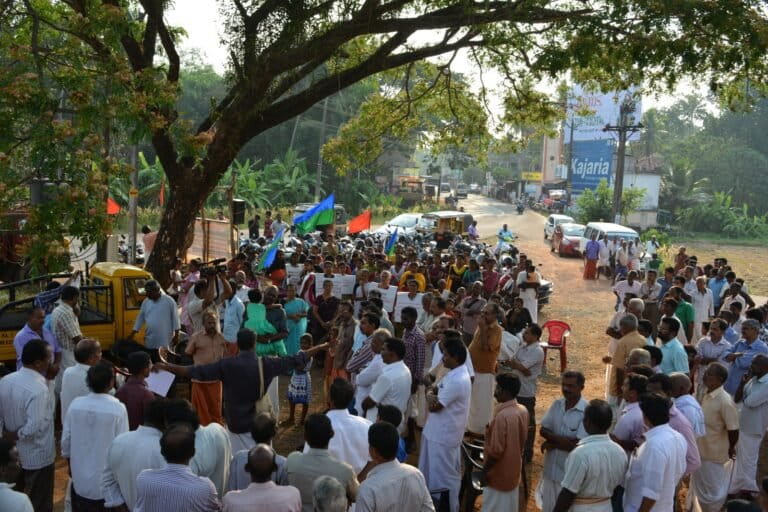
The village’s water conservation initiatives trace back to a conflict in 2012, when a real estate company attempted to excavate Manakkamala, a laterite hill located within Thuruthikkara. Residents feared that removing the hill would affect soil stability and groundwater recharge.
“We were living at the base of the hill. Excavation would have directly affected our water sources,” says Murukeshan M.K., a construction worker who had participated in the protests against the excavation.
The local unit of the Kerala Sasthra Sahitya Parishad (KSSP), a science and literature organisation in the state, along with residents and researchers from the Cochin University of Science and Technology (CUSAT) and the Centre for Water Resources Development and Management (CWRDM), conducted studies on the hill’s hydrogeological role. “The soil quarrying at Manakkamala will very seriously affect the ground water recharge and thereby will lead to water scarcity in the valley around the area,” one study noted.
A protest committee involving multiple local organisations was formed, and legal action was initiated. After a year, the excavation proposal was withdrawn.

Almost six year later, in 2018, the residents set up the Rural Science and Technology Centre, which became a hub for water-related initiatives in the village. Every evening, residents gather at the centre for meetings and training sessions on water reuse, waste management and small livelihood activities. Discussions often include topics like greywater reuse, and filtering kitchen and laundry use water.
In 2018, Thuruthikkara was recognised as Oorja Nirmala Haritha Gramam, a self-reliant and environment-friendly model village, under the Kerala government’s Haritha Kerala Mission for its work on renewable energy, waste management and water conservation. Similar models are now being adopted in nearby panchayats.
A water quality surveillance programme was also launched in the same year. With support from CUSAT, around 50 trained volunteers visited every household and tested local water sources for 12 chemical parameters, including hardness, acidity and alkalinity. Now, the science centre has around 300 volunteers, two of whom are primarily responsible for water quality checks.
A small water clinic which operates free of charge, was also set up at the science centre. Here, trained volunteers test water samples brought in by residents and explain the results.


Harvesting rain revives wells
Rooftop rainwater harvesting has been Thuruthikkara’s primary focus area to revive groundwater. Rainwater from rooftops is channelled through a low-cost filter before being redirected into open wells. Two types of filters are commonly used: a PVC-based multi-layer filter and a simpler drum filter.
The PVC-based system costs about ₹4,000, which is paid by the households interested in installing it. According to estimates by the village’s science centre, a 1,000-square-foot house can collect up to 3,00,000 litres of rainwater each year, more than an average household’s estimated annual water needs of around 2,00,000 litres.
The PVC system has been installed in private homes as well as public institutions such as temples, churches and care homes.
Tracking rain, grid by grid
To enhance the rainwater harvesting, Thuruthikkara has also established a system for monitoring rainfall. In the neighbouring Amballur village, where similar initiatives are being piloted under the Orukkam development programme, pluviometers have been installed across 11 geographical grids.
Each grid has one household responsible for recording rainfall. Volunteers submit daily readings via a WhatsApp group before 8 a.m. and the data is compiled into graphs showing rainfall distribution across the village. “This exercise helped us understand that rainfall varies [even] within short distances,” says Sumi Mol, a KSSP member who trains volunteers. “Some areas receive more rain than others, which affects water availability.”
The Ernakulam district administration also plans to install rain gauges in various parts of the district, including Thuruthikkara, with the support of the Haritha Keralam Mission.

Challenges remain
There are, however, some challenges that remain. The maintenance of filters can be difficult for some households, and the costs vary depending on the system used. The adoption is uneven too, with some families opting for cheaper drum filters instead of PVC-based systems.
“There are also limits to how much volunteers can manage,” says Suresh, a community facilitator at Thuruthikkara. “We rely on a small group of committed people.”
Meanwhile, the science centre aims to expand testing capabilities at the water clinic and publish findings from recent studies.
But for Thuruthikkara, the focus of water conservation remains local. “We learned that protecting water starts at home,” says Manjush who participated in the earlier protests. “Once people see the results, they don’t need to be convinced.”
Watch: How are Kerala’s ‘rainkeepers’ measuring rainfall to save themselves from floods?
Banner image: Researchers from CUSAT and the Science Centre Thuruthikkara conduct testing for microplastic elements in the well water at Vidhya Manjush’s residence. Image by Suresh Thuruthikkara.

