- Scientists uncover a new drought survival strategy in plants where fibres envelop dormant buds.
- The trait has so far been recorded in six species typically found in open grasslands and rocky plateaus exposed to drought and seasonal fires.
- Researchers hypothesise that the plant adaptation may protect buds from desiccation and possibly fire, though its exact function remains unconfirmed and requires experimental testing.
The northern part of the Western Ghats, a UNESCO-recognised biodiversity hotspot known for its remarkable diversity of seasonal herbs, has a dramatic landscape. During the monsoon months between June and September, it experiences intense rainfall. Its open grasslands and rocky plateaus become awash in verdant green and then erupt into colour as seasonal plants leaf and flower across its terrain. But once the rains withdraw in October, the terrain turns harsh, and until May, all the plants in this area face intense heat, drying winds, and recurring surface fires.
Some plants have an unusual strategy to survive these extreme seasonal cycles, finds a recent study. They wrap their dormant buds in dry, cottony coats to help them survive the inhospitable months.
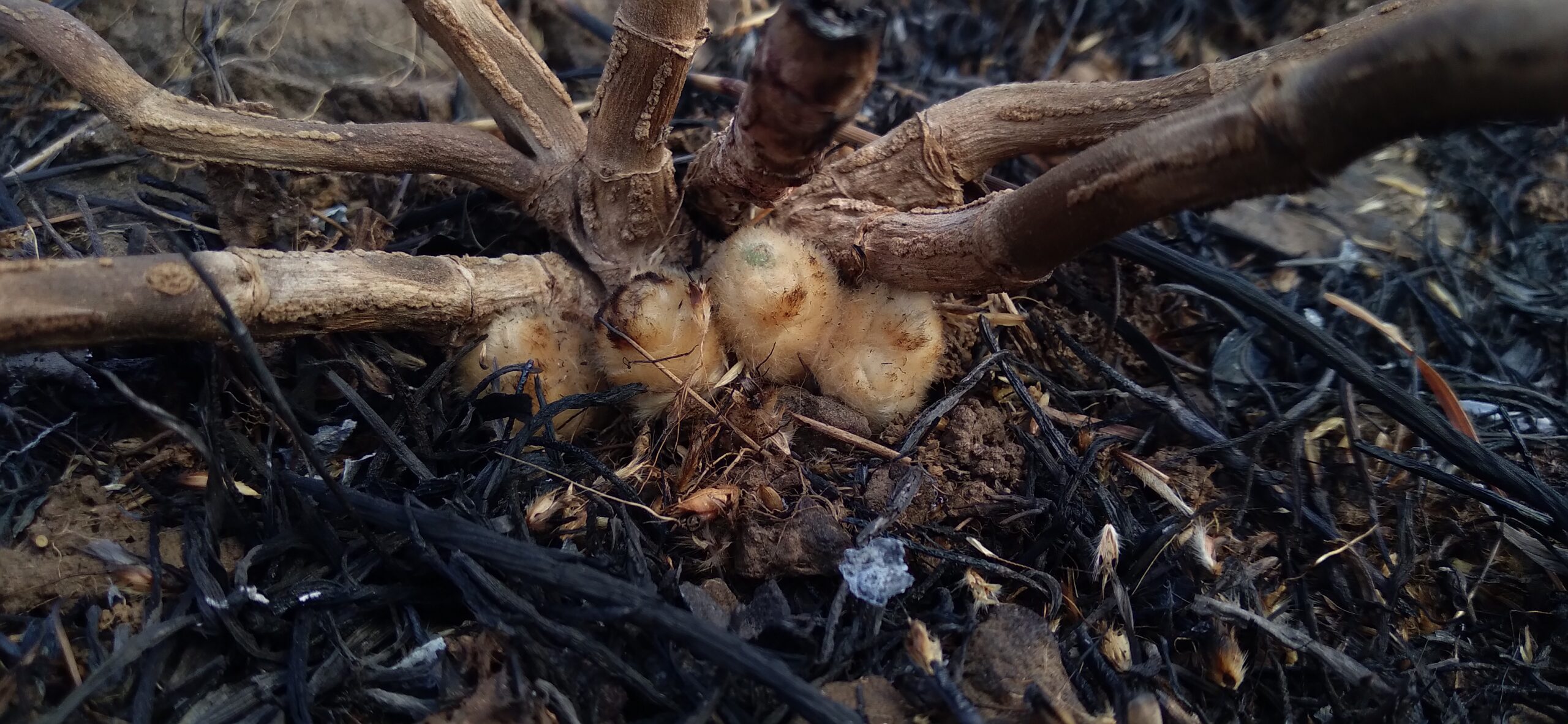
Researchers have named this adaptation ‘Xerocoma’, deriving it from the Greek words ‘xero’ (dry) and ‘kóma’ (tuft). These structures occur as dry, cottony balls that form at the rootstock — the area where the shoot and root meet, either just above or just below the soil surface.
What is Xerocoma?
Just before monsoon sets in, as the plant’s buds begin to grow, the Xerocoma also elongates with the growing buds to completely envelop them during this critical period. Eventually, as young leaves emerge, the cottony mass of the Xerocoma loosens to allow the expanding leaves to grow.
Mandar Datar, who is a professor at the Agharkar Research Institute in Pune, and an author in the paper, emphasises that Xerocoma is a distinct plant organ rather than a fungal association called mycorrhiza that sometimes has a similar cottony appearance.
“The cottony structures are definitely not mycorrhizae as they do not occur in the roots. Even though they may occur in the sub-surface, in the plants we have observed, these Xerocoma entirely encapsulate the new shoots,” adds Adittya Dharap, one of the authors of this study published in the National Academy Science Letters last month.
The difference between the similar-looking structures was demonstrated using a chemical stain called phloroglucinol hydrochloride, which helps to identify lignocellulose. Lignocellulose, which is a common structural component of plant stems and woody tissues, was found to be present in the Xerocoma fibres. In addition, the researchers also examined these fibres using a scanning electron microscope (SEM). The SEM images revealed that the fibres looked like flattened, narrow, wrinkled ribbon-like strands with small bumps and pointed ends.
Simply put, the cottony Xerocoma fibers were not fungal material, but a network of tough plant fibers that covered the sensitive buds.
Clues from long-term field observations
Despite the Western Ghats being a well-explored area, Xerocoma as a phenomenon, has not been formally described till now. The study also described six plant species that exhibit this phenomenon.
The discovery emerged after years of field observations across cliffs, rocky outcrops, and grasslands in the Northern Western Ghats.
“About 10 years back, we observed these cottony structures in some cliff-dwelling species of plants in the Northern Western Ghats, which we published in a paper in 2018,” says Datar. “We then collaborated with Adittya Dharap, who has been observing similar structures in the Talegaon area (on the outskirts of Pune city). He has been keeping close observations on some species and how they seasonally develop these structures,” he adds.
“I had read about these structures, which were called ‘cottony balls’, in Mandar’s paper long ago, and I was also observing them independently in a species called Senetio edgeworthii in the field,” says Dharap, who is a mechanical engineer by profession, and an ardent botanist. These independent observations by Dharap helped connect scattered sightings into a broader pattern.
“I also happened to observe Xerocoma in Neuracanthus sphaerostachyus, which is a plateau-dwelling species at Dongarwadi near Talegaon Dabhade and a large basaltic plateau near Ghusalkhamb in the Lonavala region (near Pune). It had these very prominent cottony balls, and they were jutting out of the ground. So, in this species, the Xerocoma are either surface or sub-surface, which was again, similar to what I was seeing in Senetio edgeworthii,” he adds.
Collaboration followed as more species were examined.
“I was already in contact with Mandhar regarding another plant — a Dicliptera species, which we eventually described as a new species, which also had these cottony balls”, says Dharap.
He credits decades of field observation for recognising such patterns. “I have extensive field notebooks that I have maintained over the last 25 years,” he says, adding that handwritten records remain central to his work. “Nowadays, field notes have become obsolete for many people, but I firmly believe otherwise. I still journal, and prefer doing things on paper and ink”, he says.

An adaptation shaped by life between seasons
A unique pattern that the researchers noticed about all the plants they observed with Xerocoma, was that they did not fit neatly into the familiar categories of ‘annual’ or ‘perennial’ plants.
“These species that exhibit Xerocoma have life spans that fall between those of perennials and annuals,” Datar explains. “Typically, they tend to be plants that are biennials or they live for three to four years,” he adds.
Annuals complete their life cycles within the monsoon season; in essence, they weather the inhospitable dry season in a dormant state as seeds. Meanwhile, long-lived perennial plants typically tend to shed leaves during the dry season and have woody structures to help them combat the heat and dryness. But plants that fall in between these lifestyles, may have found other ways to survive.
“It makes sense for biennials and plants that live for 3-4 years to have Xerocoma because they need to survive across multiple dry seasons but lack the mechanisms that perennial plants use to survive these conditions,” says Datar.
Another pattern that was observed was that species with Xerocoma typically inhabited open habitats and were exposed to intense environmental stresses.
“We found that these cottony outgrowths were seen in species from two (plant) families, namely, Asteraceae and Acanthaceae. And all these species were typically plateau-dwelling or in open grasslands; never in undergrowth in forests,” says Dharap.
When plants prepare for disaster in advance
Since most of the species that have Xerocoma are typically exposed to desiccation stresses and surface fires, the researchers hypothesise that these structures may play some role in protecting the plants against drought and perhaps, even fire.
Dhaarap is currently testing what cues signal the plant to produce Xerocoma. “We’re trying to find out what environmental triggers cause this growth. One is desiccation, and I have an ongoing experiment to test this,” he says
Early observations have produced interesting results.
“Currently, I have some of these plants growing in pots in my home, and even though they are being watered regularly, they are still producing the Xerocoma. So it looks like the plant doesn’t seem to need an environmental cue to produce the Xerocoma,” he says.
In addition, field evidence following fire events may offer other clues.
“One of my field sites recently experienced a surface fire, where I can see the charred area around the plants and the burnt shoots, but I expect that in about 15–20 days, the buds will begin to regrow. Since I’ve observed this before, I suspect that the Xerocoma may be protecting the buds against the fire also,” he adds.
In addition to these investigations, the team is also planning to move beyond field observations and experiments to investigate the genetic origins of Xerocoma as a desiccation tolerance mechanism.
“Since the plants that exhibit Xerocoma belong to the Acanthaceae and Asteraceae families, I believe there is some phylogenetic relationship in this trait,” says Datar. “We are still trying to look for more species exhibiting this characteristic, especially in other xeric environments and locations,” he adds.
These expectations are based on an interesting find from the Kew herbarium, which suggests that the adaptation may extend beyond India.
“From herbarium specimens, we found that there is a Neuracanthus species in Africa (Neuracanthus niveus) that exhibits this Xerocoma trait,” says Dharap. “If I had to look for more species that exhibited this trait, I’d look at grassy slopes and plateau-dwelling plants,” he adds.

Insights into plant evolution
Plant geneticist R. M. Patil from the Agharkar Research Institute says that the discovery of Xerocoma may offer a useful model for studying how plants adapt structurally to stress.
“The study presents a potential model system for investigating key functions such as meristem insulation, stress-triggered resprouting, and the seasonal timing of bud break,” he says.
According to Patil, the findings shift attention beyond traditional drought-tolerance mechanisms. “The study emphasises that the ‘aridity response’ in plants has to do with the developmental patterning of specific organs at the root-shoot junction that regulate when and how buds are exposed, in addition to traditional drought-tolerance mechanisms,” he says.
“In short, some plants don’t just withstand drought; but they reshape their bodies so that the most important parts stay safe. In this case, they make a little dry cottony ball around their resting buds so those buds don’t dry out or burn and then can grow again when rain comes or after fire.”
The trait could eventually inform crop research, though not directly.
“The exact ‘cotton ball’ structure probably isn’t something you would copy directly into crops,” Patil says. “But the basic ideas behind it are very relevant, which is to protect growth points, allowing plants to bounce back after stress, and tightly linking new growth to good conditions,” he adds.
However, translating such traits into agriculture comes with challenges.
“These plants evolved for very specific conditions. So, the same traits might not behave well in dense crop fields or irrigated farms,” he said, adding that the trait is likely controlled by multiple genes and may carry trade-offs affecting yield. “The safer path for breeding is to abstract key functions and search for analogous, already tractable variants within crop gene pools or closely related wild relatives,” he says.
Questions and scientific caution
While the study introduces an intriguing idea, plant ecologist Uma Shaanker, formerly with the University of Agricultural Sciences, and now an independent researcher urges caution about drawing firm conclusions.
“It’s a very preliminary paper about these cottony structures that the authors describe as Xerocoma,” he says. “The functional roles of these structures in protecting the shoot epidermis are still speculative as there are very few details on this”, he adds.
Shaanker notes that more detailed analysis could strengthen the findings. “Even the structural descriptions are quite cursory; just EM images and very cursory chemical evidence to show that these structures are made of lignocellulosic material. There is no deep chemical analysis of the material in the paper”, he says.
He adds that further studies could examine whether the structures help retain moisture. “Physico-chemical analyses to investigate the chemistry of the material, as to whether it is able to retain water around the bud growing zone to prevent the bud from drying out would be interesting,” he says.
The mechanical function also remains unclear. “From the description that the authors give, it is not clear how mechanically robust these structures are in protecting the bud. For example, bud scales protect the bud as a robust shield, but can Xerocoma also do that? It would also be interesting to see if these structures can protect the bud from herbivores. I also wonder if these structures function like spines in cacti to harvest atmospheric water?” he adds.
Shaanker explains that some detailed observations via experimental manipulations could give deeper insights into the function of Xerocoma. “A simple experiment where they remove the cottony material and ask ‘what is the survival rate, growth, or unfolding of the bud?’ could give a more definitive answer about the function of Xerocoma,” he says.
Despite these limitations, Shaanker says the work raises important evolutionary questions.
“This paper does bring forth questions on the evolution of protective layers around the epidermis. This has not been seriously studied, in my opinion. So, it becomes very interesting to look into the evolution of these structures and their significance in plants that face xeric environments.”
For now, the cottony structures named Xerocoma remain both a mystery and a clue; evidence that even small, short-lived plants may possess sophisticated adaptations shaped by drought, fire and time.
Read more: Birds are declining even in undisturbed grasslands, raising climate concerns
Banner image: New growth emerging from a Neuracanthus plant following a surface fire, enclosed in Xerocoma, amid charred grassland vegetation. Image by Adittya Dharap.