
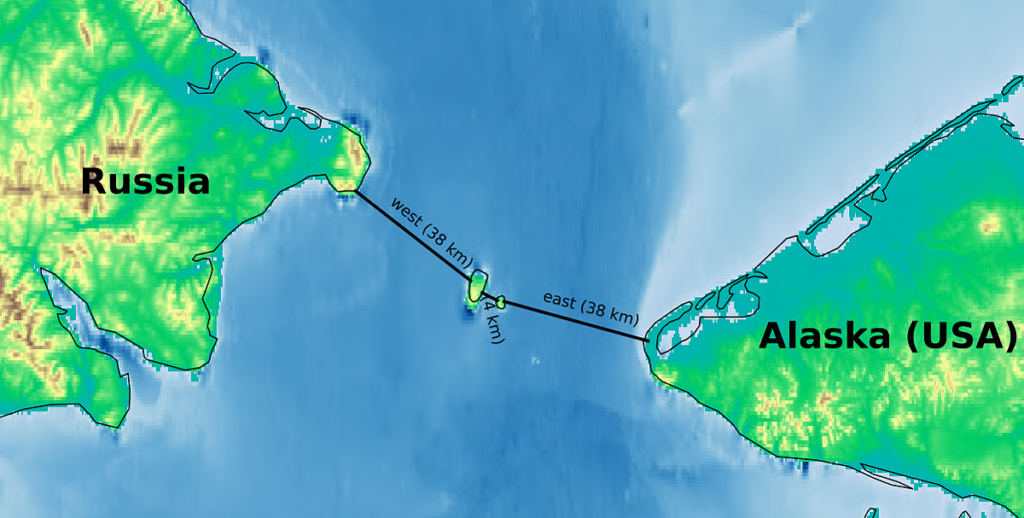
A dam in the body of water that separates Eurasia from the Americas could potentially help stabilise the Atlantic Meridional Overturning Circulation (AMOC), a large system of ocean currents in the Atlantic Ocean, according to new research by a PhD student from Utrecht University in the Netherlands.
Using climate models, Jelle Soons investigated how closing the Bering Strait (named after explorer Vitus Bering) would affect the current. In some scenarios, the AMOC remains more stable, although uncertainties are large and it is unclear whether such an intervention would work in practice.
In the AMOC system, warm, salty water flows northward at the surface, cools, and sinks in the North Atlantic, before returning southward at depth. “This system plays an important role in transporting heat around the globe. Changes in temperature and salinity, for example due to melting ice sheets, can disrupt this circulation,” notes a statement by the university.
A Soviet plan
According to the University, Soviet engineer Petr Mikhailovich Borisov came up with a plan in the 1960s to melt Arctic sea ice. Borisov thought this would have a beneficial effect on the Soviet Union as larger parts of the country could be used for agriculture and settlement. It would also make the Sahara greener and create a milder global climate.
He proposed that building a dam in the Bering Strait could influence the exchange between cold Arctic water and warmer water from the Pacific Ocean. This, in turn, would allow warmer water to flow towards the Arctic, causing much of the sea ice to disappear.
“The scientific paper describing Borisov’s plans was published in a Russian journal at the time,” says Soons, PhD researcher at the Institute for Marine and Atmospheric Research Utrecht. “But he didn’t cite a single source to support his conclusions.” According to Soons, the physics behind the idea does not really hold up. Still, Borisov’s plans show that the idea of deliberately altering the climate is not new.
Climate modelling
Soons, notes the University statement, wondered whether a dam in the Bering Strait could help prevent the AMOC from slowing down or collapsing. “Earlier research suggests that this circulation was stronger during the Pliocene, between five and two million years ago. At that time, sea levels were lower and the Bering Strait was closed, meaning North America and Asia were still connected. This raised a question: what would happen if that connection were closed again today?”
Soons used climate models to simulate different initial states of the ocean, since no model perfectly represents reality.
In some of these scenarios, closing the Bering Strait helps stabilise the AMOC, even as CO2 levels in the atmosphere increase. In others, the opposite happens and the circulation becomes more vulnerable. “This study is a proof of concept,” says Soons. “We’ve shown that there are scenarios in which such a dam could work. But we don’t yet know how realistic those scenarios are.”
Timing also turns out to be crucial. If the intervention is implemented early enough, it may support the circulation. But if the AMOC has already weakened, the effect could reverse.
Is it possible?
There are also other concerns regarding such a dam.
For one, the Bering Strait is about 80 kilometres wide and located in a remote area with little infrastructure. “The location is a major challenge. There are no roads leading there,” says Soons.
The Strait is also an important migration route for marine mammals, and changes in currents and salinity would affect entire ecosystems.
Building such a dam would be a perfect example of geoengineering where large, deliberate interventions in the climate system are aimed at producing a desired effect. Take for instance, injecting particles into the atmosphere to reflect sunlight, or capturing CO2 on a large scale.
However, in this case, who would decide that such geoengineering would take place by closing a sea passage between Russia and the United States? And who would bear the consequences if ecosystems are disrupted?
“There is also a broader concern: that technological fixes like this could distract from the root of the problem: greenhouse gas emissions. If a ‘backup plan’ seems to exist, the pressure to reduce emissions might weaken,” notes the statement.
According to Soons, geoengineering should not be seen as an alternative to climate policy, but rather as a last resort. “It’s a bit like weight-loss surgery. It’s better to lose weight, but if that doesn’t work, you might consider an intervention.”