
There’s a moment before kickoff when everything gets quiet for Seattle Sounders midfielder Cristian Roldan.
The Lumen Field crowd is boisterous and the stadium feels like it’s shaking. Inside, however, it’s calm.
Roldan knows by then whether he’s ready—not because of adrenaline, nor emotion. But because of the days leading up to this moment
For most fans, a match is 90 minutes. For Roldan, it’s days of preparation layered carefully on top of each other—heart rate targets hit in training, hydration dialed in, sleep schedule protected, lower-body lifts executed with intent. But the time he steps onto the pitch, the work is already done.
“It really takes the entire week to kind of build you up,” Roldan says. “That’s where a lot of people that aren’t involved in the sport don’t realize.”
As the Major League Soccer season is now in full swing, and the calendar leans toward a World Cup summer, Roldan isn’t chasing a new formula. He’s refining the one that’s kept him durable, explosive, and available in a sport that punishes the unprepared.
Last season took a lot out of him. Heavy minutes, tendon flare-ups, and the cumulative toll of travel and competition. Across a full MLS season, midfielders average around 6-8 miles per match depending on tactical role. Multiply that over 30-plus starts, and the mileage alone makes the season a test of endurance.
Those numbers don’t count the collisions absorbed, and tackles either. Thus year, he’s approaching things differently.
He’s more intentional, more measured, and more aware.
How Cristian Roldan Maintains Elite Soccer Performance Week After Week
If you ask Roldan what his body needs to feel like before match day, he focuses on a formula.
“I need to get my heart rate up to certain levels throughout the week,” he says. “Make sure I sleep right, and my hydration is good.”
Many MLS players wear GPS monitors and heart-rate trackers during training. Load management is structural. As a midfielder, Roldan’s job description changes every game.
“You’re kind of OK at a lot of things,” he said. “You’re not extremely great at one thing. You kind of have to do everything.”
That “everything” includes sprinting in transition, covering ground defensively, withstand contact, dictate tempo, close space, and repeat.
Why Endurance Is the Foundation of Soccer Fitness
Roldan trains for variability because the game demands it. Some matches open up and become sprint-heavy. Others compress into tactical battles that require endurance and mental clarity. He doesn’t get to choose which one it will be. That’s why conditioning is the focal point of his preparation.
“Endurance is probably the most important thing for me,” he says. “It allows me to feel free. It allows me to get on the ball, to dictate the game.
Freedom is an interesting word choice in a sport built on structure. What Roldan means is that when your conditioning is solid, you’re not surviving, you’re flourishing.
Repeat spring ability is the capacity to explode again and again without falling off. This is built in the offseason and sharpened in the preseason. If the body hasn’t been exposed to that load early, the risk of injury climbs.
Once the season starts, rhythm takes over. Matches build fitness. The body adapts to game speed. But without the base, the season becomes image control.
For Roldan, the week is his study session, and Saturday is the exam.
At Age 30, Recovery Becomes a Performance Tool
There’s a maturity in the way Roldan details the process in staying healthy for a long season.
“Recovery is harder these days,” he says. “That’s the reality.”
He turned 30 last year, and as most of us do when we hit a new decade, he felt every bit of the aging process. Last season left him managing tendinopathies and accumulated fatigue. Instead of pushing through it in the offseason—something he admits he became accustomed to—he asked for something unfamiliar, but valuable.
“I asked our medical team if it would be OK to take an extra week off,” he says.
For a player who describes himself as “go, go, go,” that wasn’t easy, but it was necessary. Instead of immediately jumping back into conditioning, he focused on tendon loading, isolating connective tissue, building resilience before chasing fitness.
The offseason became less about cardio and more about durability.
In season, his gym work is structured around one demanding lower-body session—typically his hardest training day of the week—paired with an upper-body lift earlier in the cycle.
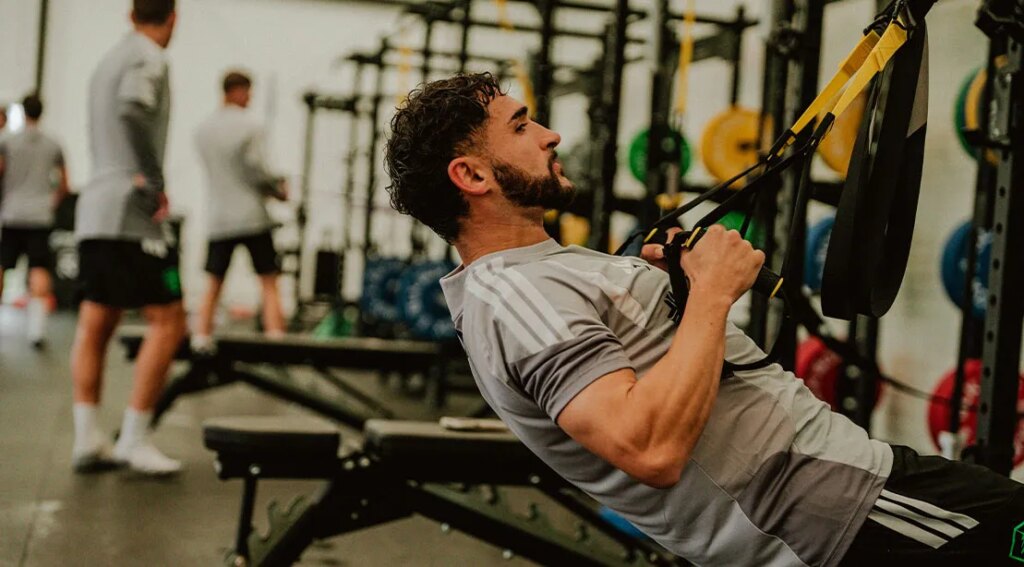
Upper body might include pull-ups, presses, dips, rows. Lower body targets glutes, hamstrings, quads, calves—the engine room of a midfielder.
“In the sport that we play, hitting the lower body is really important,” he says. “It gives you the best chance to succeed on the field.”
Lifting is only half the equation. Recovery is now deliberate. Ice baths, contrast therapy, soft tissue work, and massage. He’s a heavy sweater, so hydration is strategic. He drinks more than most because he has to. His sleep is non-negotiable.
His effort hasn’t changed, but his awareness has elevated. At 22, you recover because it’s second nature. At 30, you recover because you must.


International Soccer Speed: Why Conditioning Must Level Up
Club soccer is intense. International competition compresses everything.
“Anytime you leave your club level and go to the international level, you feel that difference,” Roldan says.
Players are more athletic, technical precision tightens, the margin for error shrinks and close space too slowly, and you’re on the wrong end of someone’s highlight.
Qatar reinforced that reality for Roldan. At the highest level, conditioning isn’t just about covering ground. It’s about reacting, thinking, and executing faster. That’s where the mental side becomes inseparable from the physical.
He speaks openly about working with a therapist. About balancing the pressure of professional soccer with normal life. About the mental strain of expectations. He has also dealt with concussions, which sharpened his awareness of brain health and recovery. Talking through pressure allows him to release it. It keeps him present when the stakes rise.
“When I’m on the field, I’m able to focus on what I need to focus on,” he says.
In a World Cup year, it’s tempting to overhaul everything. To add more, push harder, chase some new edge. Roldan resists that impulse.
“It’s hard to shift too much,” he says. “What got you there was the system you had in place already.”
Train Like Someone’s Watching
If there’s a line that defines Roldan’s approach, it’s this: “Train like somebody’s watching,”
Professional sports are built on opportunity, and opportunity rarely comes with a heads up. You might be coming off the bench. Or, you might get a one start. You might only have one play that matters.
“When your name is called,” he says, “you have to be ready.”
That readiness isn’t build in front of cameras. It’s built in the weight room, offseason tendon work, hydration discipline, REM sleep, and in uncomfortable conditioning sessions when there isn’t a crowd.
For young athletes watching him navigate MLS competition while chasing a World Cup roster spot, his message is simple: patience and preparation are partners. Train how you want to play.
Because when the moment comes—and it will—your body shouldn’t be surprised by it. And neither should your mind.

Cristian Roldan’s Lower-Body Power Workout (In-Season Heavy Day)
Inspired by Roldan’s in-season heavy day, this session targets the glutes, hamstrings, quads, and calves — critical for sprinting, cutting, and repeat acceleration.
Goal: Build strength and tendon resilience without excessive fatigue Frequency: 1x per week during season
Warm-Up (10–12 Minutes)
- Dynamic leg swings (front-to-back & lateral): 2 sets, 10 reps ( each side
- Walking lunges with rotation: 2 sets, 10 reps
- Glute bridges: 2 sets, 12 reps
- Light banded lateral walks: 2 sets, 15 steps
Main Lift Block
- Trap-Bar Deadlift (or Barbell RDL): 4 sets, 5 reps
Focus: Posterior chain strength (glutes + hamstrings)
- Bulgarian Split Squat: 3 sets, 6–8 reps per leg
Focus: Single-leg stability and balance under load
- Nordic Hamstring Curls or Hamstring Slides: 3 sets, 6–8 reps
Focus: Tendon resilience and sprint durability
- Standing Calf Raises (Slow Eccentric): 3 sets, 12–15 reps
Focus: Ankle strength and deceleration control
Tendon Finisher
- Isometric Split Squat Hold: 2 rounds, 30 seconds per side
Focus: Tendon loading and joint stability
Post-Lift
- 8–10 minutes light mobility
- Hydrate aggressively
- Soft tissue or contrast therapy if available
Follow Cristian on Instagram @cristianroldan_. Follow the Seattle Sounders @soundersfc