How’s Dad?
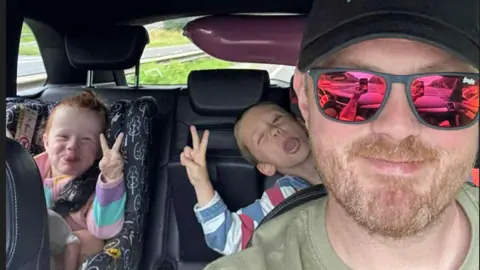
After suffering “stress and anxiety” while trying for a baby, Aled Edwards and his wife Sophie were delighted when they found out she was pregnant.
But, from the first night after getting the good news, Aled was struck by “crippling nightmares”.
On one occasion, he dreamt he had been fatally wounded while fighting off intruders in his home, dying as he crawled upstairs to tell his family the coast was clear.
Otherwise, Aled was enjoying the idea of being a father, so he put it down to normal first-time dad nerves, oblivious to the mental health struggles he was yet to face.
Warning: This story contains references to mental health struggles and suicidal thoughts that some readers may find distressing
Aled’s nightmares lasted until six months after his son Sullivan – now seven – was born.
“The actual experience of having him and that love and that joy was real and it was there,” he said.
“Everybody was happy and the nightmares disappeared almost as quickly as they came.”
But a couple of years later, when Sophie got pregnant with their daughter Bea, the nightmares returned.
“It felt like these ones were on a whole different level of horrific. I would be an emotional mess all day because of the impact of what I’d witnessed in my dream.”
Aled, from Bangor, Gwynedd, began to experience depression which affected all areas of his life.
“I felt like I had no motivation to do anything, I wasn’t happy about anything,” the 40-year-old said.
“It sounds really awful, but it felt like I just didn’t have it in me – from dealing with the nightmares – to have that emotional bond [with Bea].
“You see the perfect Instagram family – that’s what I tried to portray to everybody. I thought by acting that way, eventually that would come.”
But it didn’t, and in October 2021, when Bea was just six weeks old, Aled left the house one morning with the intention of ending his life and “eliminating the problem”.
“I started to overthink this and really focus on, I am the problem. I could see everybody was starting to feel down, because of me.”
Aled had previously seen a GP, been diagnosed with adverse childhood trauma and prescribed diazepam, an anxiety medication, but did not feel it worked for him.
He said the only thing that stopped him going through with it was the memory of Sullivan “snuggling up” to him in bed that morning.
So he went to A&E and was met by the police, but felt more could have been done to address the root cause.
“I know the NHS is overstretched and I know we have a massive backlog of people struggling with mental health in this country.
“But what happened following that is not good enough. The system is broken.”

 Aled Edwards
After trying numerous medications with side effects including difficulty staying awake and thoughts of harming others, Aled’s own research led him to consider that he might be suffering from post-natal depression (PND).
“It hadn’t been discussed with me,” he said, adding one mental health specialist told him he couldn’t have it because he was a man, but a GP later agreed it was the likely answer, only after Aled suggested it.
The NHS says PND affects more than 1 in 10 women and “can also affect fathers and partners”, labelling the idea it only affects women as “a myth”.
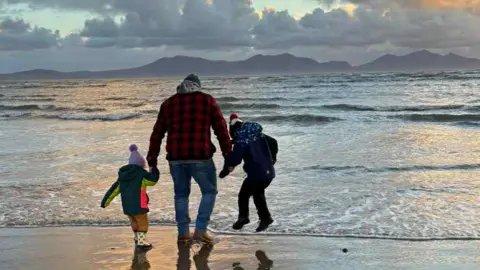
After a fruitless search for a support group, Aled put a message on Facebook in February 2024 to see if any other dads wanted to chat.
“All of a sudden, my social media just exploded. I had thousands of messages from men.”
A “handful” showed up on a planned walk and, over the past nearly two years, has developed into a community “built around supporting each other”.
 Aled Edwards
Research from Swansea University, published in September, found 8% – 13% of fathers experienced depression during pregnancy and early parenthood.
Prof Ann John, who led the research, said that, over the past 22 years, seven times as many dads had died by suicide in Wales as mums during “the 1,001 critical days” – from the conception of a child up to its two-year birthday.
She added “this inequality reflects differences we see in suicide in men and women in the general population”.
The six-month study analysed Welsh national health records, mortality data and mental health service use, and revealed there was no national system to track or categorise paternal suicide, unlike maternal mortality.
“Suicide is potentially preventable but in this group of men we need pathways, from self-care resources to specialist perinatal mental health services, to be available and tailored to dads as well as mums,” said Prof John.
One of the people Aled spoke to when he was setting up his How’s Dad? support group was Mark Williams from Bridgend.
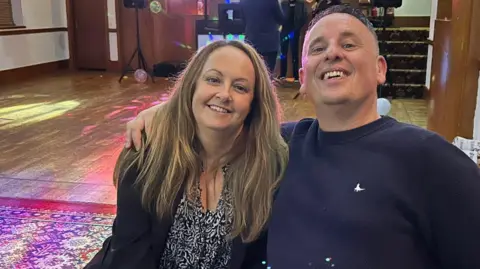
Mark experienced PND, along with his wife Michelle, after their son Ethan was born in 2004.
With Ethan having just turned 21, he has been reflecting on how his experience shaped every aspect of his life.
“People can be managing their mental health before becoming a parent and then all of sudden they are in that transitional period and they just can’t cope with it,” he said.
Michelle had an emergency caesarean section when Ethan was born and Mark, 51, said it was the “first and only time I’ve ever had a panic attack”.
“Michelle was on the ward for three days and initially she was very clingy, wouldn’t let me go. I didn’t know anything about mental health back then, so I just put it down to tiredness.”
Michelle “didn’t sleep whatsoever for close on two weeks” and was diagnosed with PND.
 Mark Williams
Mark, who was self-employed, was unable to work for six months as he tried to support her and Ethan, which meant “no money coming in, mortgage to pay and then the isolation, the loneliness”.
He “couldn’t process” the birth trauma and, overwhelmed by the transition to fatherhood, experienced “numbness” that led to suicidal thoughts.
He drank as a “coping strategy” and struggled to bond with Ethan, although now they have “the best relationship”.
“I don’t think we’ve got many photographs of us during those early years.”
He didn’t know until a decade later that he had attention deficit hyperactivity disorder (ADHD) and – he now realises – PND.
Everything “came to a head” when Mark had a breakdown in 2009 – nearly five years after Ethan was born.
“You feel not good enough, that your family would be better off without you,” he said.
“Everyone knows me as always joking, smiling, it was hard because I was trying to keep this mask on.”
But when Mark started speaking out about PND, “the abuse I had was incredible”.
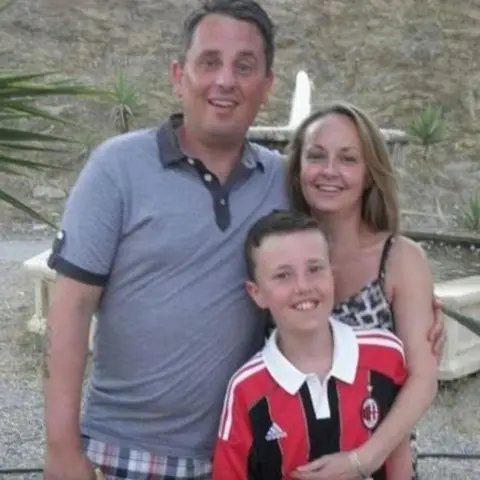 Mark Williams
Mark now works for charity Mental Health Matters Wales, as well as running his Fathers Reaching Out advocacy campaign, with the aim of influencing government policy.
He was eventually diagnosed with depression and anxiety but believes its link to him becoming a father was “not picked up on” due to most of his symptoms beginning after the official post-natal period.
“Like myself, a lot of fathers end up having depression after that period. My work is all about a holistic approach, parental mental health.
“There’s a big myth that men don’t talk. They will talk, if you put them in a safe place where people understand.
“If you support dads better, the outcomes are better for child development, lower adverse child experiences, child safety.”
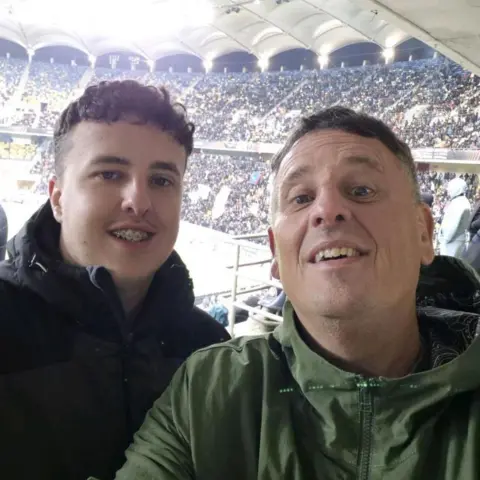 Mark Williams
Simon Jones, head of policy and campaigns at Mind Cymru, said the charity’s research had found many men reported experiencing a birth-related mental health condition, with 9% diagnosed with PTSD.
“We have to ensure that support is available both during pregnancy and after birth, in recognition that these life changes can pose different challenges.”
The Welsh government said it recognised “the unique challenges faced by men which can make them vulnerable to poor mental health and emotional wellbeing, including becoming new fathers”.
It added its mental mealth and wellbeing and suicide prevention and self-harm strategies, published in April, “set out our cross-sector approach to enhancing understanding of these challenges, prioritising safety and ensuring compassionate and person-centred support is available for everyone, whenever they need it”.
Mark said a total shift in societal attitudes was needed, adding: “Modern day masculinity, to be a man, should be about talking about feelings, talking about emotions.
“That’s what I teach my son.”
Aled added: “I was one of these people that was naive enough to just dismiss it. I nearly lost my life because I was thinking this couldn’t happen to me.
“It’s so important that we reach out and ask for help and, if you’re not feeling right, there’s no shame in that.”
- If you’ve been affected by the issues in this story, help and support is available via BBC Action Line.