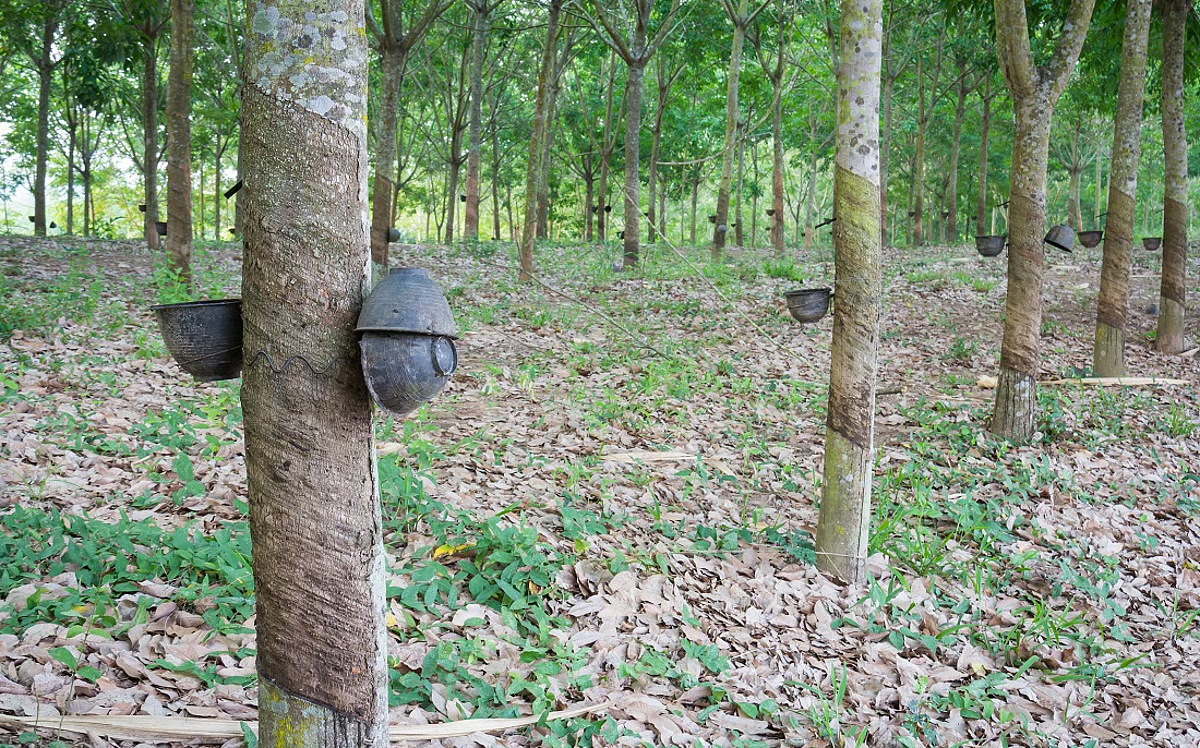
India is one of the world’s leading natural rubber (NR) producers, contributing 5.4 per cent of global production in 2023 (FAO, 2025). Ranging from defence, health, and industrial sectors, especially for tyres—to toys, NR is not only a vital commercial commodity, but also a strategic resource of national interest. Ironically, the farmers who cultivate this high-demand crop are trapped in a deeply imbalanced market structure, especially in Kerala, the heartland of Indian rubber.
Most of India’s rubber comes from smallholder farmers, over 1.3 million of them are operating on plots averaging just 0.57 hectares. These growers face a buyer-dominated oligopsonistic market, where around 36 large tyre manufacturers exert significant influence. In this skewed market, the small growers often navigate a hierarchy of intermediaries engaging in interlocked market relations, leaving smallholders at a disadvantage.
To counter this imbalance, the Rubber Board initiated the Rubber Producer Societies (RPSs) in 1986, a democratic collective of growers aimed at empowering smallholders through shared infrastructure, processing facilities, and group marketing. Over time, RPSs expanded, especially in Kerala. By 2000, there were 2,093 RPSs nationwide. But this vibrant organisation started stagnating since. Two decades later, their growth has stalled. About 20 per cent of them are now defunct, another 35 per cent dysfunctional. The Rubber Board withdrew approval to 336 societies in 2020–21, another 111 in 2021–22 and 89 in 2022–23. This decline calls into question the long-term viability of a model once heralded as the bedrock of cooperative empowerment in the rubber sector.
From empowerment to erosion: What went wrong?
The promise of RPSs was simple: provide smallholders access to shared infrastructure, enable joint procurement of inputs and marketing of outputs, offer training and technology, and create bargaining power through collectivisation. In theory, they addressed market failures common to fragmented agricultural sectors. In practice, however, many RPSs are now showing signs of institutional fatigue. Of the 99 societies studied across six districts in Kerala, less than half were involved in any active rubber procurement and sales in recent years. Fewer still owned basic infrastructure like office buildings, weighing machines, or storage units.
The average annual revenue of an RPS is around Rs2.5 lakh, of which over 85 per cent comes from rubber and input sales. But for nearly 27 per cent of RPSs, more than half of their income was derived from unsustainable sources—grants, loans, or subsidies. Expenditure patterns show high operational costs, leaving limited room for developmental investments like training, equipment maintenance, or diversification.
What’s more telling is the shift in the nature of RPS activity. Most of them today act like conventional dealers—procure latex or field coagulum (low-value forms of NR), make minimal or no value addition, and sell directly to RPS companies or private buyers. Value-added products like block rubber or ribbed smoked sheets (RSS) remain out of reach due to lack of capital, processing facilities, or technical support.
The disengaged membership
Despite the broad-based outreach, with RPSs covering nearly 80 per cent of rubber growers in surveyed wards, active participation remains below 50 per cent. Many members do not attend meetings, contribute to activities, or even see economic merit in their membership. A 2015 state-backed Rubber Production Incentive Scheme did cause a spike in memberships, but not necessarily in active participation.
The profile of RPS members reveals another challenge: ageing and disengaged leadership. About 72 per cent of members are over 50 years old, and many are retired professionals dabbling in part-time rubber farming. Only 37 per cent have completed their higher secondary education, indicating that education levels are low. The underrepresentation of Women, SC/STs, and full-time farmers worsen the existing rural inequalities. These demographic biases shrink the RPS’s receptiveness to market shifts or technological changes. It also undermines the spirit of collective action, as younger and marginalised farmers find little incentive or representation in existing structures.
Institutional dissonance: RPSs as agents
At the heart of the crisis lies a breakdown in the institutional compact. RPSs, meant to be grower-led and grower-serving, have increasingly become agents of the state, executing government schemes rather than protecting member interests. The principal-agent disconnect is stark: while growers want better prices, RPS executives often chase volume or external subsidies. For instance, many RPSs exist only to route subsidies or implement centrally mandated schemes. Decisions are not necessarily aligned with local needs or market realities. Consequently, some societies become “paper organisations,” existing in name to access grants or retain status, but with minimal functional activity. The study also reveals governance issues. Many RPSs fail to conduct regular general body meetings, and leadership is often concentrated among a few long-standing individuals. There is minimal internal democracy, poor grievance redressal, and little financial transparency.
The collective conundrum: Why cooperatives fail
Globally, cooperatives among small producers often struggle due to problems like free-riding, adverse selection, moral hazard, and the “horizon problem” (reluctance to invest in long-term assets due to uncertainty or ageing membership). The RPSs are no exception. Free-riders exist in many RPSs, particularly smaller ones. As benefits (like access to cheaper inputs or grants) often extend to the entire community, non-members have little incentive to join or contribute, weakening the collective spirit. Effectiveness of RPSs is further reduced by high transaction costs, lack of coordination, and poor managerial skills.
A glaring example is the low uptake of group processing or value-added activities. While such services could enhance income and reduce dependence on intermediaries, the lack of shared investment, trust, and accountability has made them rare. Only 11 per cent of RPSs have processing equipment like rollers or smoke houses—and even fewer have them in working condition.
Two archetypes of RPSs emerge
The study identifies two distinct models among functioning RPSs:
Sales-Oriented RPSs — These cater primarily to large growers. They focus on collective sale of rubber to fetch better prices and minimise marketing risks. Their operations are financially stable, with low dependence on grants.
Input-Oriented RPSs — These target small growers, prioritising distribution of inputs like fertilisers and machinery. However, their revenue is often low and unstable, with high expenditure-to-revenue ratios due to operational costs.
While both models have merits, they rarely coexist within a single RPS, indicating the absence of a holistic service model that can serve diverse grower profiles.
RPS ecosystem: Fragmented and hierarchical
Another limitation is the poorly integrated ecosystem within which RPSs operate. Despite the existence of 13 RPS companies formed jointly by the Rubber Board and RPSs, trade between RPSs and these entities remains limited and one-dimensional, mainly latex and field coagulum. Meanwhile, other potentially lucrative trade routes, like direct sales to private manufacturers, exporters, or cooperatives, remain underexplored. Only five of the 99 RPSs in the study reported trading with domestic retail dealers; none traded with exporters or government agencies. In short, the RPSs are stuck at the bottom rung of the value chain, with little agency to climb higher.
The way forward: Reimagining the RPS model
The decline of RPSs holds valuable lessons for policy and practice. Collectivisation won’t cure all; long-term success needs better support system. Reinforcement of transparent governance is vital. This includes regular democratic elections, capacity-building for members, and effective grievance mechanisms. Financial assistance must move beyond short-term operational subsidies toward investments in durable assets such as smoke houses, rollers, and storage facilities, which enhance value addition. Additionally, inclusivity is essential: giving women, SC/ST groups, and younger farmers leadership positions can revitalise RPS governance and promote social equity. RPSs must also become more professional by employing qualified staff, implementing digital tools, and establishing marketing connections with private sector players. This will turn them from simple procurement hubs into hubs for entrepreneurship. Lastly, better ecosystem integration is essential. Better synchronisation between RPSs, RPS companies, the Rubber Board, and other stakeholders can facilitate more efficient processing, pricing, and market access. Without significant structural changes, RPSs risk becoming outdated relics that can no longer deliver the collective economic power they once promised. Their revitalisation thus calls for a multidimensional approach that links institutional innovation, market integration, and grassroots empowerment.
The RPS initiative in Kerala was a bold and forward-thinking approach to democratising the state’s rubber markets. But the effect of time, changing market dynamics, and institutional inactivity has taken a toll. While some societies continue to offer real value, many are in need of urgent revival or reinvention. Rather than withdrawing support or treating them as outdated relics, the state must reimagine these collectives as vibrant nodes in a restructured rubber economy—capable of value addition, social inclusion, and ecological resilience. The revival of solidarity has the potential to revive the rubber economy, For India’s small rubber growers it is a matter of economic justice.