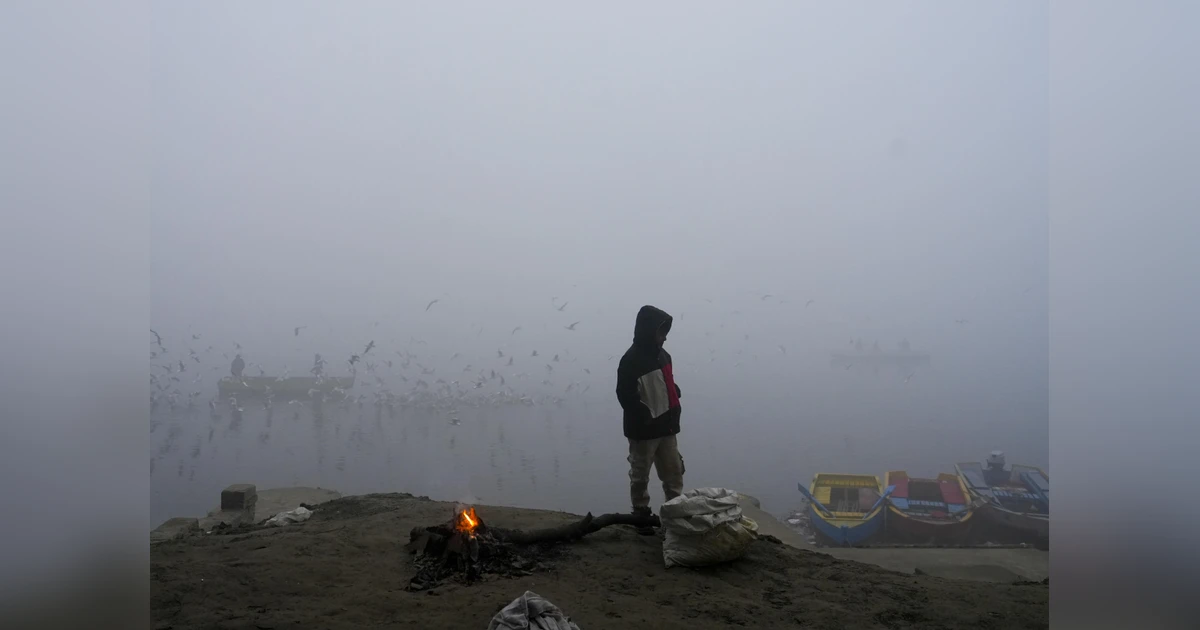
Air quality showed marginal improvement across the national capital on the second day of the new year, though most monitoring stations continued to report Air Quality Index (AQI) levels in the ‘very poor’ category. Fog persisted in several areas, leading to reduced visibility.
The average AQI in Delhi stood at 311 at 8 am, according to data from the Central Pollution Control Board (CPCB). Of the city’s 39 monitoring stations, 24 recorded ‘very poor’ air quality, while 15 remained in the ‘poor’ category. Data was unavailable for four locations at the time of reporting.
Anand Vihar logged an AQI of 348, while NSIT Dwarka was the only station to record ‘severe’ air quality, with an AQI of 423.
Areas with the worst AQI
-
NSIT Dwarka: 423 -
Siri Fort: 342 -
Chandni Chowk: 340 -
Vivek Vihar: 330 -
IIT Delhi: 329 -
Okhla Phase-2: 328
Airlines issue advisory for flight disruptions
Airlines, including Air India and IndiGo, have issued travel advisories for passengers departing from Delhi.
Air India stated, “Due to forecasted dense fog and reduced visibility in Delhi and parts of northern India tomorrow morning, flight schedules may be affected, with potential ripple effects across the network.”
IndiGo added, “Early-morning fog is expected to limit visibility across Delhi. A few flights scheduled for tomorrow have been pre-emptively cancelled to reduce waiting times at the airport.”
Several flights are already experiencing delays at Delhi Airport, with schedule disruptions reflected on flight information display boards across terminals.
Delhi recorded best air quality in 8 years: Sirsa
Delhi recorded its best air quality in eight years during 2025, Environment Minister Manjinder Singh Sirsa said on Thursday, citing an improvement in key pollution indicators.
Sirsa attributed the improvement to a science-driven strategy adopted by the Delhi government after it assumed office in February last year. The approach focused simultaneously on vehicular emissions, dust control, industrial pollution and waste management.
Measures included mechanised road sweeping, the deployment of anti-smog guns and stricter oversight of construction activities. Enforcement against vehicular pollution intensified, with more than 1.2 million challans issued since October 1. Industrial emissions were addressed through ward-level inspections, while waste management efforts focused on faster garbage removal and bio-mining of legacy waste.
The government also experimented with innovation-led initiatives such as cloud-seeding trials and pollution-control technology challenges. Officials said the focus in 2026 would be on stricter implementation of the Graded Response Action Plan (GRAP), technology pilots and enhanced citizen participation.
Delhi weather today
The India Meteorological Department (IMD) has forecast cold wave conditions at isolated places in Delhi between January 2 and 5. Dense to very dense fog is likely during night and morning hours until January 6.
Very light rain or drizzle was recorded at isolated locations, while skies remained partly cloudy through the day. A similar pattern is expected to continue, with moderate fog at many places and dense to very dense fog at a few locations during the morning hours.
Minimum temperatures are likely to range between 8 degrees Celsius and 10 degrees Celsius, while the maximum temperature is expected to hover between 16 degrees Celsius and 18 degrees Celsius.