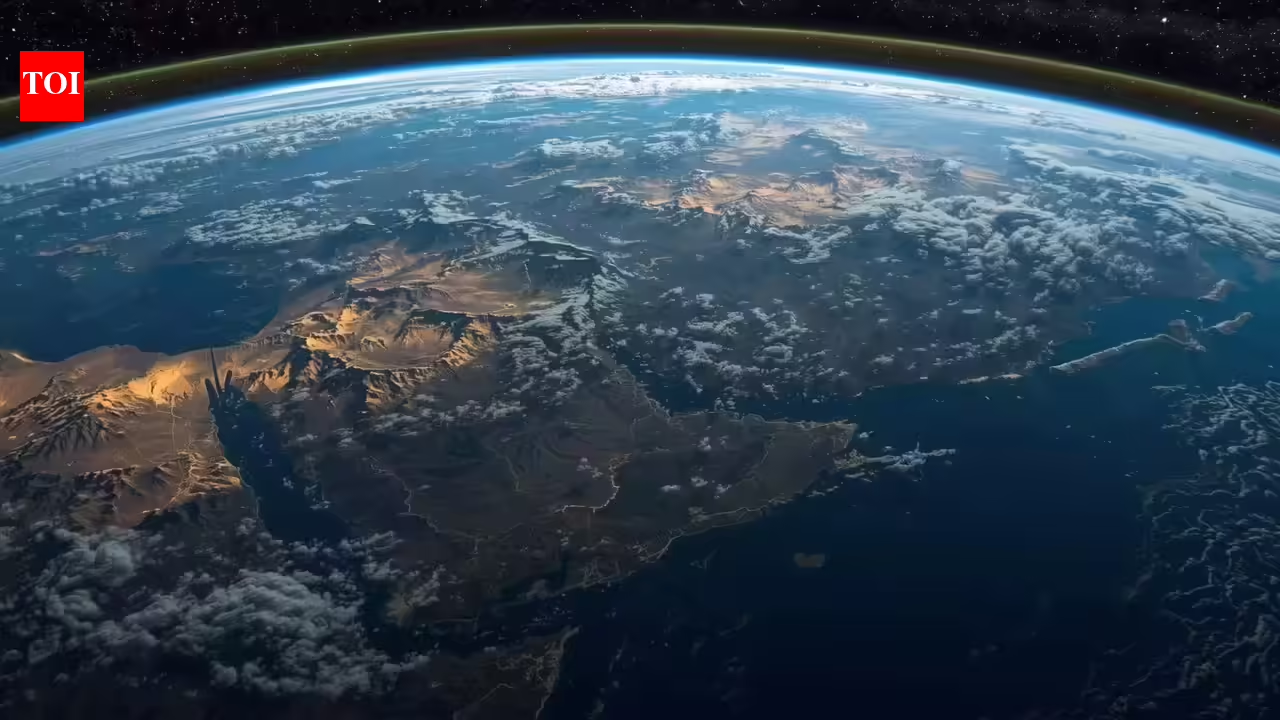
Pannotia occupies an awkward position in Earth science. It is described in textbooks and review papers, yet its outline remains faint. The proposed supercontinent is said to have existed around 600 million years ago, before the better-known Pangea. For years, it offered a neat bridge between the breakup of Rodinia and the later assembly of Pangea. That bridge now looks less solid. New dating methods and reanalysis of old data have led some geologists to doubt whether Pannotia ever fully formed. What was once presented as a short-lived southern supercontinent is increasingly viewed as a loose and changing arrangement of continents. The debate has shifted from when Pannotia broke apart to whether it came together at all, and that shift carries wider consequences for how Earth’s deep past is understood.
A long-accepted supercontinent called Pannotia may never have existed
The concept of Pannotia emerged in the 1970s as scientists sought to identify patterns in the long history of continental assembly. Earlier supercontinents such as Rodinia had already been proposed, and Pannotia appeared to fit naturally into a repeating cycle. It was imagined as a landmass gathered near the South Pole during the late Neoproterozoic period. The name reflected this southern focus. Early reconstructions suggested that many of today’s continents briefly joined before drifting apart again as the Cambrian period began.
Geological timing created early confidence
Early evidence for Pannotia largely rested on the overarching resemblance of rock sequences, fossils, and orogenic events seen in various continents. These characteristics appeared to be contemporaneous, thus indicating a world assembly phase. Certain scientists suggested that the assembly and disintegration of Pannotia had led to the changes in sea levels and the chilling of the Earth during Ice House conditions. Environmental changes, in turn, were tentatively correlated by scientists to the advent of complex life forms.
The picture became more complex as dating methods improved.
As radiometric dating improved, the timeline began to blur. Rocks once thought to record the assembly of Pannotia were dated more precisely and found to span longer intervals. In some regions, evidence suggested that rifting and separation began before full assembly could have occurred elsewhere. Instead of a single moment of global connection, the record pointed to overlapping and regionally distinct events.
Mountain belts told conflicting stories
From the research of mountain ranges which were formed during the Ediacaran and early Cambrian periods, one significant issue arose. These orogens didn’t fit together chronologically or directionally. A few of them seemed to depict collisions, while others showed extension and breakup occurring simultaneously. This contradiction was the reason why it was hard to make a case for a single supercontinent operating as a unified system.
Paleomagnetic data remained unclear
Palaeomagnetism, which tracks the ancient position of continents using magnetic signals in rocks, offered mixed results. Some datasets could be arranged to support a southern supercontinent. Others placed continents far apart during the same interval. Because magnetic signals from this deep time are often weak or altered, the data allowed multiple interpretations. As a result, palaeomagnetism did not decisively confirm or rule out Pannotia.
Pannotia may represent a transitional arrangement
An alternative view has gained ground. Rather than a true supercontinent, Pannotia may reflect a transitional phase between Rodinia and Pangea. In this model, continents were close and interacting but never fully assembled into one stable landmass. David Evans and others have suggested that the geological signals once attributed to Pannotia fit better with continuous reorganisation rather than a clear cycle peak.
The debate reshapes the supercontinent cycle
Whether Pannotia existed matters beyond one name on a timeline. The supercontinent cycle is used to explain patterns in volcanism, climate, and mantle behaviour over hundreds of millions of years. Removing Pannotia shortens that cycle and changes how energy and material are thought to move through the Earth system. It also alters the narrative linking continental motion to biological change.
Uncertainty remains part of the record
Some researchers continue to defend the existence of Pannotia, arguing that even a brief assembly qualifies as an assembly. Others now omit it entirely from reconstructions. What is clear is that the late Neoproterozoic was a time of rapid and uneven change. Continents collided, slid past each other, and pulled apart in ways that resist clean labels. Pannotia may survive as a useful idea, or it may fade as a placeholder for complexity. Either way, the rocks remain, and they are still being read.The information is sourced from a study titled “Pannotia: To be or not to be?”