
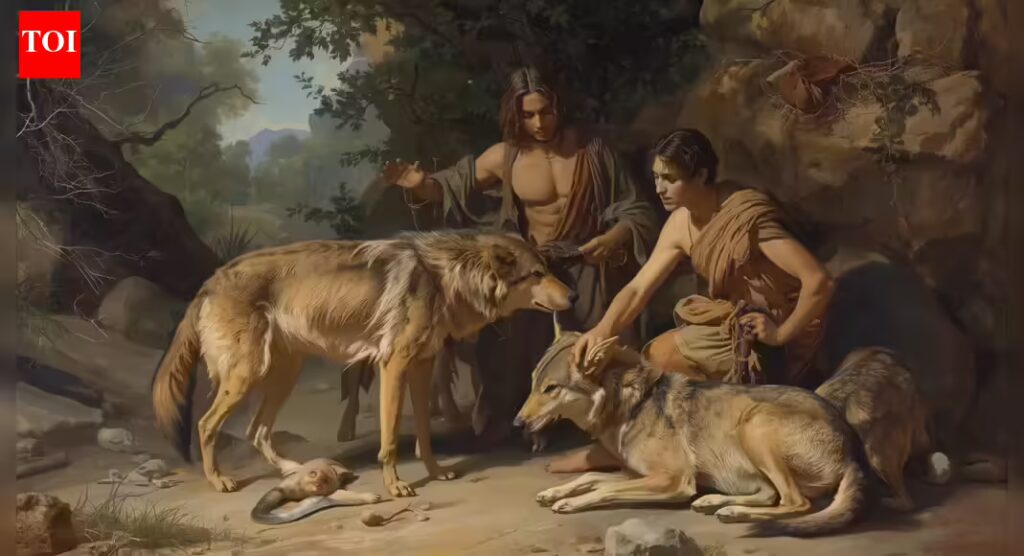
The cave is low and dark, and it is dug into limestone on a little island in the Baltic Sea where the wind blows salt from all directions. For thousands of years, humans used this spot to be safe while they hunted seals and fished in the ocean. The trash they left behind was normal. Bones, tools, and signs of fire. Two skeletons that didn’t quite fit were among them. They were from wolves. Not wolves or dogs that live today. The remains were unearthed on Stora Karlsö, an island where there are no native land animals at all. Humans brought everything that walks there. That detail is important. It implies intention rather than coincidence. As scientists looked more closely at the bones, the story changed from straightforward archaeology to something more complicated and human than they had thought before.
Were wolves living with humans 5000 years ago? New findings raise questions
The findings, published in Proceedings of the National Academy of Sciences, were made on Stora Karlsö, a small island in the Baltic Sea not far from Gotland. The island is barely 2.5 square kilometres big and doesn’t have any land mammals that live there natively. This means that any animal bones found there are likely to be strange.Archaeologists digging in the cave found two canid remains that were between 3,000 and 5,000 years old. These bones come from layers that were laid down in the Late Neolithic and Bronze Ages, when people often travelled to the island to hunt seals, fish, and subsequently graze.
Why do wolves finding at Stora Karlsö is so strange
Wolves couldn’t have gotten to the island by themselves. There are no land bridges and no signs of natural migration paths. Researchers have come to the conclusion that people must have brought the creatures with them.The history of the island backs this up. People are thought to have brought most of the mammals that live there, either on purpose or by mistake. It looks like the wolves fit into that pattern instead of being an exception.
Were these wolves connected to early dogs
A genome-wide analysis showed something really interesting. The two animals have ancestors that were the same as Eurasian wolves. There was no genetic connection between them and domestic dogs from the Canis familiaris ancestry.This is important because some think that dogs were domesticated from an unknown population of wolves at least 15,000 years ago. Even if these Stora Karlsö wolves lived with people thousands of years later, they didn’t belong to that known domestic line.
What did the wolves eat while they lived near people
The bones’ stable isotope study showed that they ate a lot of marine protein. This suggests that the wolves were consuming fish, seal flesh, or seabirds.The people who lived on the island at the time ate this way. It shows that the animals weren’t hunting on their own but instead were eating scraps or sharing resources. To get that kind of access, you usually need to be tolerant, if not in charge.
Do the bones look like they were taken care of by people
One of the wolves had an evident skeletal injury that made it harder for it to move. If the injury had happened, it would have been hard, if not impossible, to hunt.Even yet, the animal lived long enough for some of the injuries to heal. Researchers think this means that people were involved. A wild wolf that is hurt would probably not be able to live alone on a small island with few food alternatives.
What does limited genetic diversity mean for scientists
One wolf’s genome has a very low amount of genetic variation. This characteristic is more prevalent in isolated populations or tamed animals than in wild wolves.This doesn’t establish selective breeding, but it does make you think. People may have managed, restrained, or kept the wolves in small packs.
Does this suggest that people tamed wolves 5,000 years ago
The researchers are careful not to say that. There is no direct proof that these wolves were completely tamed. The findings indicate a more intricate interaction. People in the past may have caught, moved, and cared for wolves without making them into dogs. In this example, the line between wild and domestic seems to be less distinct than it used to be.