
The post Discover the Fast and Fierce Old World Tarantulas of Asia appeared first on A-Z Animals.
Quick Take
-
Taksinus tarantulas live in silk-lined retreats in the stalks of Asian bamboo.
-
Some Orphnaecus species are cave-dwelling and exhibit subterranean adaptations.
-
Haplocosmia sherwoodae surprisingly thrives at elevations of 7,730 feet near permanent snow.
-
There are many similarities between the arboreal tarantulas of Asia, particularly among the Lampropelma, Omothymus and Phormingochilus genera.
From the warm, humid rainforests of Southeast Asia to the harsh, dry conditions of the Tibetan Plateau, over 125 tarantula species have adapted to the diverse climates and geography of Asia. They can be found in burrows on steeply sloped hillsides or in silken retreats in the trees. Others even have specialized habitats, such as inside bamboo stalks or deep inside caves. Although the Old World tarantulas of Asia lack the stinging, urticating hairs of their New World cousins, they rely on speed, potent venom, and aggressive behavior to defend against threats. Some arboreal species have intricate color patterns to blend in with the trees, helping them avoid predators and ambush prey.
From frozen peaks to hollow bamboo, these 125 species ditch defensive hairs for lethal speed and sheer aggression. © A-Z Animals
With the exception of the Indian subcontinent, the following list includes all of the tarantula species in Asia according to the World Spider Catalog as of December 2025. The list is also comprised of species in the island nations of Southeast Asia. Although the western part of the island of New Guinea is politically part of Indonesia, geographically it is considered part of Oceania. Click on the link to learn more about tarantulas in Australia and Oceania, or see our complete list of tarantula species for a comprehensive reference of all tarantula species. Please note that an asterisk after the species name indicates it is the type species.
Aspinochilus Müller, Fardiansah, Schneider, Wanke, von Wirth & Wendt, 2024
Aspinochilus is a recently described genus created to accommodate a single species, Aspinochilus rufus. This genus is distinguished from others in its subfamily, Ornithoctoninae, commonly known as earth tigers, by the lack of spination on the tibiae of males and females. The paratype female reaches a maximum body length of 2.26 inches. Legs I and IV are nearly equal in length, both measuring around 1.81 inches. The female’s body is reddish brown with vivid red setae on its femora and lighter red setae on its legs and abdomen. The carapace is a light brown with radial stripes, and the abdomen has a dark fishbone pattern. Males are brown overall and have a less defined abdominal pattern. Adult females are found in tree hollows or forks in the branches at heights of around 6.5 feet. A. rufus is only known from montane rainforest habitats in East Java at Argopuro Mountain.
-
Aspinochilus rufus* Müller, Fardiansah, Schneider, Wanke, von Wirth & Wendt, 2024
-
Common name: Peach earth tiger
-
Distribution: Indonesia (Java)
-
Birupes Gabriel & Sherwood, 2019
The genus Birupes was established to house a single species, Birupes simoroxigorum. It is differentiated from other genera primarily by its uniquely shaped stridulation organ. As a juvenile, this tarantula has a cream to light brown body, black femora, and electric blue iridescent setae on its legs. However, the bright blue coloration fades as the spider matures. B. simoroxigorum inhabits the lowland rainforest of Batang Salak, Sarawak, Borneo. This medium-sized burrowing spider typically has an adult leg span of around 5 inches.
-
Birupes simoroxigorum* Gabriel & Sherwood, 2019
-
Common name: Bornean neon blue leg
-
Distribution: Malaysia (Borneo)
-
Chilobrachys Karsch, 1892
Chilobrachys is a diverse genus of medium to large-sized tarantulas found across South and East Asia. They are primarily distinguished by a stridulation organ with thorny setae on their chelicerae and 1-3 rows of club-like setae. The majority of Chilobrachys species are shades of brown, grey, or black and lack vibrant colors. However, there are a few species, such as C. natanicharum and C. jonitriantisvansickleae, that exhibit a metallic sheen on their legs, and/or on the carapace and abdomen. Chilobrachys are terrestrial spiders, living in burrows lined with webbing and other detritus. They prefer moist, humid habitats and can often be found near bodies of water.


-
Chilobrachys andersoni (Pocock, 1895)
-
Common name: Burmese mustard or Burmese brown
-
Distribution: India, Myanmar, Malaysia
-
-
Chilobrachys annandalei Simon, 1901
-
Chilobrachys bicolor (Pocock, 1895)
-
Chilobrachys brevipes (Thorell, 1897)
-
Chilobrachys dominus Lin & Li, 2022
-
Chilobrachys dyscolus (Simon, 1886)
-
Common name: Asian smokey earth tiger or Vietnam blue
-
-
Chilobrachys flavopilosus (Simon, 1884)
-
Distribution: India, Myanmar
-
Chilobrachys guangxiensis (Yin & Tan, 2000)
-
Common name: Chinese fawn
-
-
Chilobrachys huahini Schmidt & Huber, 1996
-
Common name: Asian fawn, Hauhini bird spider, or Hauhini birdeater
-
-
Chilobrachys hubei Song & Zhao, 1988
-
Chilobrachys jinchengi Lin & Li, 2022
-
Chilobrachys jonitriantisvansickleae Nanayakkara, Sumanapala & Kirk, 2019
-
Chilobrachys liboensis Zhu & Zhang, 2008
-
Chilobrachys lubricus Yu, S. Y. Zhang, F. Zhang, Li & Yang, 2021
-
Chilobrachys natanicharum Chomphuphuang, Sippawat, Sriranan, Piyatrakulchai, & Songsangchote, 2023
-
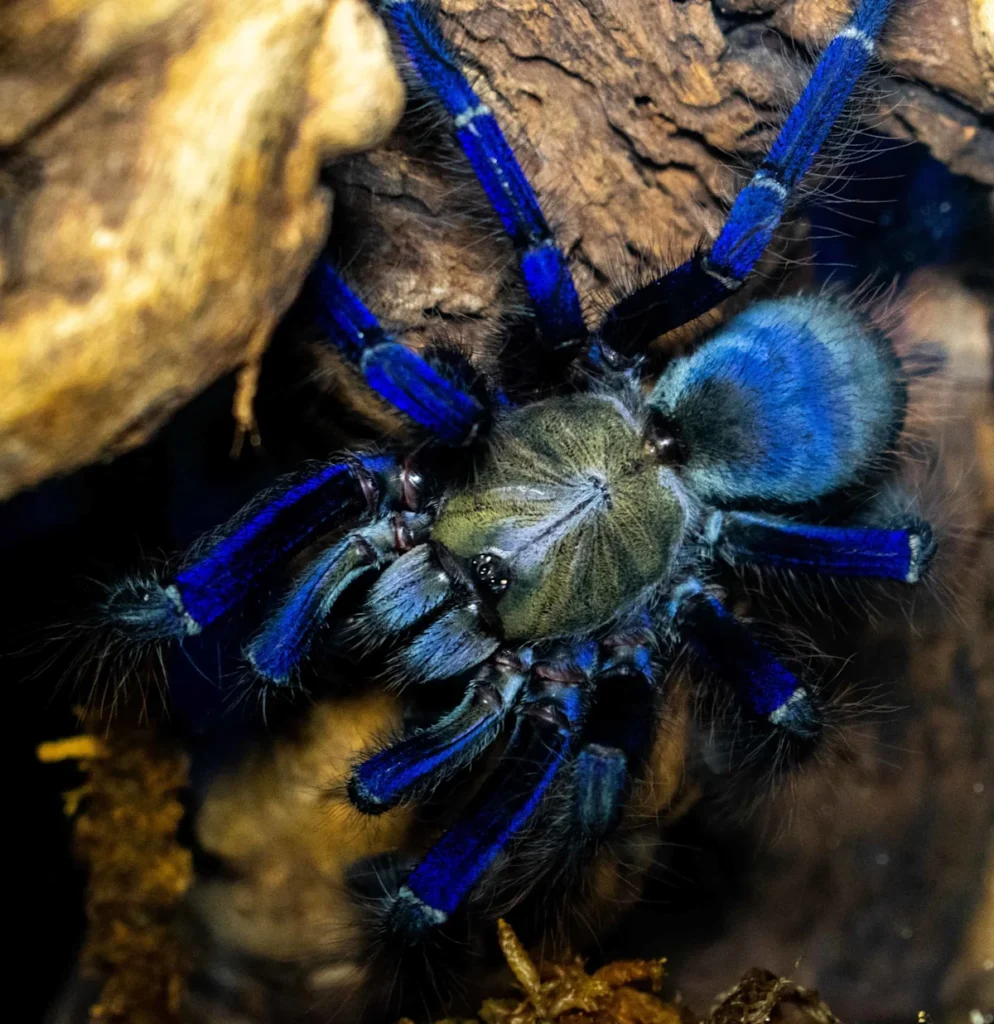
Common name: Electric blue earth tiger
-
-
Chilobrachys nitelinus* Karsch, 1892
-
Chilobrachys oculatus (Thorell, 1895)
-
Chilobrachys paviei (Simon, 1886)
-
Chilobrachys pococki (Thorell, 1897)
-
Chilobrachys qishuoi Lin & Li, 2022
-
Chilobrachys sericeus (Thorell, 1895)
-
Chilobrachys soricinus (Thorell, 1887)
Citharognathus Pocock, 1895
Citharognathus is a monotypic arboreal genus consisting only of Citharognathus hosei. Females can be distinguished from females of other genera by the dense, short, black spines on the patellae, tibiae, and metatarsi of legs III and IV. Leg IV is also longer and thicker than leg I. Males are primarily differentiated by the morphology of their reproductive organs. The newly redescribed female type specimen has a total body length of 1.9 inches, with the longest legs (pair IV) measuring 1.7 inches. Females are shades of silvery-grey with white bands on their joints and long reddish setae. They have brown abdomens with a dark striped pattern. The male is brown overall with long, light brown setae and no abdominal pattern. There are two known populations of these spiders, both in Sarawek, Borneo. C. hosei lives in tropical forests, typically in tree trunks and branch cavities.
-
Citharognathus hosei* Pocock, 1895
-
Common name: Sometimes called the Bornean bat eater
-
Coremiocnemis Simon, 1892
Tarantulas in the genus Coremiocnemis have bottlebrush setae on tibiae and metatarsi IV and long, backward-curved bottlebrush setae on most or all of the rear-facing surface of metatarsi IV. These medium-sized spiders also have a low-profile cephalothorax. Malaysian species are known from the montane tropical rainforests in West Malaysia, where they dig burrows in shady areas on sloped ground. Burrows may have silk around the openings, and some species also line the opening with leaf litter and other organic debris. C. kotakana is known from the Ketambe Research Station in Gunung Leuser National Park, Aceh Tenggara, Sumatra, but nothing is known about its ecology. C. valida is known from Baram District and Belait District on the island of Borneo. Burrows are found in lowland moist forests.
-
Coremiocnemis cunicularia (Simon, 1892)
-
Common name: Penang black femur, Singapore brown
-
-
Coremiocnemis hoggi West & Nunn, 2010
-
Common name: Malaysian purple femur
-
-
Coremiocnemis kotacana West & Nunn, 2010
-
Distribution: Indonesia (Sumatra)
-
Coremiocnemis obscura West & Nunn, 2010
-
Coremiocnemis valida Pocock, 1895
-
Common name: Common black femur
-
Cyriopagopus Simon, 1887
Members of Cyriopagopus are terrestrial spiders found in East and Southeast Asia. With the exception of the type species, members of this genus formerly belonged to Haplopelma, a genus name that is no longer in use. Cyriopagopus species are generally medium to large sized spiders, with species such as C. schmidti measuring between 2.08 and 3.35 inches in body length. Its longest legs (pair I) measure around 2.75 inches. Despite the popularity of these tarantulas in the pet trade, little is known about the ecology and biology of most individual species in the wild.

-
Cyriopagopus albostriatus (Simon, 1886)
-
Common name: Thai zebra tarantula
-
Distribution: Myanmar, Thailand, Cambodia
-
-
Cyriopagopus doriae (Thorell, 1890)
-
Common name: Kalimantan tarantula, Borneo orange fringe
-
Distribution: Malaysia (Borneo)
-
-
Cyriopagopus hainanus (Liang, Peng, Huang & Chen, 1999)
-
Common name: Chinese giant Earth tiger
-
-
Cyriopagopus lividus (Smith, 1996)
-
Common name: Cobalt blue tarantula
-
Distribution: Myanmar, Thailand
-
-
Cyriopagopus longipes (von Wirth & Striffler, 2005) –
-
Common name: Vietnamese tiger, Vietnam earth tiger (despite no listed distribution in Vietnam)
-
Distribution: Thailand, Cambodia, Laos
-
-
Cyriopagopus minax (Thorell, 1897)
-
Common name: Thailand black
-
Distribution: Myanmar, Thailand
-
-
Cyriopagopus paganus* Simon, 1887
-
Cyriopagopus schmidti (von Wirth, 1991)
-
Common name: Chinese earth tiger
-
Distribution: China, Vietnam
-
-
Cyriopagopus vonwirthi (Schmidt, 2005)
-
Common name: Vietnam black, Vietnamese/Vietnam earth tiger (which it shares with C. longipes)
-
Distribution: Southeast Asia
-
Haplocosmia Schmidt & von Wirth, 1996
Haplocosmia is a small genus native to the Himalayan region. It can primarily be distinguished from other Selenocosmiine genera by the morphology of the genitalia and stridulating organ, as well as the scopulae on tarsi I-IV. They are small to medium-sized burrowing tarantulas that create their burrows in moist soil along slopes. H. sherwoodae was collected in Xigaze, Tibet, China. It inhabits a montane habitat at elevations of around 7,730 feet, close to areas with permanent snow cover. The other two tarantulas in this genus, H. himalayas and H. nepalensis, are found in the foothills of the Himalayan mountains and Gandaki Province, Nepal.
-
Haplocosmia sherwoodae Lin & Li, 2022
Lampropelma Simon, 1892
The extent of morphological similarities among the arboreal genera Lampropelma, Omothymus and Phormingochilus makes generic diagnosis difficult. However, scientists have determined Lampropelma can be differentiated from Omothymus and Phormingochilus by the structure of the genitalia, the comparative measurements of leg I and IV in females (+/– 0.20 inches in Lampropelma versus +/– 0.39 inches in Omothymus and +/– 0.079-0.12 inches in Phormingochilus), and their geographical distribution is limited to Sangihe Island and northern Sulawesi. There are also differences in the structure of the tibial apophyses in males. These large spiders inhabit humid, old-growth forests, building silk-lined retreats in tree cavities or behind loose bark. They are primarily shades of grey and black with a striated carapace and a striped abdominal pattern. Females may also exhibit a violet sheen in certain lighting, especially after molting.


-
Lampropelma carpenteri (Smith & Jacobi, 2015)
-
Common name: Sulawesi black tarantula, Sulawesi giant black earth tiger
-
Distribution: Malaysia (Borneo), Indonesia (Sulawesi)
-
-
Lampropelma nigerrimum* Simon, 1892
-
Common name: Sangihe Island black, Sangihe black earth tiger
-
Distribution: Indonesia (Sulawesi, Sangihe Island)
-
Lyrognathus Pocock, 1895
Lyrognathus is one of the most widely distributed genera, with species in India, Sumatra and Lombok, Indonesia, Western Malaysia, and Borneo. They can be distinguished by the morphology of the stridulation organ, genitalia, and legs. Lyrognathus are medium to large-sized spiders that are typically shades of brown, grey, and black. All currently known species are found at high elevations. They tend to favor clay-like soil and make their burrows on partially shaded, sloped embankments. Most species use the surrounding vegetation, leaf litter, and other debris around the entrance.
-
Lyrognathus achilles West & Nunn, 2010
-
Lyrognathus crotalus* Pocock, 1895
-
Lyrognathus fuscus West & Nunn, 2010
-
Lyrognathus giannisposatoi Nunn & West, 2013
-
Distribution: Indonesia (Sumatra)
-
Lyrognathus lessunda West & Nunn, 2010
-
Distribution: Indonesia (Lombok)
-
Lyrognathus robustus Smith, 1988
-
Lyrognathus saltator Pocock, 1900
Magnacrus Hoang, Yu, Wendt, West & von Wirth, 2025
Magnacrus is a newly described genus of ground-dwelling spiders established to house two species found in the Central Highlands of Vietnam. Researchers believe that there may have been a mistake in recording the type locality for M. tongmianensis, and it is unlikely to inhabit China. They are medium to large spiders with body lengths of 1.34–2.16 inches. In Magnacrus females, the patellae, tibiae, and metatarsi of legs III and IV are stronger and thicker than those in legs I and II. These spiders have spines on tibiae and metatarsi I–IV, spine-like protrusions on the back of the carapace, and indistinctly patterned abdomens. Their silk-lined burrows are dug in lightly sloped ground among shaded vegetation. They also use surrounding organic materials to form the entrance, which is covered with silk when occupied.
-
Magnacrus taynguyenensis Hoang, Yu, Wendt, West & von Wirth, 2025
-
Magnacrus tongmianensis* (Zhu, Li & Song, 2002)
-
Distribution: Vietnam, China
Melognathus Chamberlin, 1917
In 2019, the genus Melognathus was restored, and M. dromeus was transferred from Cyriopagopus back to its original genus. The restoration and transfer were due to the morphology of the male genitalia, as well as the likelihood that this species is arboreal, not terrestrial, because of the wide, paddle-shaped scopulae (dense, microscopic tufts of hairs that assist with adhesion) on the backs of tarsi and metatarsi of legs I-IV. The original description from Chamberlin states only, “East Indies? Philippines?,” so the type locality is considered problematic.
-
Melognathus dromeus* Chamberlin, 1917
-
Distribution: Philippines
Omothymus Thorell, 1891
As noted under Lampropelma, there are many morphological similarities among the arboreal genera Lampropelma, Omothymus and Phormingochilus. Researchers have found that Omothymus is distinguished from Phormingochilus and Lampropelma by the structure of the genitalia, the comparative measurements of leg I and IV in females (+/– 0.39 inches versus +/– 0.079-0.12 inches in Phormingochilus and +/– 0.20 inches in Lampropelma), and a distinct geographical region primarily in Sumatra, peninsular Malaysia, and Singapore. These large tarantulas create their burrows in tree cavities in tropical deciduous forests and rainforests. Some species, such as O. schioedtei, inhabit tree hollows very high in the trees. They typically exhibit striated carapaces and striped patterns on their abdomens.

-
Omothymus fuchsi (Strand, 1906)
-
Distribution: Indonesia (Sumatra)
-
Omothymus rafni Gabriel & Sherwood, 2019
-
Distribution: Indonesia (Sumatra)
-
Omothymus schioedtei* Thorell, 1891
-
Common name: Malaysian earth tiger
-
Distribution: Thailand, Malaysia (peninsula)
-
-
Omothymus violaceopes (Abraham, 1924)
-
Common name: Malaysia blue, Singapore blue
-
Distribution: Malaysia (peninsula), Singapore
-
Ornithoctonus Pocock, 1892
The genus Ornithoctonus includes only three species, which are endemic to Thailand and Myanmar. This genus is distinguished by the morphology of the stridulation organ and the genitalia, as well as the number of spines on the metatarsus of leg IV (less than 7) and the palp coxae (fewer than 12). O. aureotibilialis is also differentiated by its color pattern. It has a dark body with a fringe of golden orange setae on the edges of the carapace and on the sides of the patellae and tibiae of leg I and II. It also has orange and dark stripes on the abdomen. O. andersoni is shades of brown, while O. costalis is shades of brown, grey, and black. Burrows are found on embankments and slopes, and the openings are extended with leaves and other organic materials.
-
Ornithoctonus andersoni* Pocock, 1892
-
Common name: Asian mahogany tarantula
-
-
Ornithoctonus aureotibialis von Wirth & Striffler, 2005
-
Common name: Thailand brown tarantula or Thai golden fringe
-
-
Ornithoctonus costalis (Schmidt, 1998)
-
Common name: Thai silver grey earth tiger
-
Orphnaecus Simon, 1892
The Orphnaecus genus is primarily distinguished from other Selenocosmiinae genera in the morphology of the stridulatory organ. They are small to medium-sized terrestrial spiders, with most species found under stones, rotten logs, or coconut husks. However, some species are cave-dwelling. O. kwebaburdeos inhabits Puting Bato Cave 3 and 4 in Burdeos, Polillo Island, Quezon Province, making webbed nests in cave crevices, but they are not truly troglomorphic. Researchers have found that O. pellitus has troglomorphic characteristics and subterranean adaptations. Specimens of O. pellitus were collected in the Culapnitan Cave system in Libmanan Caves Natural Park, Camarines Sur Province. They have much smaller eyes, their bodies are lighter in color and lack the purple-to-dark-blue sheen of other Orphnaecus species, they are less sensitive to hypoxia, and they have greater sensitivity to ground movement.
-
Orphnaecus adamsoni Salamanes, Santos, Austria & Villancio, 2022
-
Distribution: Philippines
-
Believed to be misidentified, but it cannot be transferred to another genus due to the poor condition of the specimen.
-
-
Orphnaecus kwebaburdeos (Barrion-Dupo, Barrion & Rasalan, 2015)
-
Common name: Burdeos cave tarantula
-
Distribution: Philippines
-
-
Orphnaecus libmanan Acuña & Guevarra, 2025
-
Distribution: Philippines (Luzon Island)
-
Orphnaecus mimbilisanensis Sumogat, Acuña & Nuñeza, 2025
-
Distribution: Philippines (Mindanao Island)
-
Orphnaecus pellitus* Simon, 1892
-
Distribution: Philippines
-
Orphnaecus tangcongvaca Acuña & Guevarra, 2025
-
Distribution: Philippines (Luzon Island)
Phlogiellus Pocock, 1897
Phlogiellus tarantulas are typically small, or dwarf, terrestrial tarantulas, although some species may grow to medium-size. Many species in this genus are brownish-orange overall. Researchers note that these tarantulas lack easily definable traits, and characteristics used for diagnosis are extremely variable among the spiders in this genus. For example, some species possess maxillary lyra (a patch of modified setae on the palp coxae that are part of the stridulatory organ) while others do not. However, the literature agrees that Phlogiellus species can be differentiated by traits such as a deep fovea, labial cuspules (peg-like structures on the lower “lip”) numbering between 200–350, and the morphology of the reproductive organs. These spiders are found throughout South and Southeast Asia.

-
Phlogiellus aper (Simon, 1891)
-
Distribution: Indonesia (Java)
-
Phlogiellus atriceps* Pocock, 1897
-
Distribution: Indonesia (Java)
-
Phlogiellus baeri (Simon, 1877)
-
Common name: Philippine dwarf tarantula
-
Distribution: Philippines
-
-
Phlogiellus birulai Bariev & Logunov, 2024
-
Phlogiellus bogadeki Nunn, West & von Wirth, 2016
-
Distribution: China (Hong Kong)
-
Phlogiellus brevipes (Thorell, 1897)
-
Phlogiellus bundokalbo (Barrion & Litsinger, 1995)
-
Distribution: Philippines
-
Phlogiellus daweiensis Sivayyapram & Warrit, 2020
-
Phlogiellus inermis (Ausserer, 1871)
-
Common name: Singapore frontdoor tarantula
-
Distribution: Malaysia to Indonesia (Lombok)
-
Lombok is considered likely erroneous, as the original description lists Java and Sumatra
-
-
-
Phlogiellus insulanus (Hirst, 1909)
-
Distribution: Indonesia (Sulawesi)
-
Phlogiellus insulanus borneoensis (Schmidt, 2015)
-
Phlogiellus insularis (Simon, 1877)
-
Distribution: Philippines
-
Phlogiellus jiaxiangi Lin & Li, 2021
-
Phlogiellus johnreylazoi Nunn, West & von Wirth, 2016
-
Common name: Palawan blue tarantula
-
Distribution: Philippines (Palawan Island)
-
-
Phlogiellus khampheng Sriranan, Songsangchote & Chomphuphuang, 2025
-
Phlogiellus longipalpus Chomphuphuang, Smith, Wongvilas, Sivayyapram, Songsangchote & Warrit, 2017
-
Phlogiellus moniqueverdezae Nunn, West & von Wirth, 2016
-
Common name: Thailand dwarf earth tiger
-
-
Phlogiellus mutus (Giltay, 1935)
-
Distribution: Philippines
-
Phlogiellus obscurus (Hirst, 1909)
-
Distribution: Malaysia (Borneo)
-
Phlogiellus ornatus (Thorell, 1897)
-
Phlogiellus orophilus (Thorell, 1897)
-
Phlogiellus pelidnus Nunn, West & von Wirth, 2016
-
Distribution: Malaysia (Borneo)
-
Phlogiellus quanyui Lin, Li & Chen, 2021
-
Distribution: China (Hainan)
-
Phlogiellus raveni Sivayyapram & Warrit, 2020
-
Distribution: Philippines (Cebu)
-
Phlogiellus subinermis (Giltay, 1934)
-
Distribution: Southeast Asia
-
Phlogiellus watasei (Kishida, 1920)
-
Phlogiellus xinping (Zhu & Zhang, 2008)
Phormingochilus Pocock, 1895
As previously discussed, morphological similarities among the arboreal genera Lampropelma, Omothymus, and Phormingochilus complicate researchers’ ability to define taxa. However, they have found that Phormingochilus is differentiated from Lampropelma and Omothymus by the morphology of the genitalia, the structure of the tibial apophysis in males, the comparative measurements of leg I and IV in females (+/– 0.079-0.12 inches versus +/– 0.20 inches in Lampropelma and +/– 0.39 inches in Omothymus), and a geographical distribution in Sarawak and Sabah, Borneo, with one species, P. hatihati, known from West Sulawesi. They are medium to large spiders with striated carapaces and striped abdominal patterns. These tarantulas construct silk retreats in tree cavities and branch forks in highland or lowland rainforests.
-
Phormingochilus arboricola (Schmidt & Barensteiner, 2015)
-
Common name: Borneo black
-
-
Phormingochilus everetti* Pocock, 1895
-
Common name: Sarawak earth tiger
-
Distribution: Malaysia (Borneo)
-
-
Phormingochilus hatihati Müller, Fardiansah, Schneider, Wanke, von Wirth & Wendt, 2024
-
Common name: Purple earth tiger
-
Distribution: Indonesia (Sulawesi)
-
-
Phormingochilus pennellhewlettorum Smith & Jacobi, 2015
-
Distribution: Malaysia (Borneo)
-
Phormingochilus tigrinus Pocock, 1895
-
Distribution: Malaysia (Borneo)
Psednocnemis West, Nunn & Hogg, 2012
Psednocnemis is primarily differentiated from other genera by the morphology of the stridulatory organ, spiniform setae on coxae IV, reduced hair on the top front of the abdomen, and the shape of the reproductive organs. These tarantulas are found in West Malaysia, except for P. imbellis, which inhabits north-central Borneo. These burrowing tarantulas typically excavate their retreats on steep slopes in shady areas of montane tropical rainforests. The female holotype of the type species, P. davidgohi has a body length of 1.96 inches with the longest legs measuring 2.26 inches.
-
Psednocnemis brachyramosa (West & Nunn, 2010)
-
Psednocnemis davidgohi* West, Nunn & Hogg, 2012
-
Psednocnemis gnathospina (West & Nunn, 2010)
-
Psednocnemis imbellis (Simon, 1891)
-
Psednocnemis jeremyhuffi (West & Nunn, 2010)
Selenobrachys Schmidt, 1999
There are just two species in the genus Selenobrachys. Like many Old World tarantulas, it is primarily distinguished from other genera by the morphology of the stridulatory organ and genitalia. The S. philippinus holotype has a total body length of 1.65 inches, and its longest legs (pair IV) measure 2.84 inches. It has a reddish-brown exoskeleton and pale setae, giving it an overall orange to orange-brown coloration. S. ustromsupasius differs from S. philippinus by having a longer leg I than leg IV and brown to dark brown coloration. The holotype specimen has a total length of 1.7 inches, and its longest legs (pair I) measure 2.53 inches. S. philippinus is typically found in burrows near streams. They hide under rocks and in crevices on mountain slopes. S. ustromsupasius makes its retreats under piles of coconut husks or under limestone along embankments.
-
Selenobrachys philippinus* Schmidt, 1999
-
Distribution: Philippines (Negros Island)
-
Selenobrachys ustromsupasius Acuña, Dumbrique, Ranido, Ragasa, Noriega, Mayor, Florendo, Fadri, von Wirth, Santiago-Bautista & Guevarra, 2025
-
Distribution: Philippines (Romblon Island)
Selenocosmia Ausserer, 1871
Selenocosmia is a large, diverse genus consisting of 41 species widely distributed in South Asia, Southeast Asia, and Australasia. The Selenocosmia genus is distinguished from other Selenocosmiinae genera by the morphology of the genitalia and the structure of the stridulatory organ. Tibia IV is also not swollen, and they lack dense, brush-like tufts of setae on tibia and metatarsus IV. Yet researchers believe the variable morphotypes of stridulating organs and genitalia among Selenocosmia species suggest the genus is polyphyletic. This means the species evolved from different ancestors and do not belong to the same genus. These burrowing spiders are medium to large-sized and are often shades of brown, grey, and black, but some species have contrasting markings, such as the pale yellow knee markings of S. javanensis. They typically excavate deep, silk-lined burrows in the soil or burrow under rocks or roots.

-
Selenocosmia anubis Yu, S. Y. Zhang, F. Zhang, Li & Yang, 2021
-
Selenocosmia aruana Strand, 1911
-
Distribution: Indonesia (Aru Island)
-
Selenocosmia barensteinerae (Schmidt, Hettegger & Matthes, 2010)
-
Selenocosmia deliana Strand, 1913
-
Distribution: Indonesia (Sumatra)
-
Selenocosmia effera (Simon, 1891)
-
Distribution: Indonesia (Moluccas)
-
Selenocosmia fuliginea (Thorell, 1895)
-
Selenocosmia hasselti Simon, 1891
-
Distribution: Indonesia (Sumatra)
-
Selenocosmia hirtipes Strand, 1913
-
Distribution: Indonesia (Moluccas), New Guinea
-
Selenocosmia insignis (Simon, 1890)
-
Distribution: Indonesia (Sumatra)
-
Selenocosmia javanensis* (Walckenaer, 1837)
-
Common name: Javan yellowknee
-
Distribution: Malaysia to Indonesia (Sulawesi)
-
-
Selenocosmia javanensis brachyplectra Kulczyński, 1908
-
Distribution: Indonesia (Java)
-
Selenocosmia javanensis dolichoplectra Kulczyński, 1908
-
Distribution: Indonesia (Java)
-
Selenocosmia javanensis fulva Kulczyński, 1908
-
Distribution: Indonesia (Java)
-
Selenocosmia javanensis sumatrana Thorell, 1890
-
Distribution: Indonesia (Sumatra)
-
Selenocosmia jiafu Zhu & Zhang, 2008
-
Distribution: China, Laos
-
Selenocosmia kovariki (Schmidt & Krause, 1995)
-
Selenocosmia lanipes Ausserer, 1875
-
Distribution: Indonesia (Moluccas), New Guinea
-
Selenocosmia longiembola Yu, S. Y. Zhang, F. Zhang, Li & Yang, 2021
-
Selenocosmia peerboomi (Schmidt, 1999)
-
Distribution: Philippines
-
Selenocosmia qiani Yu, S. Y. Zhang, F. Zhang, Li & Yang, 2021
-
Selenocosmia raciborskii Kulczyński, 1908
-
Distribution: Indonesia (Java)
-
Selenocosmia samarae (Giltay, 1935)
-
Distribution: Philippines
-
Selenocosmia strubelli Strand, 1913
-
Distribution: Indonesia (Java, Moluccas) or New Guinea
-
Selenocosmia tahanensis Abraham, 1924
-
Selenocosmia xinhuaensis Zhu & Zhang, 2008
-
Selenocosmia zhangzhengi Lin, 2022
Taksinus Songsangchote, Sippawat, Khaikaew & Chomphuphuang, 2022
Taksinus is an arboreal species collected from Tak province in northern Thailand. It is distinguished from other arboreal genera in Southeast Asia by its genital morphology, comparative leg measurements, its geographic location, and specialized habitat. These spiders have a brownish-yellow carapace and dark brown to black legs with pale banding at the joints. The abdomen is dark grey with thick black setae on the top and sides. They also have longer white setae and reddish-tinted setae on the legs and abdomen. The male holotype has a total length of 1.04 inches and its longest legs (pair I) measure 1.83 inches. They are found in mixed deciduous forests at elevations of around 3,280 feet. Taksinus tarantulas live in the stalks of Asian bamboo (Gigantochloa sp.) in silk-lined retreats with covered entrances.
-
Taksinus bambus* Songsangchote, Sippawat, Khaikaew & Chomphuphuang, 2022
The post Discover the Fast and Fierce Old World Tarantulas of Asia appeared first on A-Z Animals.