

For most people, dolphins sit in a safe mental category: intelligent, playful, sociable animals better known for aquarium tricks and beachside encounters than for anything genuinely threatening. They do not carry the menace of sharks or the fearsome reputation of other ocean predators. That assumption is exactly what a set of underwater recordings dismantled.
What the cameras captured
The dolphins, trained by the US Navy to locate and mark underwater mines, were fitted with cameras to observe how they found and caught food in open water. The animals were not confined or staged. They swam, searched, pursued and fed as they normally would. The lead author of the 2022 study was the late Sam Ridgway, who led the Navy’s Marine Mammal Program and was widely known as the “father of marine mammal medicine”. Before his death three years ago, Ridgway reviewed the footage and shared the findings, which showed the dolphins consuming hundreds of fish between them, alongside far stranger prey, including venomous sea snakes. Audio captured during the hunts revealed a precise sequence. As the dolphins searched, they emitted sonar clicks at intervals of 20 to 50 milliseconds. When prey came into range, the clicks tightened into a rapid terminal buzz, followed by what researchers described as a squeal. “Searching dolphins clicked at intervals of 20 to 50 ms,” the researchers wrote. “On approaching prey, click intervals shorten into a terminal buzz and then a squeal. Squeals were bursts of clicks that varied in duration, peak frequency, and amplitude.” The squeals did not stop once prey was caught. They continued as the dolphins seized, manipulated and swallowed their meal.
The method that surprised scientists
For years, scientists assumed dolphins caught fish using a technique known as “ram raiding”, charging straight at prey and snapping it up. The GoPro footage showed something else entirely. Instead of biting, the dolphins expanded their throats and flared their lips, creating suction powerful enough to pull fish directly into their mouths. During captures, their lips flared to reveal nearly all of their teeth, while the throat visibly ballooned outward.

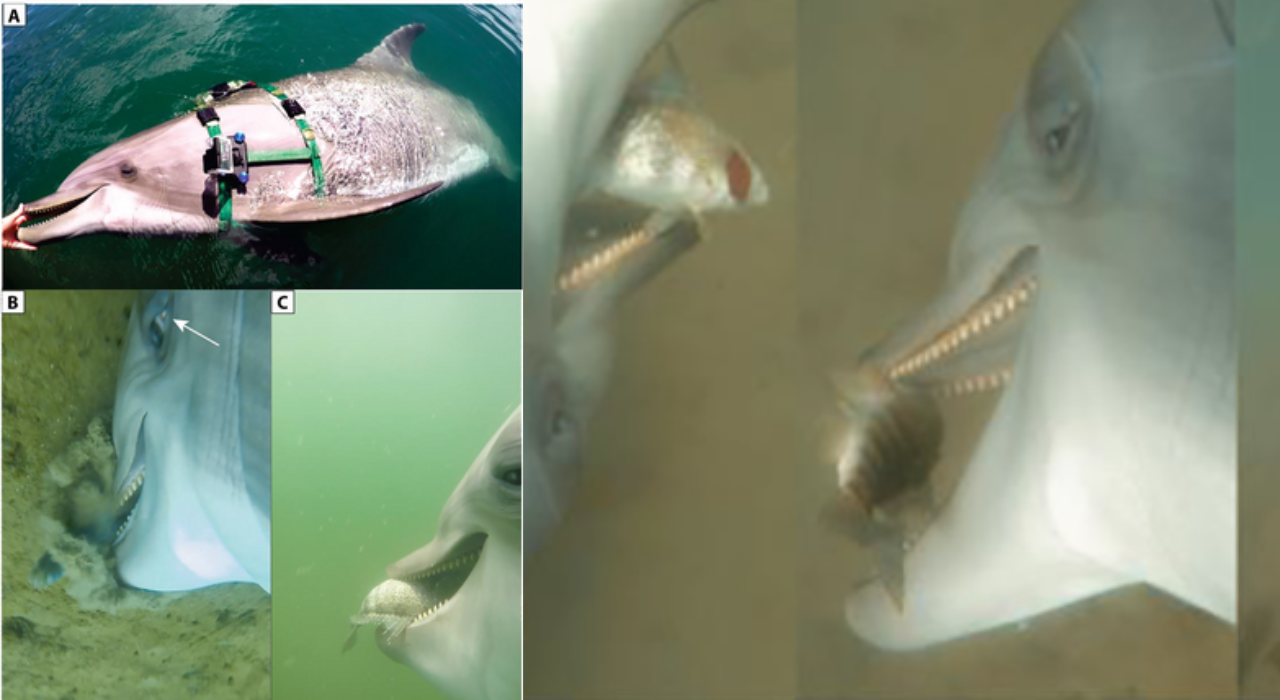
One of the aquatic mammals seen ‘drilling’ into the sea floor to seize a fish (US Navy/National Marine Mammal Foundation)
“Fish continued escape swimming even as they entered the dolphins’ mouth,” the researchers noted, “yet the dolphin appeared to suck the fish right down.” The illusion of cuteness did not survive these moments. Watching dolphins hoover fish from the seabed, or drill into sand to flush prey, proved deeply unsettling for many viewers. What shocked the researchers most was how casually one dolphin consumed eight yellow-bellied sea snakes, a species described by the Australian Museum as “highly venomous” and “possibly even toxic to ingest”. After pouncing, the dolphin jerked its head and released a high-pitched squeal. Despite the risk, it showed no signs of illness after the meal. When clips circulated online, reactions were blunt. One Reddit user wrote: “Dolphins aren’t to be trifled with.” Another added: “Freaking dolphins. Second biggest bastards of the mammal world.” A third observed: “Everything seems to emit a triumphant squeal when they catch their prey.”
The footage does not suggest cruelty or malice. It shows efficiency, adaptation and control. Dolphins remain intelligent and social animals, but the GoPro cameras made one thing clear: beneath the smooth skin and friendly reputation sits a highly tuned predator, perfectly comfortable doing what it has always done, whether humans are watching or not.