
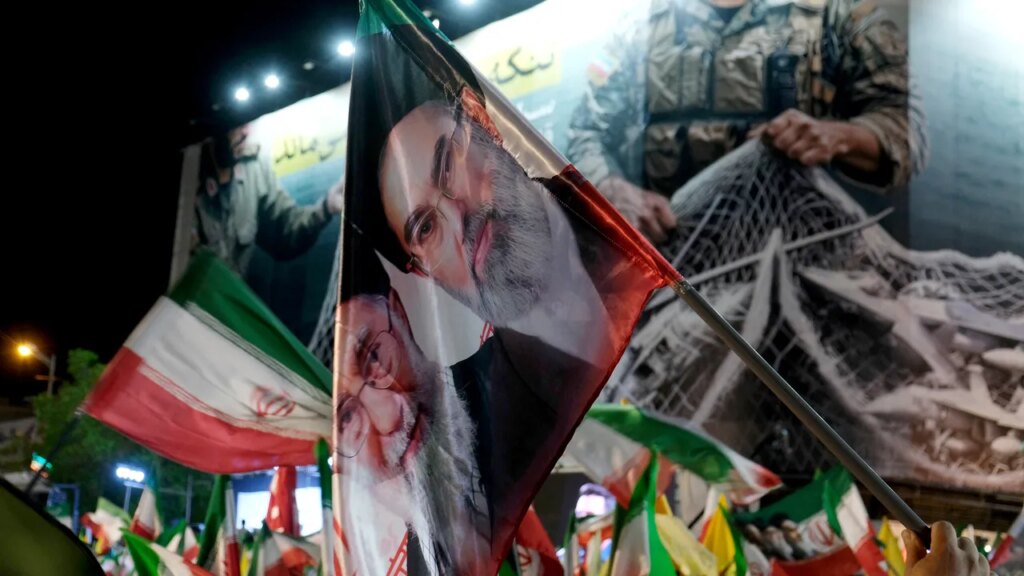
Although in a way, they already have that.
I mean making it official; that’s what they want. And my understanding is that, in Islamabad, what the U.S. position has been is that either there’s freedom of navigation for all, or there is a tolling system that the U.S. is involved in, mirroring what the President had said publicly. So it is not inconceivable that there might be some kind of compromise that would see a consortium running the strait and charging tolls for a period of time, and those funds could be used for recovery from this war for countries on both sides of the Gulf.
To return to Iran: Even if things do get really dire in Iran, is that really going to matter to the regime, which doesn’t care about the Iranian people? They were shown several months ago that if they rise up they’re going to be massacred en masse.
I think that’s absolutely right. This is why I’m saying it’s futile, because there’s no situation under which the regime would either capitulate or collapse as a result of economic pressure. So this triangulation is just not going to work. But the reverse also applies. President Trump wants to visit President Xi in mid-May and would like this issue to be resolved by that time. And then there’s the World Cup in the U.S., and, if there’s no jet fuel, it’s going to undermine the U.S.’s ability to host the tournament. There are all of those considerations, but at the end of the day, again, the U.S. is also not going to completely capitulate to the Iranians. They both have to compromise. So this is why it’s just a ridiculous standoff.
And it seems like the only thing that’s going to potentially cause them to compromise is if both sides feel a certain amount of pain, which is a terrible thing to say, because you don’t want anyone to feel pain. And the thing we’re not even talking about is the effect this has had on the global economy and what that means for people all across the world.
Absolutely. We already saw this with the Russia-Ukraine war. So now imagine, with the fertilizer disruption, what kind of effect this is going to have on the price of food in the Global South. Nobody is paying attention to that right now, but this standoff is going to cost so many lives, even though, at the end of the day, as we discussed, it is not really going to fundamentally change either side’s positions.
But something that I would say is different, not just in terms of analyzing how this standoff is going to play out but to convey to you the view from Tehran in terms of what they believe is the U.S. strategy behind the blockade, is that they don’t believe that the objective is to strangulate their economy. They believe the objective is to deliver a third strike that would include another surprise attack, another high-level assassination of senior officials, and basically would be on par with what they have seen in June of 2025 and February of 2026. They believe that this whole strategy is to buy time until the U.S. can get more troops to the region and prepare for another shock-and-awe operation that the U.S. hopes would bring down the Iranian regime. So they don’t believe that this whole thing is just a game of chicken. They believe that it is most likely a cover for another kinetic action against them.
Why didn’t Iran shut down the strait after the attack by the U.S. and Israel last June, if they had the power to do so?
The Twelve-Day War completely changed Iran’s defensive doctrine. Prior to that war, they always believed that the best strategy was to tiptoe around a direct confrontation with the United States, which would be very costly for Iran. But when the U.S. joined the Twelve-Day War, even if they did it briefly, it really changed Iran’s calculus, and they came to the conclusion that their deterrence was no longer being taken seriously by the U.S. Therefore, they decided that they would have to respond to the next round of conflict in a way that would create a new equilibrium and restore that deterrence. And in order to do that they would have to demonstrate that Iran is not the predictable cautious actor that Trump had experienced ever since he killed Qassem Soleimani in 2020, and that Iran would not hesitate to go all out and act as if it has nothing to lose.
The planning for this war started on June 24, 2025, not in February of this year. Right after the Twelve-Day War, they started planning, and Khamenei was involved in this planning. So I can’t say that his absence resulted in Iran becoming bolder. However, I do believe that in its implementation his absence has helped the regime, or the new class of Revolutionary Guard leaders who are currently in charge, to act with more maneuvering space and with less restraint because Khamenei was such a cautious man.
The reporting, at least that I’ve read, suggests that the Revolutionary Guard generals are really in charge of the country now, much more than Khamenei’s son. Is that your understanding, too?
One hundred per cent. First of all, he is grievously injured, so he’s not able to be involved in the day-to-day decision-making at the tactical level. He’s in a completely different position than his father was. In any case, the new Supreme Leader would have to take time to consolidate power. A Supreme Leader who is injured and incommunicado for security reasons would face very serious limitations, in addition to the fact that he owes his power to the Revolutionary Guard. He owes the survival of the regime to the Revolutionary Guard. So there is a change in the balance of power, in that he is now subservient to them rather than the other way around, as it was under his father’s rule. And, again, I think the strategy of going all out, attacking all neighbors, closing the strait, was designed under his father, but the Guard now has a much freer hand than would’ve been the case if the father were still around.
There is a tendency to see war as a zero-sum game, with one side winning and one side losing. But regarding the question of whether more time without a deal helps Iran or helps the United States it seems like you don’t view it as zero sum. You don’t think, well, one week from now, Iran’s position will clearly be better, or the United States’ will be better. It seems like you’re saying that everyone’s going to suffer.