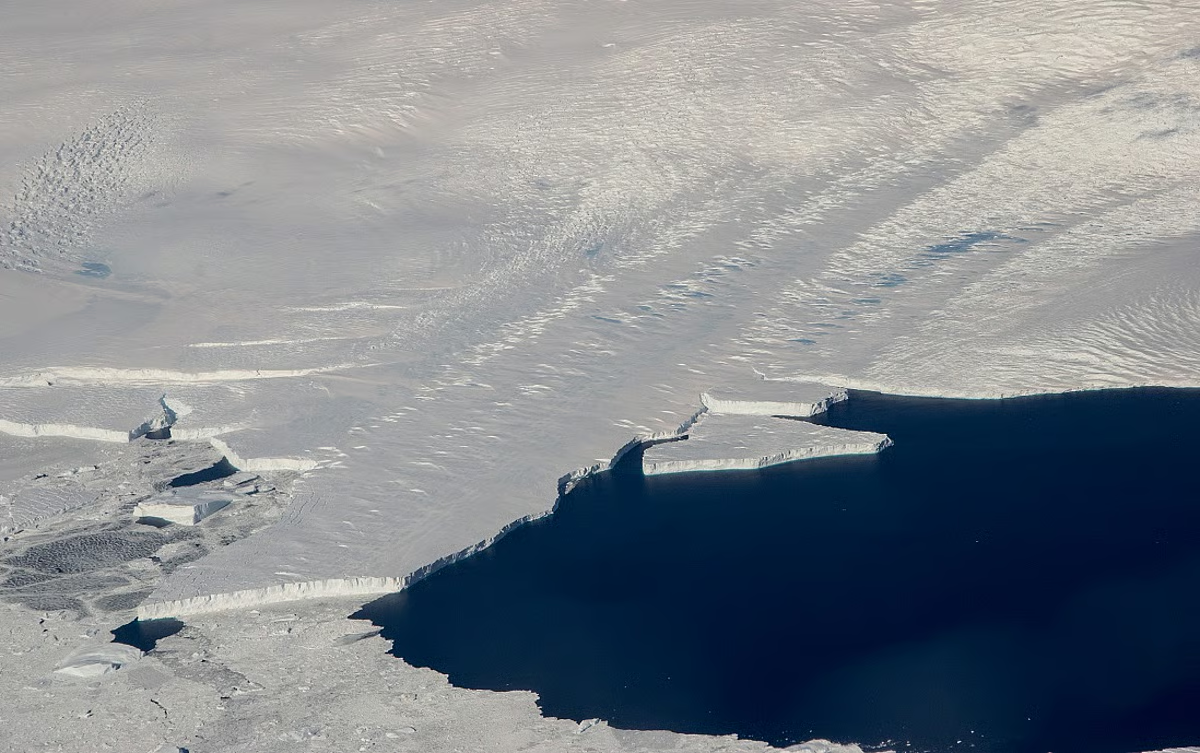
The pattern of fractures in the ice of the Thwaites Glacier, which is the outflow of the West Antarctic Ice Sheet, show how the rest the Antarctic Ice Shelf could collapse in the future. The Thwaites Glacier, commonly known as the ‘Doomsday Glacier’ because of its potential to significantly add to worldwide sea levels, is one of the fastest changing ice-ocean systems on the planet. The complete melting of the glacier could add 65 cm to global sea levels.
A new research paper published in the Journal of Geophysical Research: Earth Surface provides a detailed account of the changes to the glacier and other features around it which provide us with a template for how other Antarctic ice features could collapse.
The paper produced at the Centre for Earth Observation Sciences at the University of Manitoba analysed data from satellites and in situ Global Positioning System (GPS) for the ice fractures on the Thwaites Eastern Ice Shelf (TEIS) between 2002 and 2022. The TEIS is an extension of the Thwaites Glacier floating on the sea surface.
The TEIS is joined to an undersea ridge which acts like an anchor and is known as a pinning point. These “pinning points obstruct the flow of the ice, also causing it to deform, compress, and fracture”, according to the research paper. The study found that the TEIS has undergone an increase in fracturing in the upstream of its pinning point between 2002 and 2022. This area is known as a ‘shear zone’ because of the way the ice deforms due to the changes occurring in the region.
The study authors also found the pattern of fracturing in this shear zone. “This yielded two key insights. First, fractures occurred in two stages: the initial propagation of long fractures parallel to ice flow, followed by smaller fractures perpendicular to ice flow”, as per the study authors. The total annual length of ice fractures has increased from 165.2 +/- 6.6 km in 2002 to 335.5 +/- 13.4 km in 2022, according to the paper.
They further showed that the disintegration of the shear zone causes the ice flow on the TEIS to increase. The researchers also portend that this could be the template for future fractures and ice flow changes within the West Antarctic Ice Sheet and the rest of the ice sheets on the continent as well.
The West Antarctic Ice Sheet is one of the 16 climate tipping elements on the planet. These are planetary scale ocean, atmosphere and land systems that have a threshold or a tipping point beyond which the changes occurring within them become irreversible leading to a cascade of events.
This cascading could include tipping of other climate elements and large-scale changes to the ocean, atmosphere and land systems in general. The current study provides a template for how such a collapse of the West Antarctic Ice Sheet climate tipping element could occur.