
- The Maharashtra government has temporarily halted an iron ore mining project in Chandrapur amid concerns over deforestation, ecological damage, and increased human–tiger conflict.
- The proposed site lies within a critical wildlife corridor and could disrupt tiger dispersal in a region already witnessing a rise in human-tiger interactions.
- Environmentalists argue the project’s ecological and social costs far outweigh its limited economic benefits, with minimal job creation and inadequate compensatory afforestation.
After weeks of protests and hunger strikes by activists and concerned local residents, the Maharashtra government temporarily halted further action on the Lohardongri iron ore mining project in the Bramhapuri forest division of Chandrapur district, which had ecologists and environmentalists in a bind for months.
Nagpur-based Sunflag Iron and Steel Company Ltd was allotted almost 36 hectares of forested land under the Mineral (Auction) Rules, 2015. News reports suggest that an estimated 18,000 trees would be felled to make way for the project. While Mongabay-India couldn’t access the documents to verify the number of trees to be felled, a 2022 tree enumeration survey report available publicly points to over 11,773 trees to be cut and experts suggest that more trees have likely been added to this number in the last few years.
What truly concerns residents is the environmental cost of the project, including a potential rise in negative interactions with tigers.
Rising tiger interactions
Chandrapur district of Maharashtra is the epicentre of rising human–tiger interactions, often resulting in fatalities. Mongabay-India visited the conflict areas in late 2024 to report on this, and found that a staggering 111 human deaths from tiger attacks were reported in 2022–2023, with 59 deaths already recorded in 2023–2024. The latest official numbers are awaited.
Strict conservation measures at one of the country’s most popular tiger reserves — the Tadoba-Andhari Tiger Reserve (TATR) — have contributed to an impressive rise in tiger numbers in the state. According to a nationwide tiger estimation released in April 2022, Maharashtra is home to 444 tigers out of a national population of 3,682. TATR reportedly has around 97 tigers, though unofficial estimates suggest the number may be closer to 150.
“Tadoba has become a cradle of tigers in central India. It has connectivity with several important tiger reserves and landscapes. This connectivity is critical from a long-term conservation perspective,” informs Kedar Gore, Director of The Corbett Foundation, a conservation non-profit.
If the proposed mining project comes into effect, it is likely to disrupt natural tiger dispersal and movement, as it is located on a highly sensitive wildlife corridor connecting TATR with the Bramhapuri–Gadchiroli forest division. Other than tigers, the landscape also supports a range of wildlife, including wild pig, gaur, sambar deer, leopard, and more.
The site allotted for mining, a forested area, connects TATR, which lies to the west of the proposed site, with other forests on all sides — Gadchiroli district, with its dense forests, to the east; the Nawegaon–Nagzira Tiger Reserve to the north; and Chhattisgarh, with tiger reserves such as Indravati Tiger Reserve, to the south.


Explaining the ecological importance of the proposed mining site within a landscape significant for wildlife movement, Gore says that these forest patches form natural ecological connectivity. “When corridors are officially mapped, however, they are often shown as narrow strips, just three to four kilometres wide. This is a very limited way of representing connectivity. In reality, for ecologists, the entire forested landscape functions as a corridor and a dispersal area for tigers moving out of tiger reserves, because tigers do not recognise these narrow, mapped areas,” he says, adding: “Because of this, anything that falls outside the officially designated corridors is often treated as if it is not important, even though it may be ecologically critical.”
“As tigers move out of Tadoba and into Bramhapuri and beyond, they rely on these forest patches for connectivity. The proposed mining project would take up a substantial patch of forest land, further fragmenting an already stressed system,” shares Mandar Pingle, assistant director of the Satpuda Foundation, a non-profit focused on wildlife and landscape conservation in central India. These wildlife corridors are already under severe anthropogenic stress, with roads, canals and railway lines cutting across the region. “These infrastructures are unavoidable in a developing country, but mines can be reconsidered, considering the importance of the area for wildlife,” Gore adds.
Increased human pressure
Another concern raised by environmentalists is the potential spike in infrastructure such as access roads and other associated facilities, along with increased heavy vehicle movement to facilitate open-cast mining. This could result in disturbances in the forest, increase the risk of roadkills, and open up critical forest areas to further pressure.
From an economic perspective, Pingle shares that the project makes little sense. Human–wildlife conflict already imposes a significant burden on the state, with compensation of about ₹25 lakh paid per human death. Any increase in conflict due to habitat disruption would further escalate these costs. On the other hand, the mining project is expected to generate only around 32 permanent jobs, with about 40 additional temporary positions. Pingle says that this limited economic benefit does not justify the ecological and social costs.
The proposal includes compensatory afforestation in Yavatmal, which Pingle says does not offset the loss of old-growth forest at the mining site. The mining project raises critical concerns of net ecological and economic loss, exacerbating conflict, fragmenting a critical tiger landscape, and undermining long-term conservation in the region.
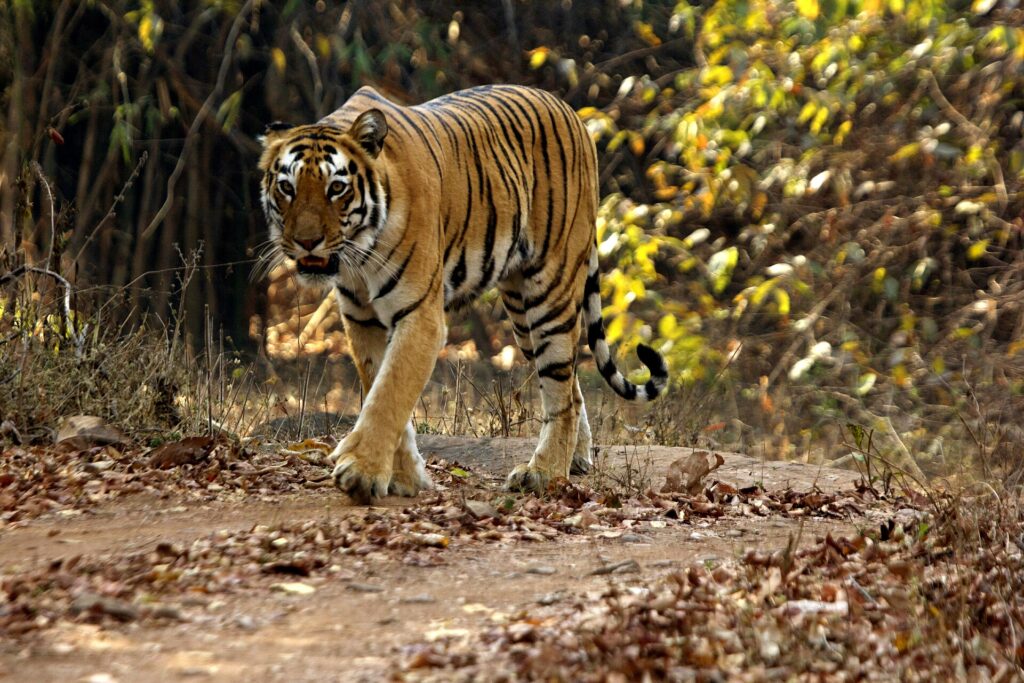
Banner image: A 2017 image of a tigress is Agarzai buffer area of Tadoba-Andhari Tiger Reserve in Chandrapur. Image via Wikimedia Commons.

