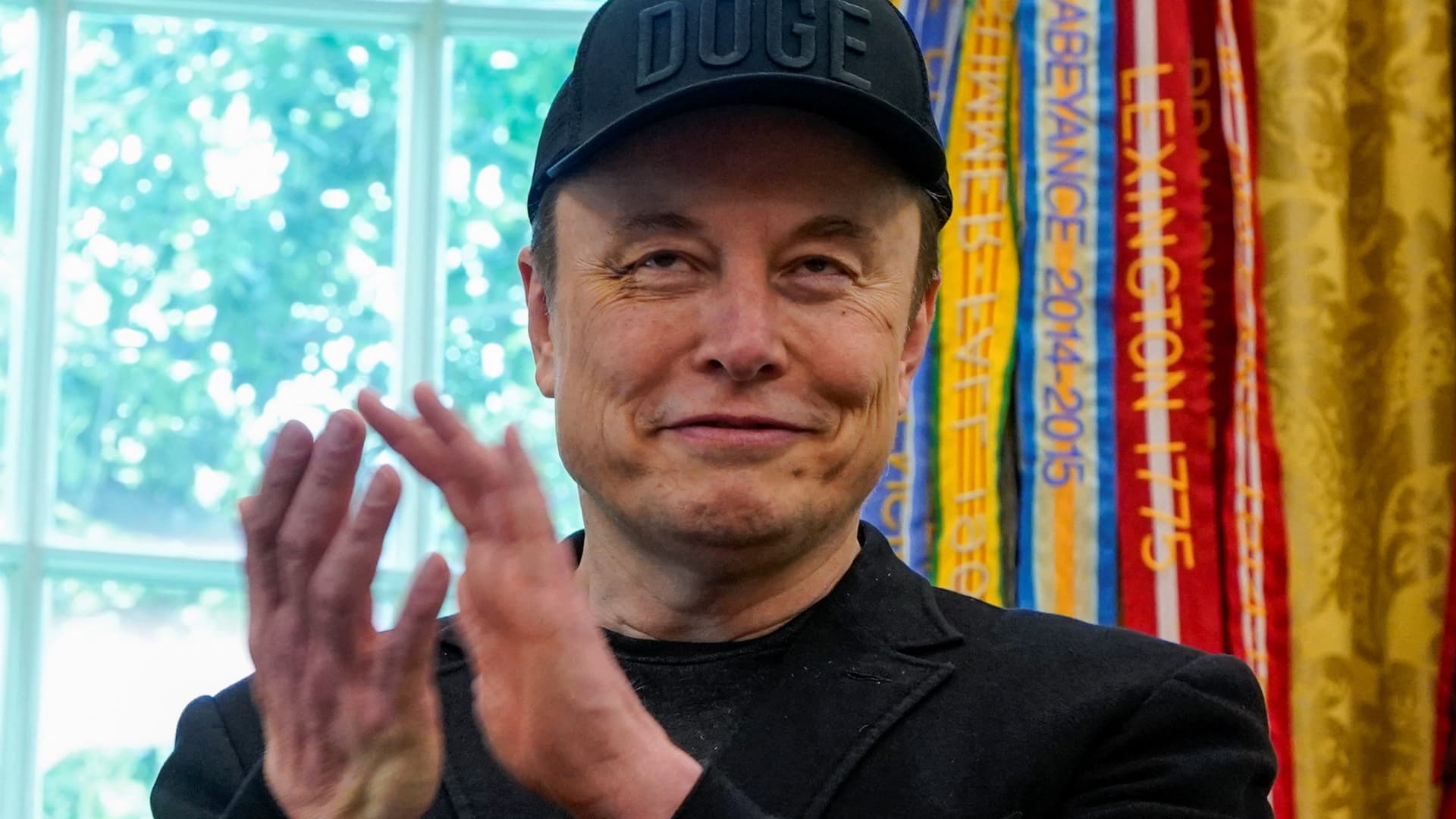
Elon Musk’s journey to becoming the world’s first trillionaire will likely be powered by rockets rather than cars, as SpaceX now accounts for nearly two-thirds of the Tesla CEO’s wealth.
Musk became the first person ever to top the $800 billion mark this week, with his net worth now around $845 billion, according to Forbes. He’s worth more than the next three richest people – Google co-founders Larry Page and Sergey Brin and Meta CEO Mark Zuckerberg – combined.
The tech magnate’s unprecedented wealth surged after his aerospace and defense company, SpaceX, acquired his artificial intelligence and social media company, xAI, this week in a deal that valued the merged entity at $1.25 trillion, according to financial documents reviewed by CNBC.
With Musk’s ownership estimated at around 43% in the combined company, his stake would be valued at over $530 billion, marking a rapid shift in his fortunes.
Musk’s priorities are also likely shifting his focus more to SpaceX than Tesla, a reality that the EV company acknowledged in its latest proxy filing, where it noted that “a majority of Mr. Musk’s wealth is now derived from other business ventures.”
Last year, Musk confirmed he wants to take SpaceX public in 2026, which would make Tesla a less prevalent component of his liquid wealth. But he still has to get buy-in from public market investors, who may be reluctant to pay up for a company that combines a defense contractor and satellite business with a cash-burning AI model developer that’s trying to take on Google, OpenAI and Anthropic.
SpaceX has received more than $20 billion from contracts with the federal government, according to research from FedScout, with more lucrative contracts on the way, and Musk has framed the acquisition as the next step towards “orbital data centers.”
“You’ve muddied up your story a little bit as a pure-play SpaceX shareholder, but the opportunity has gotten a lot bigger,” said Greg Martin, managing director at Rainmaker Securities, which works on transactions for pre-IPO companies. “It makes sense for them to access a much larger capital market, especially with xAI, which does have insatiable need for capital.”
XAI is currently being investigated by authorities in Europe, Asia, Australia and California, after the company’s Grok image generator let users create and share “deepfake” explicit images of children and women.
It’s not clear whether Musk’s merger will require any regulatory review. Democratic senators this week called for the Pentagon to investigate SpaceX over undisclosed Chinese investors in the company.

Musk still has a major incentive to stay focused on Tesla. Late last year, shareholders voted to approve a new pay package that could be worth $1 trillion, paid out in 12 tranches, if Tesla hits certain milestones, including market cap gains and operational achievements, over the next decade. The first tranche of stock gets paid out if Tesla hits a market cap of $2 trillion, about $460 billion more than the current valuation.
Tesla said in the proxy filing detailing the plan that the structure aims to “prevent him from prioritizing those other ventures.”
However, Columbia Law professor Dorothy Lund, a corporate and securities law expert, told CNBC in an email that the strategy may not work.
Musk is now “negotiating comp packages at each company, with each board trying to induce him to pay attention via comp,” Lund wrote. “If SpaceX/xAI gives him more money and a bigger share, that Tesla package may look less appealing.”
Before the xAI acquisition, Musk owned about 42% of SpaceX and controlled 80% of the votes, according to FCC reports. His current ownership in Tesla is between 11% and 15% of shares outstanding, depending on what’s included in his stake, according to public filings.
With Tesla’s brand value and core auto sales in decline, and its long-promised robotaxis and humanoid robots still in development, the company’s stock price is down about 9% this year.
Based on Musk’s ownership in SpaceX, and assuming Tesla shares are flat, the rocket and AI company would have to reach a valuation of about $1.6 trillion for the world’s richest person to reach trillionaire status.
Ross Gerber, CEO of investment firm Gerber Kawasaki, is betting that Musk won’t ever want to take SpaceX public as a standalone entity. Rather, he expects to see a merger of SpaceX and Tesla, and he speculated this week it would list on the New York Stock Exchange under ticker symbol X, which formerly belonged to U.S. Steel.
Gerber is a long-time Tesla investor and now holds shares in SpaceX after his firm previously backed Musk’s leveraged buyout of Twitter in 2022. Musk rebranded Twitter as X, and merged the social network with xAI last year.
Consolidating his empire makes sense, Gerber said, because it would allow Musk to fulfill his dream of running one big company under the brand name X. Following Alphabet’s announcement this week that it will spend up to $185 billion on capex this year, Gerber said Musk is going to have to be able to bring in massive sums of cash.
“This huge entity would make it easier for them to raise money and borrow,” he said. “How else is Musk supposed to compete and become a major AI player?”
Musk didn’t respond to a request for comment.
WATCH: SpaceX acquires xAI