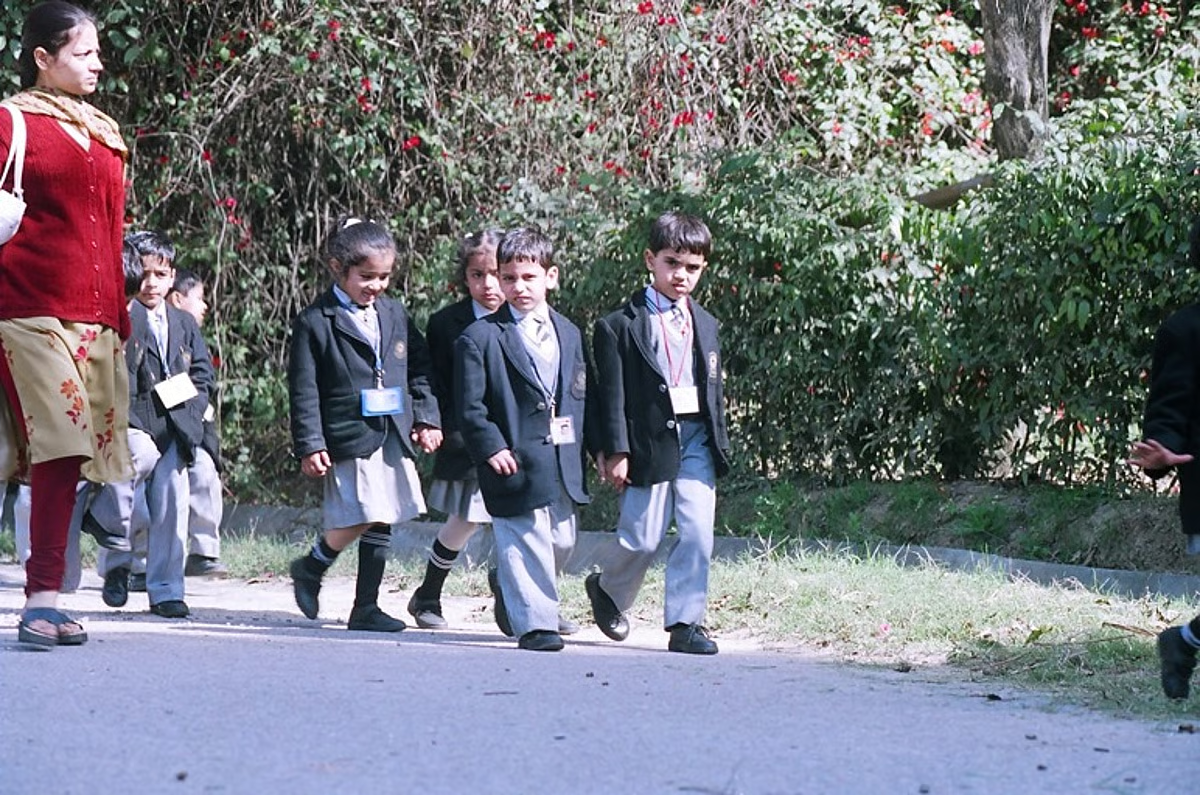
The school uniform concept evolved in India during the late 19th and 20th centuries during the British rule. The idea was to create equality and order among children from diverse backgrounds.
After independence in 1947, the school uniform notion was followed both in government and private schools. By 1980s, wearing uniform was the standardised practice in all Indian schools.
With the rising number of private schools in rural and urban areas, the sale of uniforms is becoming a profitable business. The global school uniform market is a major segment of the apparel industry, valued at arond $18.9 billion in 2024, with a projected increase to $33.1 billion by 2034 at a compound annual growth rate of 5.8 per cent.
This data clearly indicates the market size of school uniform production, which is absolutely based on “take-make-dispose model” — a linear economy model that results in large-scale school uniform waste ending up in landfills, depleting the resources and causing environmental degradation.
There is a growing popularity towards circular economy (CE) owing to financial and environmental benefits. India generates an estimated 7.8 million tonnes of textile waste annually, including school uniforms. This is higher than the weight of the Giza pyramid (5.9 million tonnes).
India has 246 million school-going children and if all of them just threw away one school shirt a year that would equate to 31,980 tonnes of non-wearable school shirts. Synthetic materials like polyester are used to make school uniforms. While polyester’s durability makes it an ideal choice for school uniforms, making 1 kg of polyester fabric requires 62 litres of water, 153 kilogramme of petroleum and 217 megajoules of energy, and releases 21 kg of carbon dioxide into the atmosphere.
Thus, instead of throwing away school uniforms produced in such resource-intensive processes, they must be kept in a circular loop, enabling reuse, extending its lifecycle and minimising waste.
However, the purchase of uniforms is made mandatory in most Indian schools every year, citing discipline, fresh uniform look or some minor logo changes, causing financial burden on parents and environmental degradation. While CE and recycling concept are gaining popularity in apparel and electronics industries, that is completely absent in school uniform businesses.
The central board of secondary education (CBSE) must come forward and ask schools, especially private ones, to work together on sustainable practices like CE and recycling of school uniforms. By focusing on the United Nations-mandated Sustainable Developmental Goal 12, schools need to prioritise sustainable consumption, waste reduction and rethink culture enabling reuse and repair items.
Plausible solutions for schools from a parent’s perspective include:
• Encouraging vendors to provide good quality uniforms: Using good quality polyester to make uniforms that can last three years without fading.
• Avoid logo changes: Make changes to the school logo, pattern or colour only if absolutely necessary, do not use them to push the uniform sales / business.
• Implement new innovation strategy in school uniform making: Use models like “the uniform that grows with the child” similar to SHE (style her empowered) implemented in Africa, for all genders. Provide enough margins on the shirts, skirts, pants, blazers, jackets and also in sports uniforms.
• Avoid logo on blazers / jackets, use same colours irrespective of schools: With lifestyle changes, children are reluctant to wear school jackets / blazers outside school premises due to presence of school logo. Similar to colour-coding adopted for school buses irrespective of schools, a specific colour code for jacket / blazers is necessary to encourage its use. This is an important measure because with global warming, blazers / jacket are hardly used but are thrown away year after year.
• Reuse: There is a growing awareness among citizens about sustainability and good environmental practices. However, to make reuse of school uniforms, it’s necessary to shift-away from school-specific uniforms. All the private schools must have same type of uniforms, and children can use unique lanyards with school name and identity cards. Enabling and promoting platforms similar to Kidkit to buy second hand school uniforms would be a great imitative too.
• Recycling: Recycle of school uniforms is possible; however, India lacks the capacity to handle post-consumer textile waste. Sorting textile waste by hand is labour intensive and time consuming, sorting needed to separate based on colour and material. Currently only Panipat and Tirupur recycle textile waste. With increasing consumerism and fast fashion, these facilities are overflowing with textile waste. This clearly shows that textile recycling is challenging and must be considered only as a last option.
If the above suggestions are considered by CBSE and schools across the country, not only will it directly reduce our carbon footprint but also educate young children about the planetary crisis and depletion of resources.