Railway fossil fuels once helped to turn King’s Cross and St Pancras into a seamy, smoke-choked area of London. Now, in the two grandly redeveloped stations with their swanky plazas, even a dropped paper ticket would look out of place.
One last corner of St Pancras station is polluted by the fug of diesel trains – but not for much longer. East Midlands Railway, which runs services to cities including Derby and Sheffield, will fire up its diesel units in London for the final time by the end of 2026.
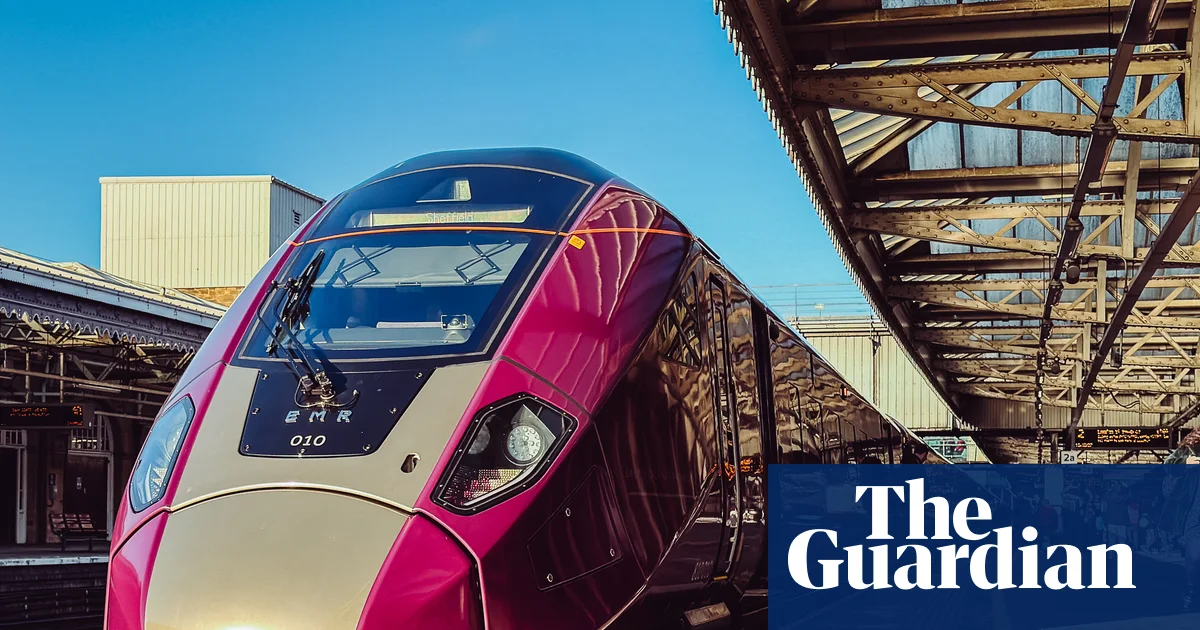
It is a milestone moment for St Pancras – albeit one that has arrived later and with more difficulty than many had hoped. EMR’s fleet of cleaner Aurora trains, built by Hitachi, has arrived years behind schedule – and parallel engineering works to fully electrify the track they will run on, the Midland main line, have been scaled back.
According to Will Rogers, the managing director of EMR, the Aurora trains “are going to make a step-change at St Pancras. It’s very noticeable in terms of noise and emissions.”
The fleet is by necessity bi-mode: running on electricity in the south before switching back to diesel farther north. Where the trains can run on electricity – up until just south of Leicester – the carbon emissions can be cut by 66%, Rogers says.
On such environmental considerations, rail travel largely beats most other mechanised transport: consuming less energy for each passenger than cars, far superior to the plane in its carbon footprint, and – in many places – pumping out fewer noxious fumes.
That comparative advantage does not make it completely green. About 70% of Great Britain’s passenger train rolling stock is electric, and about 8% bi-mode; but only 39% of the entire route length of the railway is electrified – concentrated in the more populous south-east of England, where the majority of train journeys occur.
According to the Rail Delivery Group’s own emissions calculator, the vast majority of journeys – about 94% – are greener for each passenger by rail than by a petrol car (based on an average car occupancy of 1.6 people). But the equation tips where a battery-powered car meets a diesel train.
Electrification of the railway has long been the lodestar for government and industry, but the cost and delivery of recent works has given policymakers pause. The Great Western main line electrification was eventually concluded in 2020, with key sections truncated, having run years late and tripled the budget.
That kind of risk perhaps does not sit well with a government set on balancing the books – but many were still surprised and dismayed when the Midland main line electrification was halted south of Leicester last year.
Rogers is diplomatic: “There’s clearly difficult choices, but we’d welcome any more electrification.” The new EMR trains had a £400m price tag, “and if you combine it with £1.5bn on the main line electrification, it’s a massive investment”.
Electrification work continues elsewhere, notably on the TransPennine route east of Manchester and almost completed on the South Wales Metro. But, for now, Leicester and Derby, the nominated home of Great British Railways, will, like Bristol on Great Western, suffer the frustration of brand new main-line trains running on diesel in their city centres, having made it most of the way from London on electricity.
The dieselgate scandal and London’s Ulez highlighted the health risk of diesel’s nitrogen oxide (NOx) emissions from cars. But the immediate NOx exposure on the worst trains – for passengers as well as those waiting in stations, as research from the Rail Safety and Standards Board has shown – could exceed that from air pollution on a busy road.
In London, most main line stations have eliminated diesel; at Euston, Avanti’s transition to fully electric completed a year ago, with a few bi-modes that switch to diesel at Crewe, 145 miles later, for tracks into north Wales. A handful of diesel trains run out of Waterloo for branch lines, and King’s Cross, for the 10 daily services run by Grand Central, whose order for tri-mode hybrid trains will eventually mean its small fleet runs only on electricity in the capital.
The big outlier is London Marylebone, unelectrified, and its lines out through the Chilterns sufficiently hemmed in by ageing infrastructure, bridges and tunnels to make full electrification prohibitively costly, if not impossible.
A solution for Chiltern, seen in south Wales and with similar potential for Northern’s network and the future East West Rail project linking Oxford and Cambridge, is a combined approach: selective track upgrades in accessible places allied to new train technology. Network Rail’s route director, Denise Wetton, says: “We’re looking at battery-hybrid trains and partial electrification all the way to Birmingham.”
The potential for fast-charge technology was demonstrated by a GWR test, which took a train on a world-record 200 miles on a single charge this summer. “It was a bit of fun,” says Simon Green, GWR’s engineering director, “but it also underlined a serious point: investment in battery technology is essential as we look to replace our ageing diesel fleet.”
Overhead lines are best, he says, but batteries could now bridge the gaps where the wires prove too hard or costly to install. For GWR trains, running out to the far south-west of England and Wales, those stretches could mean about 60 miles between charges. The test was, Green says, “clear evidence that this is a viable and exciting solution for the future of our railway”.
Chiltern’s MD, Richard Allan, says he thinks there will be a “compelling case” for the better technology. For now, the line will be introducing a new fleet of more efficient diesels, and also mitigating the train’s emissions by using increasing proportions of hydrotreated vegetable oil – or recycled chip fat – from 7% to 20% of the fuel used.
As EMR shows, new or better trains can take many years to order, build, test and bring into service. But it may still upgrade rail travel faster than some solutions, as commuters in the Chilterns can testify. Looking out from a new Chiltern train to High Wycombe at the scars of ongoing high-speed rail construction, Allan remarks: “They’ve had to watch HS2 being built – now they have some benefit locally too.”
Meanwhile, the Department for Transport is working with Network Rail to develop an updated electrification plan – as well as a new rolling stock strategy. The past ambition to clear all diesels from the railway by 2040 is under review.
A spokesperson said: “We are committed to electrifying and decarbonising our railway, and our approach will focus on the most cost-effective schemes that make the greatest difference as quickly as possible.”
The better trains on their way
East Midlands Railway
The £490m new fleet of Hitachi-built Aurora trains has arrived three years late – but passengers on the intercity route linking Derby, Leicester, Sheffield and Nottingham to the capital will have more seats and space, as well as a smoother, quieter ride. Wheelchair users will ride in first class. And special, German-made glass promises to allow mobile phones and data to reach into the carriages, improving notoriously patchy connectivity.
Chiltern Railway
The new fleet of 13 Mark V trains, handed over nearly new from TransPennine Express, may not be electric but are certainly less shabby than some of the 50-year-old trains they are replacing. They will bring an extra 10,000 seats a week, as well as the kind of things familiar to other passengers for years: wifi, air-conditioning and accessible toilets.
Piccadilly Line
Already electrified, but the Tube line’s new fleet, which is made of lighter material and is more energy efficient, should consume 20% less electricity in service, according to Transport for London. Most passengers will be more excited about the greater headroom, air conditioning and walk-through carriages. The trains are expected to come into service between late summer and December.