
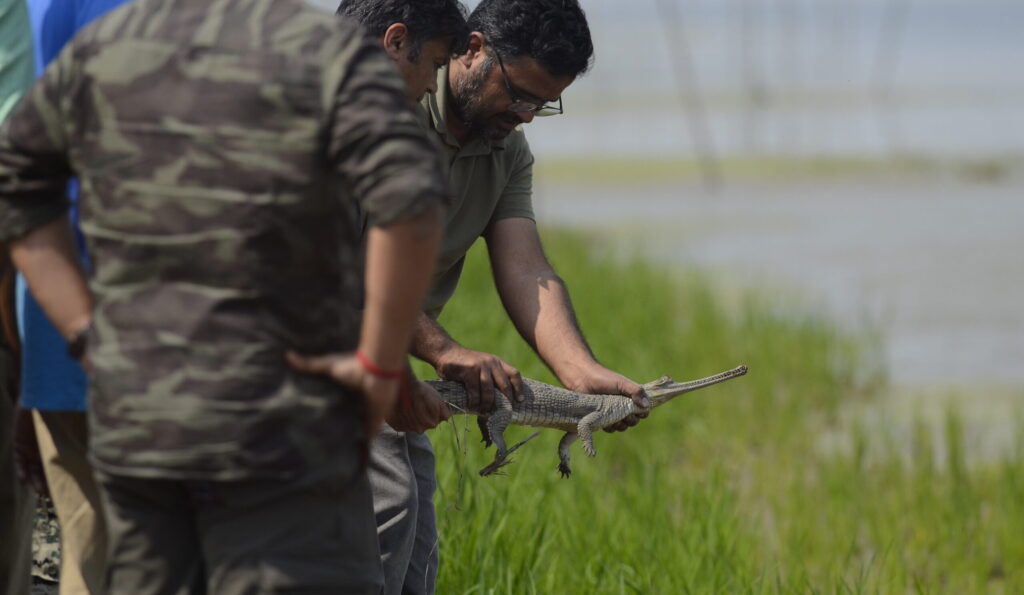
- In early 2024, thirty-seven captive-bred juvenile gharials were released into the Ganga in West Bengal, marking a return to a historic range.
- Commenting on a recent report that outlines this effort, scientists and experts say that the project ignores the challenges and decades of reintroduction efforts across India have previously failed to create new breeding populations.
- Conservation success hinges on protecting intact river habitats by curbing sand mining and river modification while engaging local communities and preventing gharials from being trapped in fishing nets.
In February 2024, 37 juvenile gharials (Gavialis gangeticus) were transported 550 kilometres from the Rasikbeel Mini Zoo to the banks of the Ganga River in Murshidabad, West Bengal.
The gharials, which were born out of a captive breeding programme in late 2021, were sheltered individually in ventilated PVC pipes. During the 15-hour overnight trip, forest staff sprinkled the animals with water every one to two hours to maintain hydration. For the species, it was a return to a historic home. For the conservationists present, it was a moment of “quiet satisfaction”, Shahnawaz Khan, the Lead for Aquatic Habitats at WWF-India, said in an email response to Mongabay-India.
Khan recalls that there was concern about the animals’ condition after the long journey and the team watched with relief as the gharials, “observed to be alert, responsive, and in good health”, paused briefly before crawling into the river.
The reintroduction project was a coordinated effort between the West Bengal Forest Directorate and WWF-India. A recent report, published in the journal Reptiles & Amphibians, outlines the project aimed at enhancing the likelihood of long-term survival of the gharials in the lower Ganga Basin.
The gharial’s population has significantly declined over the years due to loss from water impoundment, sand mining, hunting, and intensive fishing. Only about 650 adult gharials remain in the wild.
Declining population
Gharials have long and thin scutes (scales), unlike the broader ones that crocodiles have. An adult male can be as long as seven metres in length, and females remain around four to five metres.
Historically, gharials have been found in Pakistan, India, Bhutan, Bangladesh, Nepal, and Myanmar. Currently they are found only in Bangladesh, Nepal, and India. In India’s West Bengal, gharials were recorded from the Ganga and Brahmaputra River systems until the mid-20th century, after which the species declined rapidly and became locally extinct due to intense river modification (dams, barrages, and other structures that impact the water flow), unsustainable fishing practices, and human disturbance.
Globally, the gharial population has declined by more than 94% since the 1950s due to similar pressures, placing the species in the critically endangered category on the International Union for Conservation of Nature (IUCN) Red List.
Approximately 77% to 80% of the global adult gharial population is confined to a single river, the Chambal in Rajasthan, Madhya Pradesh, and Uttar Pradesh, in the west and central parts of India.
Concentrating crocodiles in one area makes the entire species vulnerable to threats.
As Khan points out, a mass mortality event in 2007-2008 in the Chambal highlighted the species’ extreme vulnerability. In the mortality event, over 100 gharials, mostly from a 40-km stretch of the lower Chambal, died of kidney failure, likely from an unidentified toxicant, the field investigation report stated.
“One disease outbreak or major infrastructure project could threaten most of the species,” Tarun Nair, a member of the IUCN Crocodile Specialist Group, and not part of the reintroduction project, said.

Experts raise doubts about reintroduction
While the reintroduction can be a vital step in decentralising a ‘critically endangered’ population, so that they are not all limited to one specific site and hence the same risks, some experts argue the endeavour ignores the challenges of fifty years of reintroduction projects across India by central and state governments and other non-governmental organisations.
At the same time, experts say gharial conservation efforts must consider habitat conservation as well and address the pressures on the river itself, including sand mining, dam construction, sewage discharge, and abandoned fishing nets.
Commenting on the reintroduction process outlined in the recent report, experts who have also worked with gharial conservation in India have expressed skepticism about the success of such initiatives, especially in Murshidabad’s stretch of the Ganga river where the reintroduction took place.
Gharials take almost a decade (sometimes two) to reach sexual maturity. The ultimate benchmark for success is not survival, but a “self-sustaining, breeding population”, said Nair of the IUCN Crocodile Specialist Group. He added that between the late 1970s and today, India has released between 10,000 and 12,000 gharials, with “almost nothing to suggest that it has succeeded” in establishing new breeding populations.
Jailabdeen A., Director of the Gharial Ecology Project under the Madras Crocodile Bank Trust, who was also not involved in this reintroduction process, points out that in reptiles, natural survival rates for hatchlings are often less than 1%. Releasing only 37 individuals in a single event — as was done in the WWF reintroduction project — is, in his view, an insufficient number to guarantee a viable population.
Jeffrey W. Lang, Emeritus Professor at the University of North Dakota, and Senior Scientific Advisor and mentor to the Gharial Ecology Project in India, explained that, on a conservative estimate, almost ₹100,000, sometimes ₹2-3 lakh, are spent per captive-bred gharial on capturing and breeding before releasing the gharials. With limited money, we need to see what we can learn from our previous programs, he says, adding, “It is essential that extensive and long-term post-release monitoring be incorporated as a critical component of such attempts.”
“Trying [reintroduction projects] is fine, but conservation right now should focus on habitat protection. About 80% of the gharial population is in Chambal, which is under threat from sand mining. If we can’t protect that, reintroduction elsewhere won’t help,” said Jailabdeen.

Site selection
As part of the reintroduction project, conducted a habitat suitability assessment. Khan said the Ganga–Brahmaputra landscape, with its free-flowing rivers, suitable sandbanks, and historic range, was found appropriate for reintroducing gharials.
The team identified the Tiktikpada’s braided channel to provide a “calm environment” for the release of the gharial juveniles.
Jailabdeen, however, criticised the habitat assessment, saying such an assessment needs to be more indepth.
“The recent releases described in the West Bengal reintroduction study have virtually no chance of really being successful given the current habitat suitability (as assessed by WWF India and the forest department for the project),” said Lang.
He cited the recent green status assessment of the IUCN red list, which states that the Lower Ganges and Delta are not suitable for sustaining gharial populations. The assessment has identified, “the six populations of gharial that showed some evidence of breeding, and 14 localities where gharial have previously been abundant, but are now marginal populations and/or transient occurrences, and the lower Ganga is one of these latter sites,” said Lang.
Pointing to ecological variation along the river, he added that the Hooghly belt of the Ganga is “most definitely” unsuitable.
However, “our assessment found Murshidabad suitable,” Pradip Bauri, IFS, Divisional Forest Officer, Bankura South Division, West Bengal, said. “Dolphins have thrived in the same river, with the same [anthropogenic] pressures.”
Proximity to border
Experts not associated with the study have raised that the release site of the WWF reintroduction project is along the international border with Bangladesh, where the Border Security Force (BSF) regulates activity. Monitoring would be difficult here, as Tarun notes, this could “raise suspicions across the border”, because of the movement of people.
Jailabdeen said, “If gharials are washed into Bangladesh during a monsoon, as happened in Punjab’s Beas River, bringing them back becomes a diplomatic and logistical nightmare.”
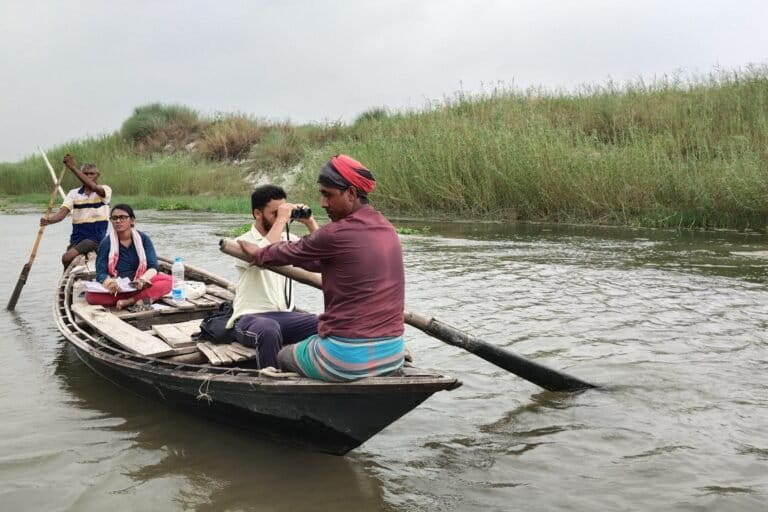
Khan looks at this challenge as an opportunity for enhanced cross-border coordination. “While traditional tracking across borders is not feasible, this situation creates a constructive opportunity to employ advanced technology, such as satellite telemetry,” he says. Currently this technology is not being used in monitoring and the team has done bi-directional monitoring through the boat.

Sand-mining, fishing, and ghost nets
Fishing nets and sand mining are some of the other threats to the reintroduced gharials at this site, say both Nair and Jailabdeen.
Within the first 15 days of the West Bengal release, three gharials became entangled in abandoned fishing nets and drowned. The Forest Directorate quickly removed 150 kg of these nets. “It’s good that they’re doing post-release monitoring, which many programs don’t do, but ideally this should have happened beforehand,” Nair said.
The reintroduction project team had noted that river-dependent communities, which have not seen gharials, need to be engaged. In their awareness programs, Khan said, “initial reactions were often rooted in fear, as many residents confused the slender-snouted gharial with the more aggressive marsh crocodile (mugger). Once the team explained that gharials are specialized fish-eaters and generally shy around humans, the response shifted toward curiosity and support.”
“Captive-reared gharial, having been fed dead fish… attempt to feed on fish caught in the netting, and get caught themselves, and quickly drown in most instances,” Lang explained. “Unless they [fisherfolks] agreed to no longer net fish in the release area, the net fishing would continue, with tragic consequences for the released gharial.”
The experts Mongabay-India spoke to also critique the “captive-bred” nature of the animals. Juveniles raised in tanks and fed dead fish often lack the musculature to survive fast-flowing currents and the instinct to hunt live prey. Furthermore, captive-raised gharials frequently exhibit atypical behaviour, such as approaching humans for food rather than being shy, which makes them vulnerable to predators, they say.
Both Nair and Jailabdeen suggest a “soft release” approach: keeping animals in enclosed ponds connected to the river to let them acclimatise and develop a “sense of place” before full release.
However, Bauri of the West Bengal Forest Department, said, “Soft release is generally done when animals are rescued.”
“These were healthy, captive-bred juveniles, about one-year-old. They were transported overnight and released immediately,” he said, referring to the reintroduction.
He added that although the gharials were released into a stream of the Ganga, which, in effect, functioned as a soft release, the logistics did not allow for a formal soft release, as there was no forest staff stationed nearby and the release site lay outside the protected area.
Read more: Rising temperatures could change the future for India’s gharials
Banner image: Mohd Shahnawaz Khan releases a juvenile gharial in Murshidabad, West Bengal. Image courtesy of Mohd Shahnawaz Khan/WWF-India.

