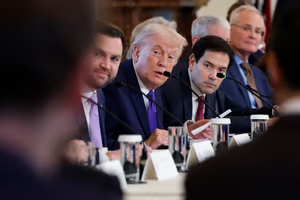
President Donald Trump gathered with chief executives from U.S. and European oil companies on Friday to drum up private-sector cash for his plans to salvage Venezuela’s devastated oil sector and exploit its reserves. They’re not buying what he’s selling so far.
Executives from Chevron, ExxonMobile, ConocoPhillips, Continental Resources were among the 14 oil multinationals at the White House meeting. European companies such as Repsol, Shell, and Eni were also in attendance. The meeting represented the latest chapter in Trump’s open-ended and deadly intervention in Venezuela, a South American nation he’s said he wants to control for years.
Trump kicked off the meeting by announcing the interim Venezuelan government handed over 30 million oil barrels to the U.S. on Thursday, an amount equivalent to a month of production.
“The departure of Maduro makes possible an incredible future for both nations, Venezuela and the United States, in which we will more closely integrate the economies of two major energy powers in the Western Hemisphere,” Trump said at the public portion of the gathering. Other cabinet officials such as Secretary of State Marco Rubio, Vice President J.D. Vance, and Energy Secretary Chris Wright attended as well.
Trump views enlisting the support of oil companies as the central element in his effort to rebuild Venezuela’s ailing economy. Yet one after another, most oil CEOs gave carefully-scripted remarks stopping well-short of committing to a spending binge to re-establish a presence in Venezuela, where a socialist government with a prior history of confiscating private assets is still in power.
ExxonMobile CEO Darren Woods delivered the most blunt assessment. “If we look at the legal and commercial constructs and frameworks in place today in Venezuela, it’s uninvestable,” Woods said. “So significant changes have to be made to those commercial frameworks [and] the legal system.”
Woods added that ExxonMobil exited the country nearly two decades ago when a prior Venezuelan government under Hugo Chávez nationalized oil projects. “We’ve had our assets there seized twice.”
He said the company was prepared to send “a technical team” within weeks to assess the state of Venezuela’s oil pipelines and more. ExxonMobil contends that it still has $12 billion in outstanding debt from the Venezuelan government.
Chevron is the only major U.S. oil company still operating in Venezuela under a special license granted by the U.S. government, given the sanctions imposed. Chevron Vice Chair Mike Nelson wasn’t any more enthusiastic about expanding operations in the current landscape.
“Chevron has been a part of Venezuela’s past,” Nelson said. “We are certainly committed to its present, and we very much look forward as a proud American company to help it build a better future.”
After the U.S. military raid that toppled Venezuelan leader Nicolás Maduro from power, the Trump administration gradually stepped up its authority over Caracas in the past week. The moves included the U.S. asserting control of its oil sales indefinitely and engineering a handover of a month’s worth of Venezuela’s oil production. A U.S. naval armada remains off the coast, blockading the country.
Trump said he was willing to provide security guarantees for the oil companies. He didn’t specify whether that would include deploying U.S. boots on the ground to protect future oil sites. He did make one item clear though.
“If you don’t want to go in, just let me know because I’ve got 25 people that aren’t here today who are willing to take your place,” Trump said.