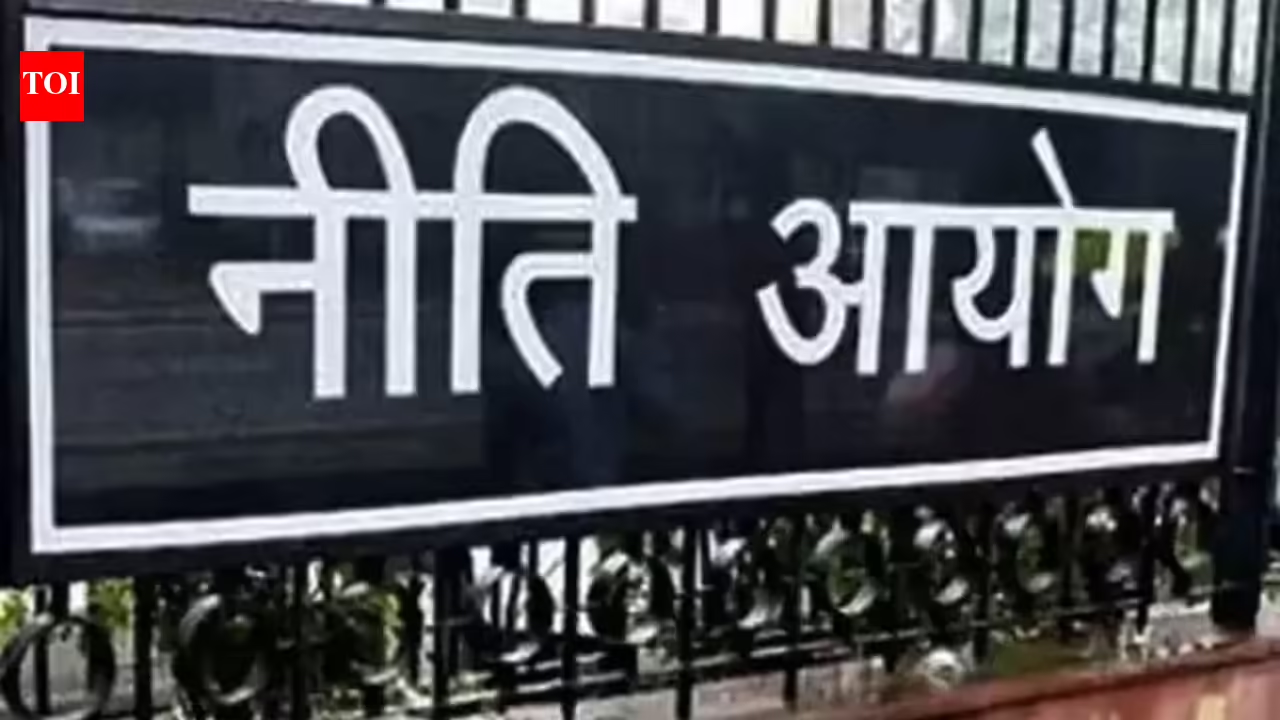
NEW DELHI: Govt think tank, Niti Aayog, on Wednesday released roadmaps for decarbonisation of aluminium, cement and micro, small, and medium enterprises (MSME) sectors, aimed at guiding the country towards a net-zero emission future through sustainable processes.The move comes in the backdrop of the country’s climate action commitments under the Paris Agreement and the govt’s recent decision to set greenhouse gas (GHG) emission intensity reduction targets of traditionally high-emitting sectors including aluminium, cement, petrochemical and textile to meet specific reduction goals by 2026-27 compared to a 2023-24 baseline.“These roadmaps will not only help these sectors reach their emission intensity reduction targets but also contribute immensely towards achieving India’s net-zero goal (carbon neutrality) of 2070,” said an official in the environment ministry.B V R Subrahmanyam, CEO, NITI Aayog, while releasing these roadmaps, emphasized that these roadmaps would serve as reference manuals for India to achieve its unique goal of becoming a developed country as well as decarbonising the industry simultaneously. Globally, cement production is a significant source of carbon emissions. In 2023, cement manufacturing contributed roughly 2.4 GtCO2e emissions worldwide. India’s production of cement resulted in roughly 246 MtCO2e of emissions which was around 6% of national GHG emissions.Similarly, production of aluminium accounted for about 2.8% of India’s total GHG emissions in 2023. The country’s domestic demand for aluminium is projected to increase sharply from 4 million tonnes in 2023 to over 37 million tonnes by 2070, almost three times the projected global growth rate.MSMEs, which have over 36% share in manufacturing, too rely heavily on fossil fuels to meet their energy and process requirements, resulting in approximately 135 million tonnes of carbon emissions (MtCO2e) in 2022 alone.Keeping this in view, the roadmaps for the cement, aluminium and MSMEs sectors are intended as practical planning tools, outlining how each sector can move step by step toward more sustainable, lower-carbon modes of production. It carries various recommendations and solutions which help decarbonise these sectors.“The move will also help India navigate through the European Union’s carbon border tax on GHG intensive (emission generated during production) goods such as aluminium and cement by reducing carbon footprints in the manufacturing processes of these sectors,” said the official.EU’s carbon border tax – Carbon Border Adjustment Mechanism (CBAM) – is a tool to put a price through imposing border tax on such goods that are entering the 27 EU nations. If India does not take steps to decarbonise these sectors, they will attract a tariff burden on such products and impact the country’s exports.Under the decarbonisation strategy, the cement sector will reduce its carbon intensity from 0.63 tCO₂e per tonne of cement to approximately 0.09-0.13 tCO₂e per tonne by 2070. The roadmap for the sector proposes to prioritize the use of refuse-derived fuels, clinker substitution, scaling up of Carbon Capture, Utilisation and Storage (CCUS) and effective implementation of carbon credit trading scheme to enable deep decarbonisation in this sector.The decarbonisation roadmap for aluminium sector identifies three phased solutions – transition to renewable energy-round the clock (RE-RTC) power and enhanced grid connectivity in the short term, adoption of nuclear power in the medium term, and long-term integration of CCUS.The roadmap for green transition of MSMEs focuses on three key levers: deployment of energy-efficient equipment, adoption of alternative fuels, and integration of green electricity.Observing that MSMEs are important members of domestic and international supply chains, Suman Bery, vice chairperson, NITI Aayog, urged prioritizing technology adoption, access to affordable finance, skilling & regulatory reforms, and increased participation of female workforce to achieve overall competitiveness of the sector.
Eyeing net zero future, Niti Aayog releases roadmaps for decarbonisation of aluminium, cement, MSME sectors | India News
 1769014906 photo.jpg
Thank you for reading this post, don't forget to subscribe!