NEWYou can now listen to Fox News articles!
For years, air taxis felt like one of those “almost here” technologies. You have seen the sleek designs. You have heard the promises. Quiet flights. Lower costs. No traffic. And yet, nothing.
Now, that might actually change. A new federal push could put electric air taxis in the sky as early as this summer. Not everywhere. Not at full scale. But in enough places to make this real for the first time. This is the first program of its kind designed to bring air taxis into everyday U.S. airspace.
Sign up for my FREE CyberGuy Report
Get my best tech tips, urgent security alerts, and exclusive deals delivered straight to your inbox. Plus, you’ll get instant access to my Ultimate Scam Survival Guide — free when you join my CYBERGUY.COM newsletter.
Joby’s long-tested aircraft is nearing final FAA approval and could be among the first to carry passengers in U.S. air taxi services. (Joby Aviation)
What exactly is an air taxi?
An air taxi, also called an eVTOL, is a small electric aircraft that can take off and land vertically. Think helicopter without the noise and cost. These aircraft are designed to move people short distances across cities or regions. You could skip traffic entirely and fly from one part of a city to another in minutes.
The pitch is simple:
- Faster than driving
- Cheaper than helicopters
- Cleaner than traditional aircraft.
It sounds great. But getting there has been anything but simple.
Why air taxis are still waiting on FAA approval
The biggest hurdle has not been technology. It has been regulation. The FAA requires commercial aircraft to meet extremely high safety standards. We are talking about failure rates closer to commercial airlines than cars.
That creates a problem. Traditional aircraft follow well-known designs. eVTOLs are completely new. They take off vertically, then transition into forward flight. That adds complexity and risk.
Companies like Joby Aviation, Archer Aviation and others have spent years testing. Some have logged thousands of flights. Still, full approval has remained just out of reach.
How the FAA is fast-tracking air taxis in the U.S.
Now comes a major shift. The government has launched a new initiative called the eVTOL Integration Pilot Program. The goal is to speed things up without lowering safety standards.
Instead of waiting for full nationwide approval, companies can begin limited operations in specific areas. This rollout breaks from the old all-or-nothing approval model. Instead of waiting years for full certification, companies can now prove safety in real-world conditions and expand from there.
Eight pilot programs have been approved across the country, including:
- New York and New Jersey, with flights from Manhattan heliports
- Texas connecting cities like Dallas, Austin and San Antonio
- Florida testing passenger flights, cargo and medical use
- North Carolina and Virginia are exploring autonomous operations.
PRIVATE AUTONOMOUS PODS COULD REDEFINE RIDE-SHARING
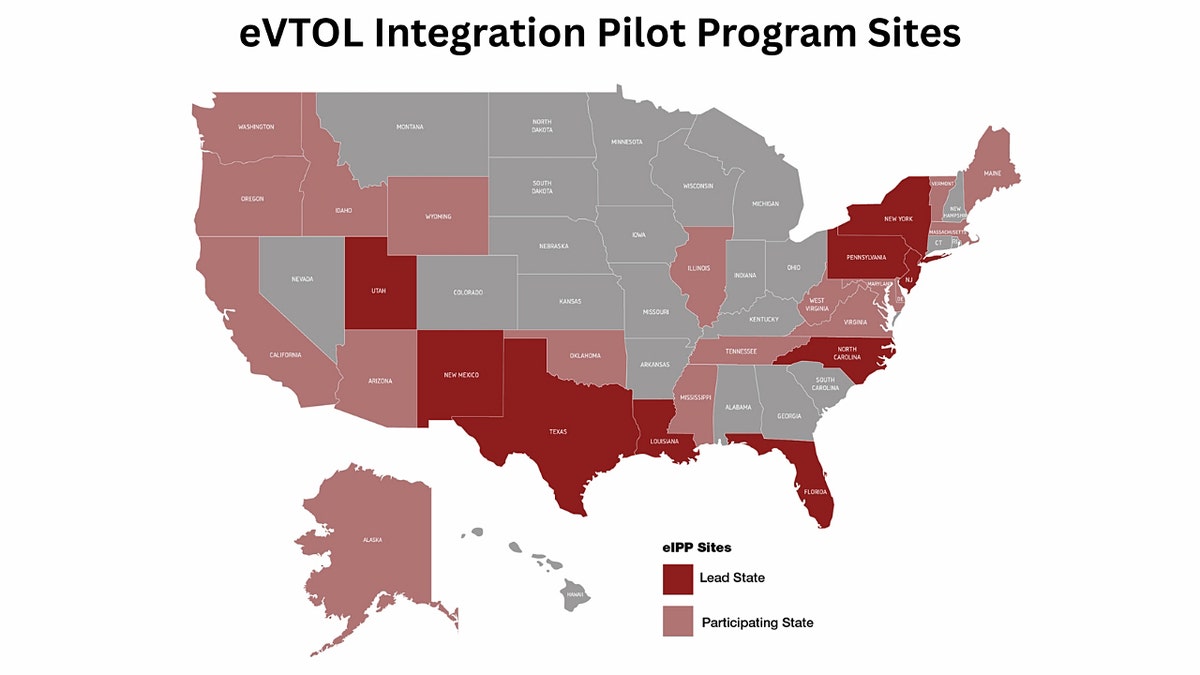
eVTOL Integration Pilot Program sites. (U.S. Department of Transportation)
These pilot programs span 26 states, creating one of the largest real-world test environments for next-generation aircraft. These aircraft will not just carry passengers. They will support cargo delivery, emergency medical response and regional transportation. Data from these pilot programs will help the FAA create new rules to safely expand air taxi use nationwide. That last part matters more than it seems.
“This is the clearest sign yet from the White House, the FAA and the DOT that bringing air taxis to market in the United States is a real priority,” said Adam Goldstein, founder and CEO of Archer. “We appreciate Secretary Duffy and Administrator Bedford’s leadership and are excited to bring Midnight to the skies of some of America’s largest cities.”
Why air taxis are part of a U.S. vs China aviation race
This push is not only about getting you across town faster. It is also about keeping up. China has already moved ahead in drones and air mobility. Companies there have been running real commercial passenger flights since 2023.
Meanwhile, drones have changed modern warfare and logistics. They are cheap, effective and scalable. The U.S. wants to lead again. That means accelerating innovation across civilian and military systems. Air taxis are one piece of that bigger strategy.
The autonomy factor no one is talking about enough
Here is where things get even more interesting. Many of these aircraft are designed to become autonomous. At first, you will likely see pilots on board. But long-term, the goal is to remove them. Why? Pilots add weight. They increase the cost. They limit scalability.
Companies are already testing highly automated systems that can handle complex flight decisions in real time. That means the version of air taxis you see in the next few years may not be the final version.
What this means for you
This is where it gets real. Air taxis will not replace your car overnight. But they could start changing how you think about getting around. Here is how it could impact you:
Shorter commutes in crowded cities
If you live near a major metro area, you may soon have a new option that cuts travel time dramatically.
Faster emergency response
Medical flights and disaster response could become quicker and more efficient.
New pricing models for travel
At first, rides may feel premium. Over time, prices could drop closer to rideshare levels.
More automation in transportation
If air taxis go autonomous, it signals a bigger shift across all forms of travel.
New safety questions
Faster rollout means regulators and companies will need to prove these systems are safe in the real world.
NEW YORK HALTS ROBOTAXI EXPANSION PLAN
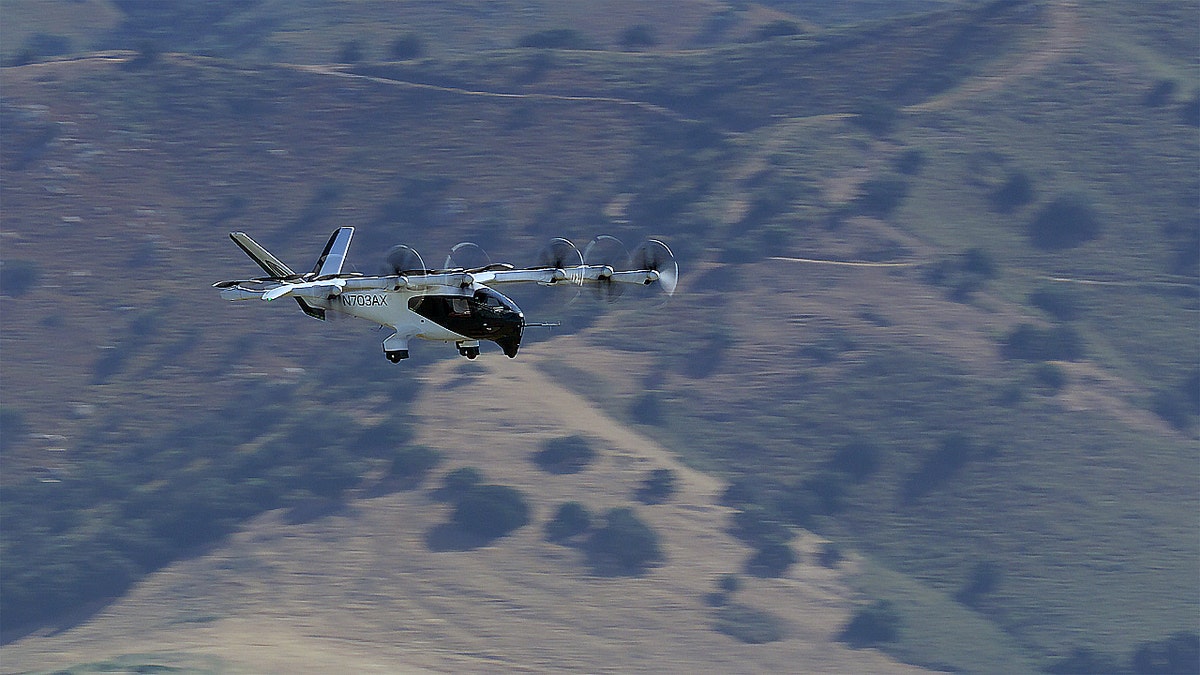
Archer’s aircraft is part of the new FAA pilot program, aiming to launch short city routes that could cut travel times dramatically. (Archer Aviation)
So when will you actually be able to ride one?
The timeline is finally getting clearer. You may start seeing limited operations as early as summer 2026. That does not mean you can open an app and book a flight right away.
Early access will likely focus on:
- Specific routes
- Controlled environments
- Pilot programs with limited passengers.
But once that door opens, expansion tends to move quickly. We saw it with rideshare. We saw it with electric vehicles. This could follow the same path.
“The first time I saw a Waymo on the road in San Francisco, it was a big deal. Now, self-driving cars are just part of everyday life there. I believe the eIPP will do the same thing for air taxis. Every safe flight builds towards public acceptance, and we need to build that acceptance in parallel with our certification efforts,” said Adam Goldstein, CEO of Archer.
Take my quiz: How safe is your online security?
Think your devices and data are truly protected? Take this quick quiz to see where your digital habits stand. From passwords to Wi-Fi settings, you’ll get a personalized breakdown of what you’re doing right and what needs improvement. Take my Quiz here: Cyberguy.com.
Kurt’s key takeaways
Air taxis have lived in the “almost here” category for a long time. Now, they are stepping into reality. There are still real challenges ahead. Safety, cost and infrastructure all need to catch up. But this new approach changes the pace of progress. Instead of waiting for perfection, the industry is moving forward in controlled steps. And once people experience this kind of travel firsthand, expectations will shift fast.
If you could skip traffic and fly across your city in minutes, would you try it… or wait until everyone else goes first? Let us know by writing to us at Cyberguy.com.
CLICK HERE TO DOWNLOAD THE FOX NEWS APP
Sign up for my FREE CyberGuy Report
Get my best tech tips, urgent security alerts, and exclusive deals delivered straight to your inbox. Plus, you’ll get instant access to my Ultimate Scam Survival Guide — free when you join my CYBERGUY.COM newsletter.
Copyright 2026 CyberGuy.com. All rights reserved.