Ethical norms dictate that judges are supposed to speak only through their written opinions, avoiding airing personal views in public. But facing an unprecedented spike in threats of physical violence – as well as public criticism from high-ranking government officials, including President Donald Trump – federal judges are making their own unprecedented appeals to the public.
The U.S. Judicial Conference, a governing body that oversees the federal judiciary, issued an advisory opinion last month making clear that judges can speak in public about issues related to judicial security. Earlier this week, Chief Justice John Roberts called the personal criticism of federal judges “dangerous.”
On Thursday, four active federal judges spoke on the record about the threats they’ve been facing in a forum organized by Speak Up for Justice, a new nonpartisan organization that says it’s been formed to support the justice system. The event came as the judicial branch weathers extreme pressure from critics, often in response to specific rulings, said Beth Bloom, a federal judge in the U.S. District Court for the Southern District of Florida, and a member of the executive committee for Speak Up for Justice.
Why We Wrote This
Federal judges in the United States traditionally express their views only through their written opinions. That stance has shifted recently, amid physical threats and criticism by public officials, including the president.
“Judges are traditionally cautious about speaking publicly. But this moment makes a strong case for why engagement is not only appropriate, but is necessary,” she added.
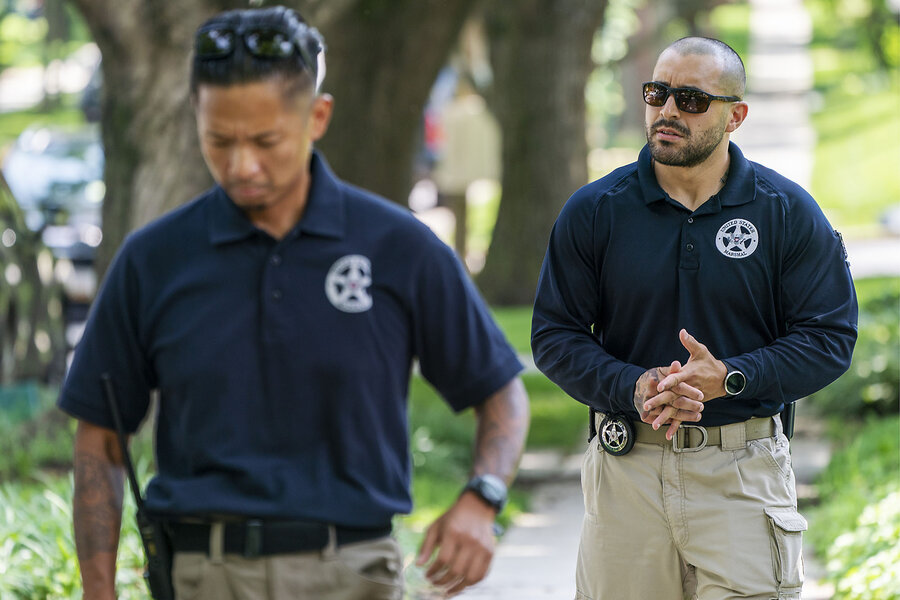
Serious threats to federal judges doubled between 2021 and 2024, according to the U.S. Marshals Service, the agency tasked with protecting federal judges and courthouses. A similar pattern is occurring at the state court level, the Marshals Service noted.
“It’s a matter of course now that when you issue an opinion that some people don’t like, you’re going to get threats and you’re going to get death threats,” said Judge Anna Reyes, a member of the U.S. District Court for the District of Columbia, at Thursday’s virtual event.
In 2020, a former attorney attacked the home of Esther Salas, a federal judge in New Jersey, killing her son and wounding her husband. A state court judge in Wisconsin was killed at his home in a “targeted” attack in 2022. In 2023, a Maryland state court judge was killed in his driveway by a man involved in a divorce proceeding that the judge had been presiding over. An Indiana state judge and his wife were injured in a shooting at their home in January; one of the men arrested in connection with the attack was scheduled to go on trial before the judge two days later.
In addition to physical attacks, hundreds of anonymous pizza deliveries have been sent to the homes of judges and their families, some addressed to Judge Salas’ murdered son, which many judges interpret as a threat.
During Thursday’s forum, Judge Michelle Williams Court, a federal judge in the U.S. District Court for the Central District of California, described a threat she received from someone claiming to know where she lived and where her children went to school. She notified the school and local law enforcement. While she took the threat seriously, she didn’t think anything would actually come of it. Then, one Saturday morning, she looked out her living room window.
“One Saturday morning, I looked out the window in my living room and there were four sheriff’s cars and four people sitting in handcuffs in my driveway,” she said.
The scariest aspect, she added, is that threats seem to be less about specific rulings and more about general political grievances that can arise out of the blue.
Potential attackers think, “‘Well this person was appointed by this person or that person, and I don’t like that decision, so I’m going to do X,’” she continued. “That’s a very dangerous place to be because it’s very unpredictable.”
Judge Reyes has decided many high-profile cases over the past year as a federal judge in Washington. Last month she read out, in open court, some of the death threats she has received, including, “The best way you could help America is to eat a bullet.”

Manuel Balce Ceneta/AP/File
Threats and criticism have not been reserved for lower court judges. U.S. Supreme Court justices have also faced them.
A would-be assassin was arrested near the home of Justice Brett Kavanaugh in 2022. Justice Amy Coney Barrett and her family have also faced threats and intimidation, including a bomb threat sent to her sister.
The judges say that the rise in threats is partially a result of increased public questioning of judges and their decisions. The Trump administration and its allies have routinely criticized judges after they issue adverse rulings. Some Republicans in Congress have called for the impeachment of certain judges because of their rulings.
Last year, as a number of administration policies were stalling in the courts, Republican Rep. Andrew Clyde of Georgia announced a new task force aiming to “unite members in exposing judicial activism, with the ultimate goal of impeaching rogue, activist judges.”
This rhetoric intensified last month after the Supreme Court struck down the Trump administration’s emergency tariffs.
Hours later, Mr. Trump lashed out at two of his own appointees, Justices Barrett and Neil Gorsuch, who had joined the majority. They were “a disgrace to our nation” and “an embarrassment to their families,” he said, adding without evidence that they had been “swayed by foreign interests.”
Speaking at Rice University on Tuesday, Chief Justice Roberts noted that judges’ opinions are fair game for criticism. He warned against crossing the line into character attacks.
“The problem sometimes is that the criticism can move from a focus on legal analysis to personalities,” he said. “Personally directed hostility [toward judges] is dangerous, and it’s got to stop.”