
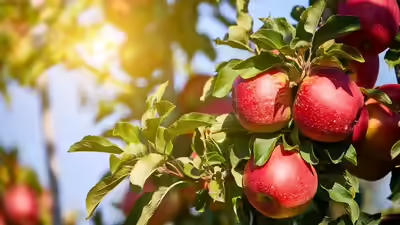
The rolling hills of Himachal Pradesh’s apple belt are typically shrouded in a delicate morning mist during winter, a signal that the season’s chill is settling in. For generations, this cold has served as nature’s guarantee: apples will grow crisp, plentiful, and affordable in the months ahead. But this year, the familiar snow-laden landscape has largely failed to appear. Many orchards are seeing bare branches where frost would normally cling, prompting farmers to resort to unprecedented measures to protect their crops. Farmers in several villages have turned on sprinklers and foggers to coat apple tree branches with a thin layer of ice, attempting to replicate the natural winter chill that is missing. For urban shoppers, this may appear as a curious spectacle, but the implications are profound: the approach adopted by farmers today could directly influence how many apples make it to markets and the price we pay.
Understanding why apples need winter chill
Apple trees, unlike other plants, need dormancy in winter. Apple tree dormancy is not merely waiting for time to pass or for winter to come and go. Apple tree dormancy is essential and plays a crucial role in making it healthy and productive. Apple tree dormancy is characterised by certain biochemical reactions in an apple tree. This phenomenon involves the notion of “chilling hours.” These refer to hours that contain temperatures ranging between 0° and 7°. This allows the tree to experience dormancy, thus suppressing growth as internal hormonal levels control the time for flushing buds. The role here involves Abscisic Acid (ABA), whose aim is for growth inhibition in the initial stage, and Gibberellic Acid (GA), whose purpose in the latter stage involves awakening and blooming. The balance will not work properly without sufficient hours of chilling. The flowers may not develop in an equal manner. The production of the fruit will decrease. The end crop may not be healthy. The traditional occurrence that will provide the trees’ needed cold is snow.
Rise of artificial frosting
Erratic winters have led some farmers to experiment with artificial methods to compensate for missing cold. Sprinklers and foggers are being used to create a thin layer of ice on apple branches, in the hope that it mimics the effect of snow. This practice, however, is controversial. As per reports, this approach may be more harmful than helpful. Farmers who resort to artificial icing are axing their own feet. There is a fundamental misunderstanding about how chilling works. Surface frost is not equivalent to the consistent cold the tree needs internally.
Hidden dangers of artificial frosting on apple trees
The consequences of artificial frosting are not limited to immediate tree damage. When a tree is suddenly exposed to freezing ice instead of steady ambient cold, it experiences shock. Buds may die, flowering may be irregular, and the risk of disease increases. Over time, this can reduce yields significantly and compromise the orchard’s long-term health. The artificial icing to flipping an ON/OFF switch in the tree’s natural biochemical processes. Dormancy is a carefully timed sequence spanning two to three months; interrupting it can have cascading effects on growth, fruit development, and survival through subsequent seasons.