- Crop damage by wild herbivores constitutes a far larger economic burden than carnivore-related conflicts, yet remains under-recognised.
- A study identifies that wild animals do not fear humans anymore and this lack of fear could be driving crop raiding, alongside other factors.
- The loss of fear is linked to long-term hunting bans. While regulated hunting is proposed as a solution, critics argue for non-lethal, behaviour-based mitigation.
Crop damage caused by wild animals, especially smaller species such as spotted deer and wild boar, is a growing but underreported driver of negative human-wildlife interactions in Maharashtra.
An estimation of net agricultural losses from human-wildlife conflict, in the western Indian state, computed by the Gokhale Institute of Politics and Economics in Pune, pegs the loss between ₹100 billion (₹10,000 crore) and ₹400 billion (₹40,000 crore) per year. One of the authors of the report and independent researcher, Milind Watve, says that crop damage from wildlife is a much larger issue than livestock depredation. “Human attacks are qualitatively different, of course, but media attention is largely focused on carnivore conflict. In reality, herbivore-related crop damage is far more significant in economic terms,” he tells Mongabay-India.
In a new paper titled Why wild herbivores raid crops: Alternative hypotheses and their differential implications for the mitigation of human–wildlife conflict, Watve, along with another independent researcher, Sonal Prabhulkar, examines the root causes of crop raiding by wild herbivores. The paper critiques the lack of causal analysis in prior studies and lists alternative hypotheses from diverse sources, evaluating their logic against data and anecdotes.
Four main hypotheses (not mutually exclusive) are analysed in the paper: habitat loss from various causes such as fragmentation, forest degradation and invasive species, acting as push factors; increasing herbivore populations due to conservation success; better nutrition from crop foraging as a pull factor; and a waning fear of humans.
Animals don’t fear humans anymore
The researchers conclude that the main cause of crop depredation is that wild animals lack the fear of humans. This fear, the researchers argue, has rapidly diminished over the last 50 years following the ban on hunting after the Wildlife Protection Act came into effect. “Crops are certainly more nutritious than wild forage, but as long as animals fear humans, crop raiding remains limited and manageable. Farmers have always had to guard their crops, even 100 or 200 years ago, but it was manageable because the animals would retreat at the sight of humans,” Watve elaborates, adding, “Now that the fear has diminished, farmers are unable to manage the situation.”
The study was conducted around the Tadoba-Andhari Tiger Reserve, where farms abutting the forest witness frequent wildlife attacks on humans, livestock, and crops. “Around Tadoba, wild pigs (Sus scrofa) are the most common culprits, followed by chital (Axis axis) and sambar (Rusa unicolor),” says Watve about crop damage. “In outer areas, nilgai are a major problem.”
Villages around Tadoba are also seeing a rising tiger presence, which makes guarding fields at night against wild herbivores risky. “Contrary to textbook expectations that carnivores regulate herbivore populations, the presence of tigers is actually increasing crop damage because farmers are afraid to go out at night,” Watve says.
He adds that while the law mandates compensation for farmers, there is no efficient implementation system. “If compensation were properly delivered, more than 50% of the economic pressure on farmers could be alleviated. Currently, farmers do not receive what they lose.”
Conservation ecologist Aritra Kshettry of WWF-India says that if agricultural loss from wildlife is the issue the study is trying to address, it should first be recognised and defined by agricultural experts. “Instead, ecologists are framing agricultural challenges through a wildlife lens, which may not fully capture the economic and market dimensions of farming,” he says. Agricultural problems, he suggests, need to be understood within an agri-market framework; they are not solely ecological. Kshettry agrees that the burden of wildlife conflict should not fall solely on farmers, adding that any solution must account for shared responsibility, involving state support or compensation mechanisms.

Examining the potential of regulated hunting
The study points to reintroducing some form of regulated hunting to restore fear of humans in wildlife as a potential solution. But there are challenges. “Agreeing in principle that regulated hunting may be necessary, and designing a robust system to regulate it while ensuring there is no corruption or overexploitation, are key challenges,” Watve says. “We do not want to return to pre-1970 conditions. The system must be carefully designed.”
Kshettry, however, finds culling or hunting a disproportionate solution. He says, “The idea of lethal control in wildlife management is largely borrowed from the Global North and is increasingly being replicated in regions like Africa. This approach is rooted in a ‘separation model’ of conservation, where humans and wildlife are treated as distinct and often competing entities.” India has a long history of coexistence with wildlife, making such frameworks misaligned with local socio-ecological realities, he points out.
Rather than resorting to lethal measures, he emphasises the need to explore more humane and innovative conflict mitigation strategies. Behaviour-based deterrents, for instance, could be more effective. These might include repellents that make crops unpalatable or other methods that leverage animal behaviour to reduce crop damage without killing wildlife.
Ecologists alone should not be tasked with solving what is fundamentally an agricultural and economic problem, he says. Agricultural experts and institutions must first acknowledge wildlife-induced losses as a legitimate economic issue. As of now, this recognition is lacking, he points out.
While he acknowledges that existing legal provisions — such as temporarily declaring certain species as vermin — can be used in extreme cases, he cautions that such measures are difficult to implement in India’s ethical and cultural context. “If we are using these measures, they should be restricted to a certain time period and carefully regulated.”
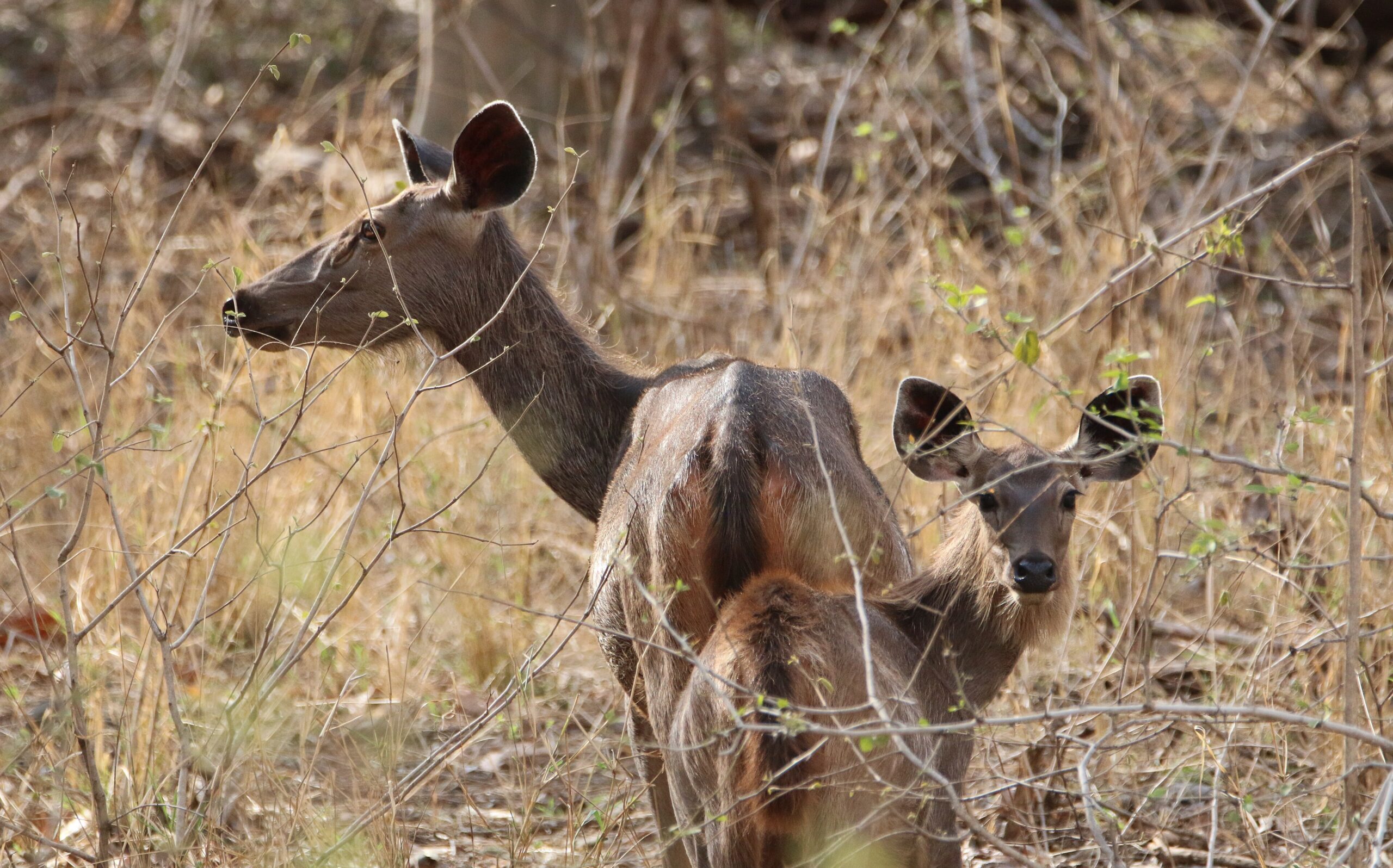
Banner image: Sambar deer in Maharashtra. The recent paper highlights an increase in herbivore populations, better nutrition from crop foraging, and a waning fear of humans as pull factors of crop damage by herbivores in the state. Image by Revati Sarnaik via Wikimedia Commons (CC BY-SA 4.0).