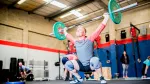
Most squat performance issues don’t show up after unracking the bar—they most likely show up when when you hit “the hole.” That’s when heels pop up, knees cave in, hips shift, and the chest caves. When that happens, lifters often blame themselves. But more often than not, the issue isn’t just strength—it’s whether you can own the bottom of your squat.
Owning the bottom isn’t about a 20-minute warmup in rehab purgatory. It’s about having sufficient ankle dorsiflexion, hip rotation, adductor length, and positional control to stay balanced and ready to power up. Dial these factors in, and you won’t just squat deeper—you’ll come out of the hole faster, stronger, and with more control. With the help of strength coach Dean Somerset, these moves will give you access to the mobility you need.
Can You Own the Bottom of Your Squat?
This test takes 30 seconds and tells you whether you have a problem at the bottom. Here’s what I want you to do before reading any further. Drop into the bottom of a bodyweight squat, hold it in front of a mirror for 20–30 seconds, and check for these four things.
Heels flat on the floor: If your heels lift or you feel stuck rocking backward, your ankles are the limiting factor.
Torso stays tall: If your chest drops forward or you need to lean to keep balanced, you’re missing usable ankle range of motion and bottom-position control.
Knees track forward and slightly out over the toes: If your knees cave in, you stall early or feel “blocked,” your hip rotators and adductors need work.
No shifting, collapsing, or side-to-side movement: If you shift to one side or lose tension, you’ve got asymmetrical hip rotation and a poor bottom position ownership.
If you can’t own the bottom of a bodyweight squat, adding weight won’t fix it. The drills that follow help you better own the bottom position.
The Top 5 Best Mobility Moves To Cursh Your New Squat Workout
When you have an exercise performance issue, the best way to make it a non-issue is to spend time in the positions that cause problems.
Rolling Cossack
The adductor rock back is an exercise staple for mobilizing the adductors, but the Rolling Cossack, brought to you by Somerset, takes this up a notch. “This provides a bit more squeeze into internal and external hip rotation as you go through flexion and extension,” explains Somerset.
Why Lifters Need It: “ Squatters tend to overlook how vital hip rotation is to their squat performance,” explains Somerset. “If one side of your squat always feels tighter, weaker, or less stable—and it shows up as a subtle shift or collapse in the hole—this drill addresses the root cause.”
- Trains adductors dynamically
- Improves hip abduction/adduction control in extended ranges of motion
- Cleans up asymmetrical hip depth, adductor stiffness, and side-to-side shifting at the bottom of the squat
How to Do It
- Start in a quadruped (on your hands and knees) position with one leg extended to the side, the same setup as the adductor rock-back demonstrated in the video.
- Keep your spine neutral and hips square to the floor.
- Roll up onto your toes on the straight leg and then roll back until the toes point up.
- Move smoothly back and forth, feeling the adductors lengthen.
- Switch sides after completing your reps.
Programming suggestions: Perform 1-2 sets of 6–8 slow rolls per side during your warmup, or pair them with goblet prying squats on your recovery days to strengthen hip control.
Weighted Ankle Rocker
Limited ankle dorsiflexion (knees over toes) is a major reason lifters lose depth, lean forward excessively, or pop their heels at the bottom of the squat. If your ankles won’t allow your knees to travel forward, your body compensates by moving from somewhere else, usually your hips, knees, or lower back.
Why Lifters Need It: The bottom of the squat requires the knee to travel over the toes while keeping the heel grounded. When that range of motion isn’t there, your squat is limited from the ground up.
- Improves ankle ROM under load
- Reinforces proper knee tracking
How to Do It
- Set up in a half-kneeling position with your front foot flat on the floor.
- Hold a dumbbell or kettlebell on the front knee to add gentle downward pressure.
- Keeping your heel glued to the floor, slowly drive your knee forward over your toes.
- Pause briefly at your end range, then return to the start under control.
Programming suggestions: Perform 2 sets of 6–8 slow reps as part of your warmup or 6 reps per side supersetted with your barbell squat.
Goblet Prying Squat
If your hips feel unsteady and you’re having difficulty in the hole, it’s likely due to poor bottom-position awareness and an inability to stay tall and balanced at full depth. If you can get to your desired depth but can’t own it, add this exercise to your rotation.
Why Lifters Need It: The goblet prying squat does something most mobility drills don’t: It teaches you how to own the bottom of the squat while actively creating the space to do so. This exercise
- Reinforces proper squat mechanics
- Improves hip external rotation
- Builds tension and control in the deepest position
How to Do It
- Hold a kettlebell or dumbbell close to your chest in a goblet position.
- Sink into a deep squat with your heels flat and chest tall.
- Once at the bottom, gently pry your knees outward using your elbows.
- Shift slightly side to side while maintaining tension.
- Stay tall and keep your feet rooted to the floor.
Programming suggestions: 1-2 sets of 20-30 seconds as part of your squat warmup works wonders.
90/90 Hip Rotation with Forward Lean
Limited hip internal and external rotation is the hidden reason many lifters shift, twist, or feel “jammed up” at the bottom of the squat. If you notice, you always favor one side or feel uneven at depth, this drill exposes why.
Why Lifters Need It: The bottom of a squat isn’t just about hip flexion. It also requires rotation, especially internal rotation of the femur and pelvis, to allow you to sit between the hips, not over them.
The 90/90 with a forward lean:
- Restores usable hip rotation
- Reduces side-to-side asymmetries
- Improves comfort and control at the bottom
How to Do It
- Sit on the floor with both legs bent at 90 degrees, one in front, one to the side.
- Keep your chest tall and pelvis neutral.
- Slowly hinge forward over the front leg while maintaining a flat back.
- Pause briefly at the end range, then return to the start.
- Reset and repeat for desired reps on both sides.
Programming suggestions: 2 sets of 4–6 slow reps per side as a part of your warmup or between your squat warm-up sets.
Elevated Knees-Over-Toes Split Squat
A common issue with the bottom of the squat is not only getting down there, but feeling unstable or sluggish as you rise. That’s a weakness or lack of control in a deep knee and ankle flexion position, which the elevated knees-over-toes split squat aims to fix.
Why Lifters Need It: Mobility without strength is borrowed range. It disappears the moment the load gets heavy or you get fatigued. The elevated knees-over-toes split squat:
- Builds strength and muscle endurance in deep knee and ankle flexion
- Reinforces controlled knee travel over the toes
- Trains the quads and adductors in the same ranges demanded at the bottom of a squat
How to Do It
- Elevate the front foot on a small plate, platform, or wedge.
- Set up in a split stance, shifting the weight to the front leg.
- Keeping your heel down, slowly drive the front knee forward as you descend.
- Lower under control until you reach the end of your comfort range.
- Push through the whole foot to stand back up, keeping the torso tall.
Programming suggestions: 2 sets of 5–6 reps per side, unloaded as part of your warm-up, or 3-4 sets of 6–8 reps with light to moderate load as part of your workout.
Wrapping Up: Depth is Earned, Not Forced
If the bottom of your squat feels off, the answer isn’t lighter weight or more stretching—it’s better position ownership. The five drills here aren’t random mobility exercises. They target the limitations that rob depth, balance, and power: ankles that prevent the knees from traveling, hips that lose rotation under load, and adductors that collapse rather than stabilizing.
Own the bottom, and the rest of the lift takes care of itself.