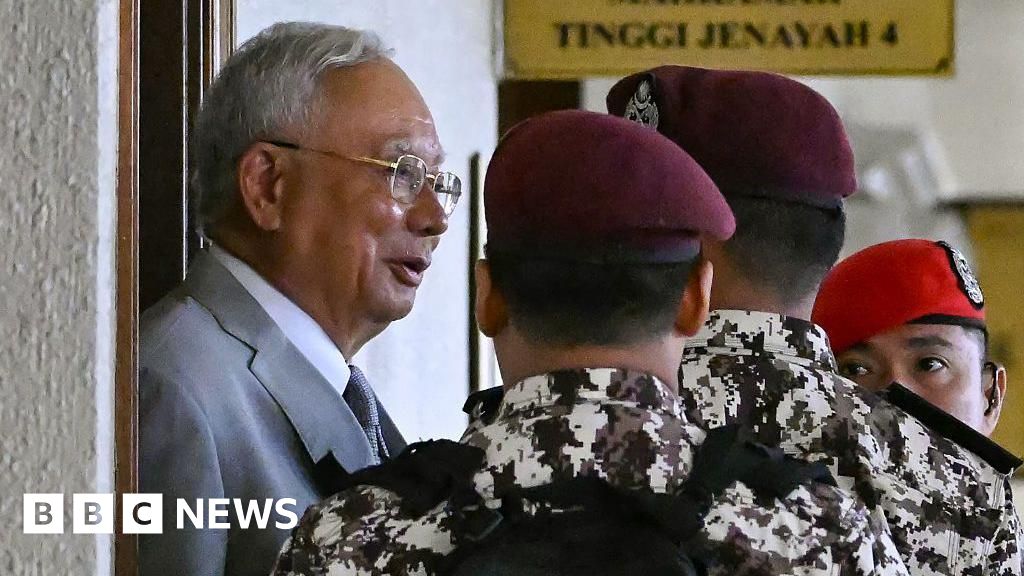
A Malaysia court has convicted former prime minister Najib Razak for abuse of power, in his second major trial for a multi-billion-dollar state funds scandal.
Najib, 72, faces multiple charges for misappropriating nearly 2.3 billion Malaysian ringgit ($569m; £422m) from the nation’s sovereign wealth fund 1Malaysia Development Berhad (1MDB).
On Friday afternoon a judge found him guilty in all four charges of abuse of power. Najib also faces 21 charges of money laundering. The verdict is still being read out in court.
The former PM is already serving a jail sentence after he was convicted in another case related to 1MDB.
Najib has been imprisoned since 2022 but saw his 12-year jail term halved last year.
Friday’s verdict comes after seven years of legal proceedings, which saw 76 witnesses called to the stand.
The verdict, delivered in Malaysia’s administrative capital Putrajaya, is the second blow in the same week to the embattled former leader.
On Monday, the court rejected his application to serve the remainder of his sentence under house arrest.
But the former prime minister retains a loyal base of supporters, who claim that he’s a victim of unfair rulings and who have showed up at his trials calling for his release.
On Friday, dozens of people gathered outside the court in Putrajaya in support of Najib.
The 1MDB scandal made headlines across the world when it came to light a decade ago, embroiling prominent figures from Malaysia to Goldman Sachs and Hollywood.
Investigators estimated that $4.5bn was siphoned from the state-owned wealth fund into private pockets, including Najib’s.
Najib’s lawyers claim that he had been misled by his advisers – in particular the financier Jho Low, who has maintained his innocence but remains at large.
But the argument has not convinced Malaysia’s courts, which previously found Najib guilty of embezzlement in 2020.
That year, Najib was convicted of abuse of power, money laundering and breach of trust over 42 million ringgit ($10m; £7.7m) transferred from SRC International – a former unit of 1MDB – into his private accounts.
The latest case concerns a larger sum of money, also tied to 1MDB, received by his personal bank account in 2013. Najib said he had believed the money was a donation from the late Saudi King Abdullah – a claim rejected by the judge on Friday.
Separately Najib’s wife, Rosmah Mansor, was sentenced to ten years in jail in 2022 for bribery. She is free on bail pending an appeal against her conviction.
The scandal has had profound repercussions on Malaysian politics. In 2018 it led to a historic election loss for Najib’s Barisan Nasional coalition, which had governed the country since its independence in 1957.
Now, the recent verdicts has highlighted fissures in Malaysia’s ruling coalition, which includes Najib’s party United Malays National Organisation (UMNO).
Najib’s failed house arrest bid on Monday was met with disappointment from his allies but celebrated by his critics within the same coalition.
Malaysia’s Prime Minister Anwar Ibrahim called for politicians on all sides to respect the court’s decisions.
Former Malaysian lawmaker Tony Pua told the BBC’s Newsday programme that the verdict would “send a message” to the country’s leaders, that “you can get caught for corruption even if you’re number one in the country like the prime minister”.
But Cynthia Gabriel, founding director of Malaysia’s Center to Combat Corruption and Cronyism, argued that the country has made little headway in anti-corruption efforts despite the years of reckoning after the 1MDB scandal.
Public institutions have not been strengthened enough to reassure Malaysians that “the politicians they put into power would actually serve their interests” instead of “their own pockets”, she told Newsday.
“Grand corruption continues in different forms”, she added. “We don’t know at all if another 1MDB could occur, or may have already occurred.”