It was during an afternoon in June 2025 that Monija Khatun, a student in class 11, decided to dial the helpline number 1098. She was reporting the wedding of a 14-year-old classmate that had been fixed with an adult man. “One day she told me in school that she did not want to get married,” Monija says. After that call, the police intervened, and the marriage was prevented.
During the year 2025, Monija, a student of Gajdharpara High School, prevented six child marriages, including two of her classmates. “They were minors, but wanted to run away from home and get married. After the intervention of the authorities, their marriage was stopped. They still come to school but do not talk to me,” she says.
Earlier this year, Monija was one of 18 girls honoured by the Murshidabad District administration as a ‘Kanyashree Yodhya’ (girl warrior). The local newspapers covered it, she says, but she has no photograph or newspaper coverage of the event.
In 2013, the West Bengal government launched the Kanyashree Scheme, a conditional cash transfer programme to improve the status of girls and reduce child marriage. While the number of beneficiaries of the scheme has almost touched 1 crore, child marriage continues to be a challenge for policymakers in the State.
Why is child marriage still high in West Bengal? | Explained
Murshidabad is one of West Bengal’s economically poorer districts. Here, men migrate to work outside the State and women roll beedis to add to their family income. The district has one of the highest numbers of child marriages in the State. The National Family Health Survey-5 (NFHS-5) records that 55.4% of women between 20 and 24 years were married before the age of 18 years in Murshidabad district, among the highest in the country. In West Bengal, NFHS-5 figures state that 42% of women in this age group were married before they became adults.
Now, of the 254 gram panchayats in Murshidabad, seven have been identified as child-marriage-free: five are in Berhampur block and two in Hariharpara block. This means that there has been no reported case for six months prior. In the campaign against the practice are girls like Monija, non-profits, and the administration.
Girls, boys, and their perceived roles
On a December afternoon, Monija, along with a dozen students, 10 girls and two boys, is engaged in a workshop on gender in a classroom at Gakunda Primary School. The classrooms are decorated with photographs of national icons: thinker Swami Vivekananda, writer Kazi Nazrul Islam, and India’s second President Sarvepalli Radhakrishnan, among others.
On a piece of chart paper, two groups of students try to determine what society’s gender roles for boys and girls are. ‘Boys ride a bike, girls do not ride a bike;’ ‘Boys go to work outside;’ ‘Girls cook, boys do not cook,’ the children write in Bengali.
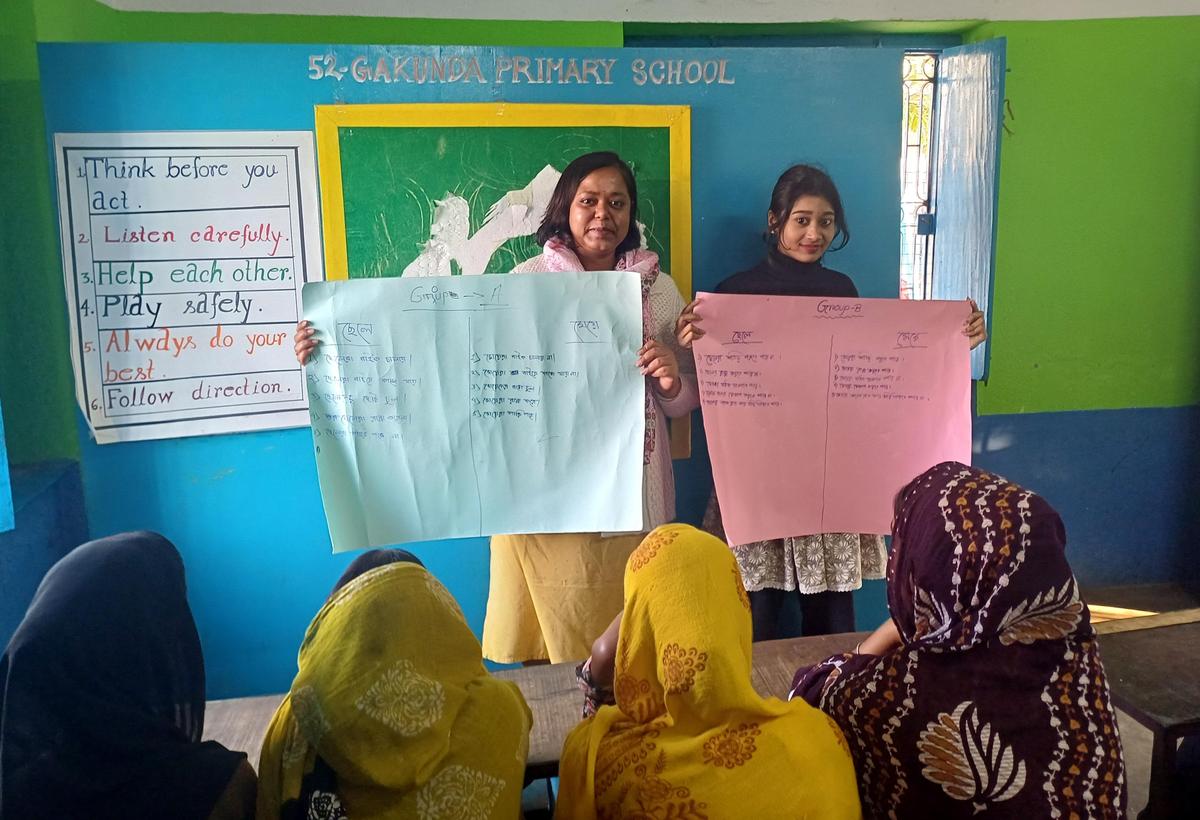
Sanchita Malo, a social worker and Mousumi Khatun, a Kanyashree Warrior during a workshop on Gender at Gakunda Primary School at Bhakuri 2-gram panchayat in Behrampore block of Murshidabad district. The gram panchayat has been declared Child Marriage Free by the District authorities with no child marriage recorded in the past six months.
| Photo Credit:
Shiv Sahay Singh
A social worker poses a few questions to the boys. “Do you think women should work? Will you want your wife to work?,” the social worker asks. The older boy answers, “No, I do not want my wife to work. If she has money, then she will give me attitude.”
At Gakunda Primary School, children and young adults hold sessions on gender every month. It is at these sessions that the children are told about child marriage and the 1098 helpline. Mousumi Khatun, a class 12 student who is regular at these sessions, says that girls whose marriages are fixed suddenly stop talking to friends, stop attending school. “One day we suddenly hear that they are at their in-laws’ place,” she says.
About a year ago, Mousumi had to fight her own battle. She still remembers the date: March 21, 2024. “I did not have a father, so my family told me I would have to get married. I was 17 years old then and told them I’d go to the police if they forced me,” Mousumi says. Like Monija, Mousumi is also a Kanyashree Yodha, and was honoured by the Murshidabad District Administration for her fight against child marriage.
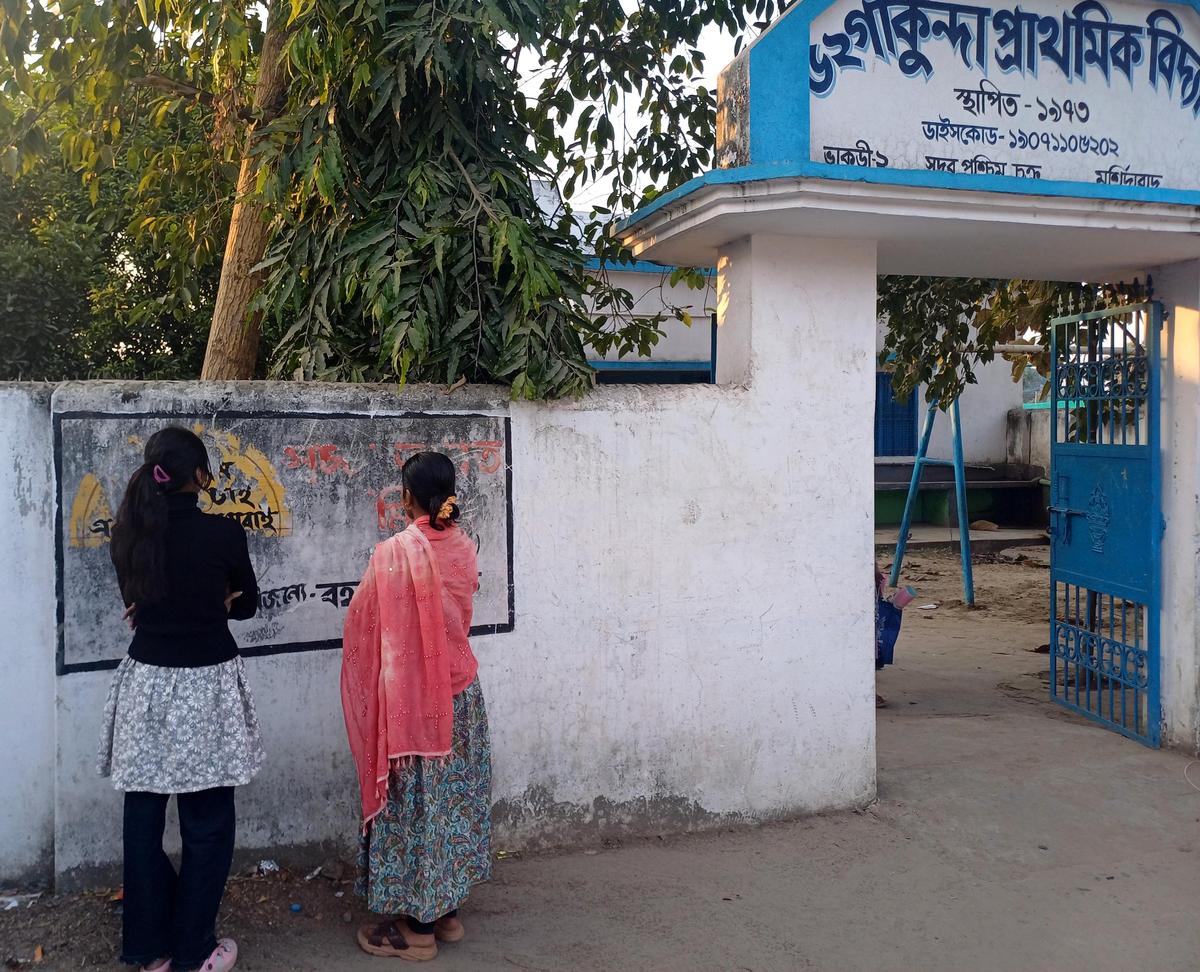
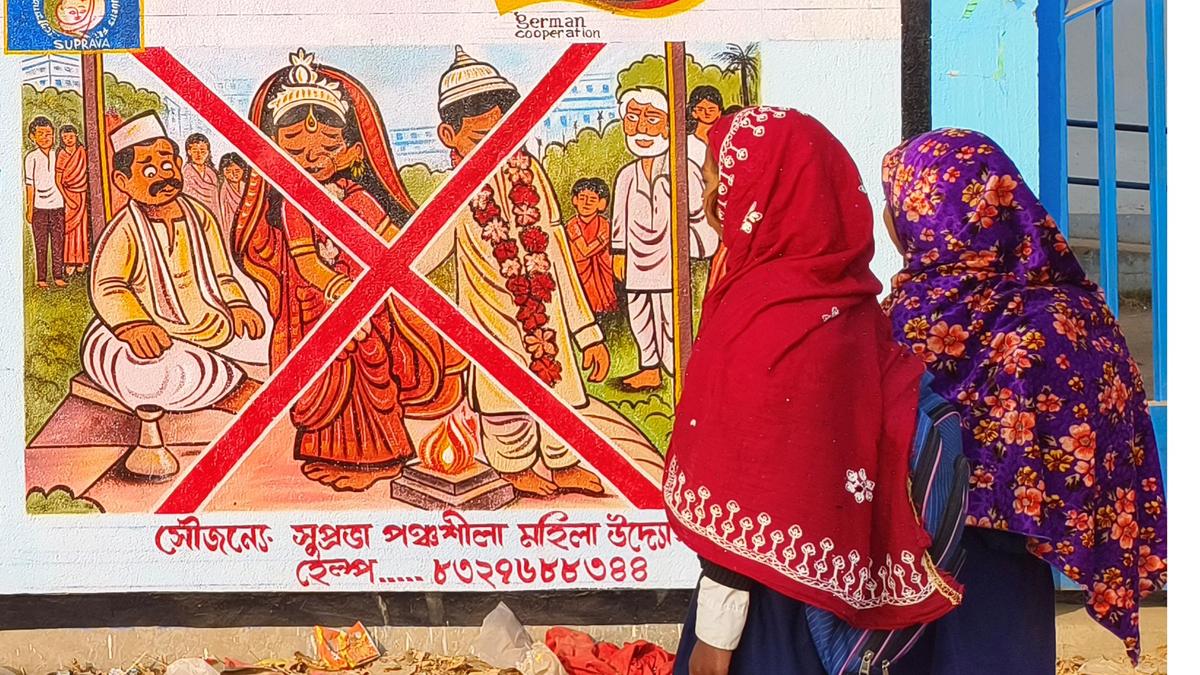
Two girls who have been honoured as Kanyashree Warriors by the Murshidabad District Administration outside Gakunda Primary School at Bhakuri 2-gram panchayat in Behrampore block of Murshidabad district. The gram panchayat has been declared Child Marriage Free by the District authorities with no child marriage recorded in the past six months.
| Photo Credit:
Shiv Sahay Singh
Prevention and prosecution
Outside the two-storeyed blue and white office of Bhakuri II gram panchayat, declared child-marriage free, there is a newly erected plaque in Bengali, which declares the gram panchayat child-marriage free. It also warns that if any incident of child marriage comes to light, action will be taken. Inside the panchayat office, the pradhan (head), Chameli Bibi, and deputy pradhan Dibyendu Mondal say that getting to this point has been an uphill task.
“We have involved schools, local community leaders, even temples and mosques to ensure that we put an end to the practice. At a panchayat level, we try to tell people how child marriage is not in the interest of the mother and child. When nothing works, we tell family members that they will be booked by the police,” Chameli says. Announcements are made from mosques after Friday prayers to tell people not to marry their children young.
Soma Bhowmick, former chairperson of Child Welfare Committee of Murshidabad district, has dealt with the issue of child marriage from close quarters. Bhowmick who runs Suprava Panchashila Mahila Uddyog Samity (SPMUS), a non-government organisation, says that some Imams who have conducted child marriages have been booked under the Prohibition of Child Marriage Act, 2006 (PCMA). Bhowmick explains that there are two ways to combat child marriage: prevention and prosecution.
Bhowmick has been interacting with Priyanka Biswas of the British Asian Trust, a non-profit that runs Kawach, a programme for overall child development. One of its missions is to stop child marriage in West Bengal and other States of the country. Bhowmick says that of late, there has been a hike in cases of girls eloping and getting married.
Once a girl below the age of 18 is married, not only can her parents be booked under PCMA, but the boy or the man she marries can also be charged with Protection of Children from Sexual Offences Act, 2012 (POCSO), a stringent law that makes bail difficult. Bhowmick and other social workers debate on which is the better approach to combat child marriage: community-driven prevention or prosecution.
Both Bhowmick and Biswas, however, agree that once FIRs are registered and minor girls sent to State-run homes, which lack basic infrastructure, it becomes difficult for them to return to regular life. “It is usually after a fight in the family that a girl decides to run away,” Biswas says, reflecting on her years of experience in the field of child protection.
Bengal, UNICEF focus on community participation to end child marriage
The fallout of child marriage
Despite the challenges, it is women who are at the forefront of the fight against child marriage. Four of the five gram panchayats in Berhampur that have been declared child marriage-free are administered by women.
Not far from Bhowmick’s office is that of the panchayat of Niralispara Goaljan Gram Panchayat, which was declared child marriage-free in October 2025. A poster against child marriage hangs outside. Usnahara Bibi, the pradhan, says that fighting child marriage was like fighting polio. “Even if there is one reported case of child marriage, the gram panchayat will no longer be child-marriage free,” she says.
Surrounded by Anganwadi and ASHA workers from the gram panchayat, Usnahara says that they play a crucial role in preventing child marriage. Kanak Bhattacharya, an Anganwadi worker for the past three decades, says, “I tell the women that if a tree starts to flower before a particular age, the flowers don’t bloom properly. There are several complications associated with early pregnancy. The children are born underweight, and such pregnancies are also a risk to women.”
Teenage pregnancies, which are an outcome of child marriage, are a major challenge. Arjun Dutta, the district child protection officer (DCPO) of Murshidabad district, points out that “teenage pregnancies were as high as 21% in the district in 2024-25” as per the HMIS (Health Management and Information System) portal. “After the district administration started an aggressive campaign against child marriage in mid-2025, teen pregnancies have reduced to 17% in both Berhampur block and Hariharpara block,” says Dutta.
Sitting in a small office in the district administrative complex, Dutta carefully reads figures on the number of child marriages that have been prevented in the district: between June and December, the number stands at 1,081, he says, quoting from the Government of West Bengal’s Child Marriage Reporting and Tracking System (CMRTS) portal. In Murshidabad, this number was 471 for 2024-25. Across its two police districts, Murshidabad and Janipur, the district recorded 118 FIRs for child marriage and 152 cases under POCSO, between May and October 2025.
A poster highlighting the practices of child marriage and child labour, drawn in a child-like scrawl, hangs across the wall behind the DCPO’s chair. Dutta says that with children having access to cell phones and the internet, the number of elopement cases is on the rise. He speaks about a minor girl from a village in Murshidabad who was rescued from Haryana. “I feel that there is a need for schools to have counsellors with whom children can interact daily,” he says.
Girls at the forefront
Murshidabad’s Additional District Magistrate (Development) Chirantan Pramanik says that there is a need for “drastic steps” to put an end to child marriage. He says anyone through the chain of involvement is being booked: parents, priests, decorators, caterers, and even panchayat functionaries. Referring to the large map of Murshidabad district in his office, he adds that blocks bordering Bangladesh have traditionally recorded higher instances of child marriages. “We have done enough awareness and sensitising. People are aware. The only way (to combat child marriage) is action,” the ADM says.
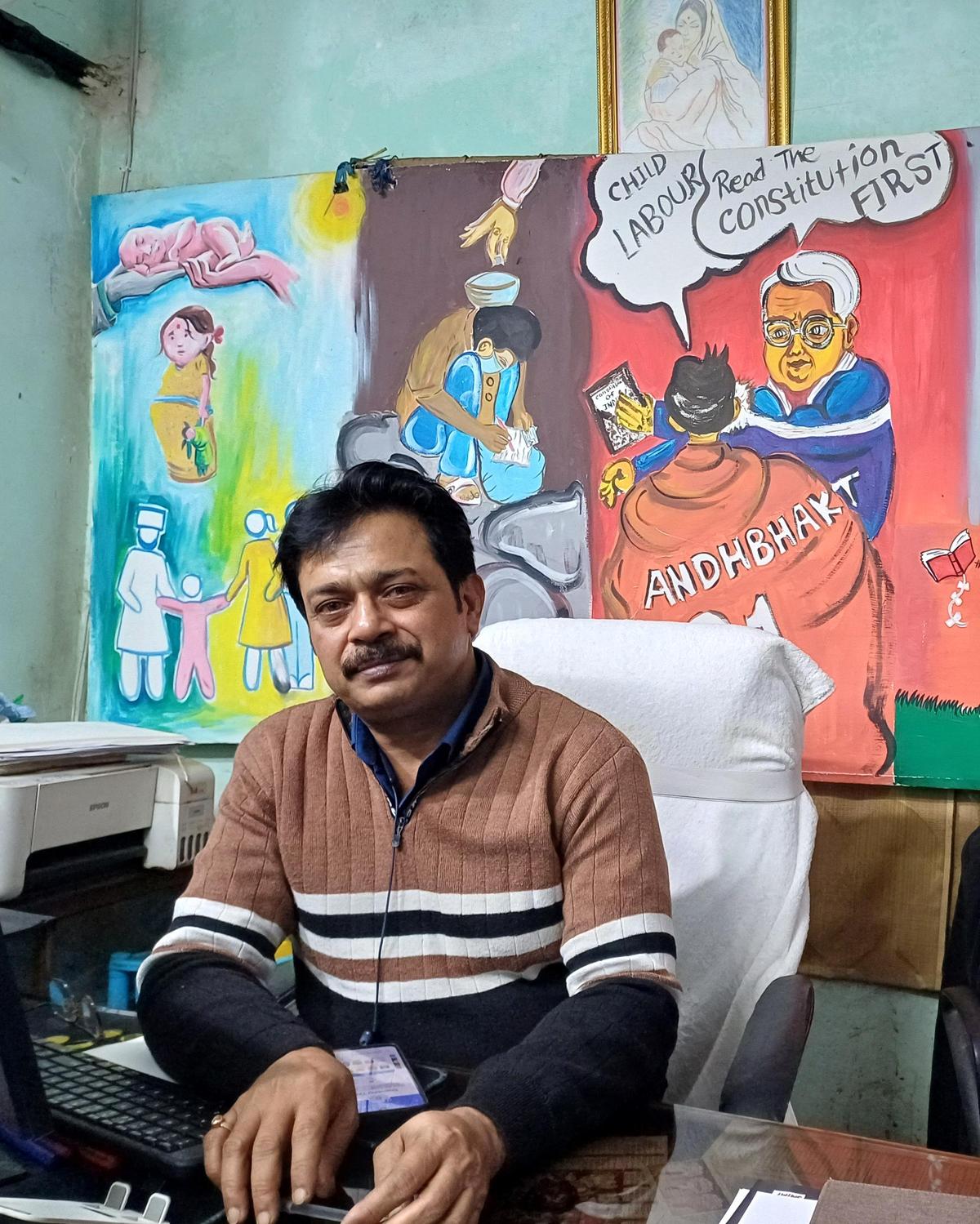
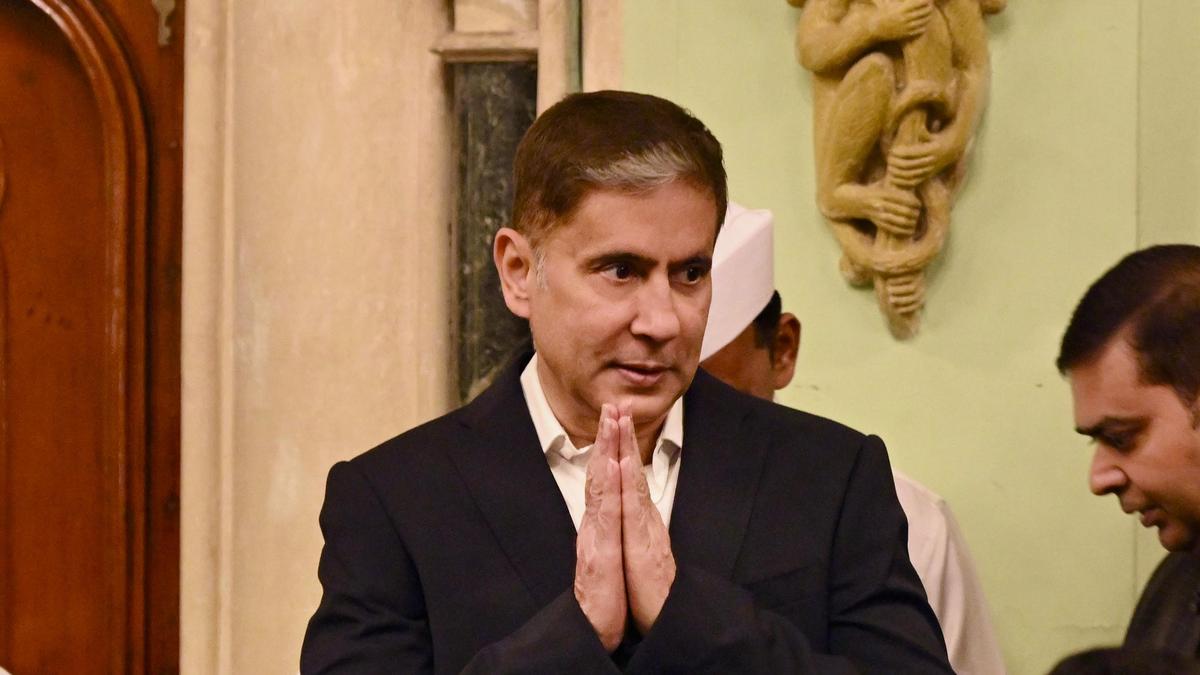
Arjun Dutta District Child Protection Officer Murshidabad. Seven-gram panachayts across two blocks in Murshidabad have been declared child marriage free in the past six months. The district administration has prevented 1081 child marriages in the district.
| Photo Credit:
Shiv Sahay Singh
In the middle of the conversation, the ADM calls junior officials and says that there have been reports of seven child births at Lalbagh Subdivisional Hospitals, where the mothers are minors. He directs that FIRs be registered. However, a few days after his orders, no FIR was registered, because this would book the fathers of the newborns under POCSO. Across West Bengal, the focus has by and large shifted from punishment to prevention, from fear-driven compliance to shared responsibility for child protection.
Nupur Biswas, a class 12 student at Nimtala High School in Berhampur, says her mother was married when she was only 14 years old. After her father died in 2019, her mother ensured that she went to school. Idris Ali, the block coordinator, says that Nupur is a good student who runs a Kanyashree club at her school.
Nupur, one of the 18 Kanyashree Yodha, has pasted notes on an unplastered, unpainted wall in front of her study desk at home, in Shibpur village, in Hathinagar gram panchayat. “My target: only for B.Sc Nursing 2026,” says one note. On another, a number of mathematics formulae. On one piece of paper in bold letters, is: “Hopeless end or endless hope”.
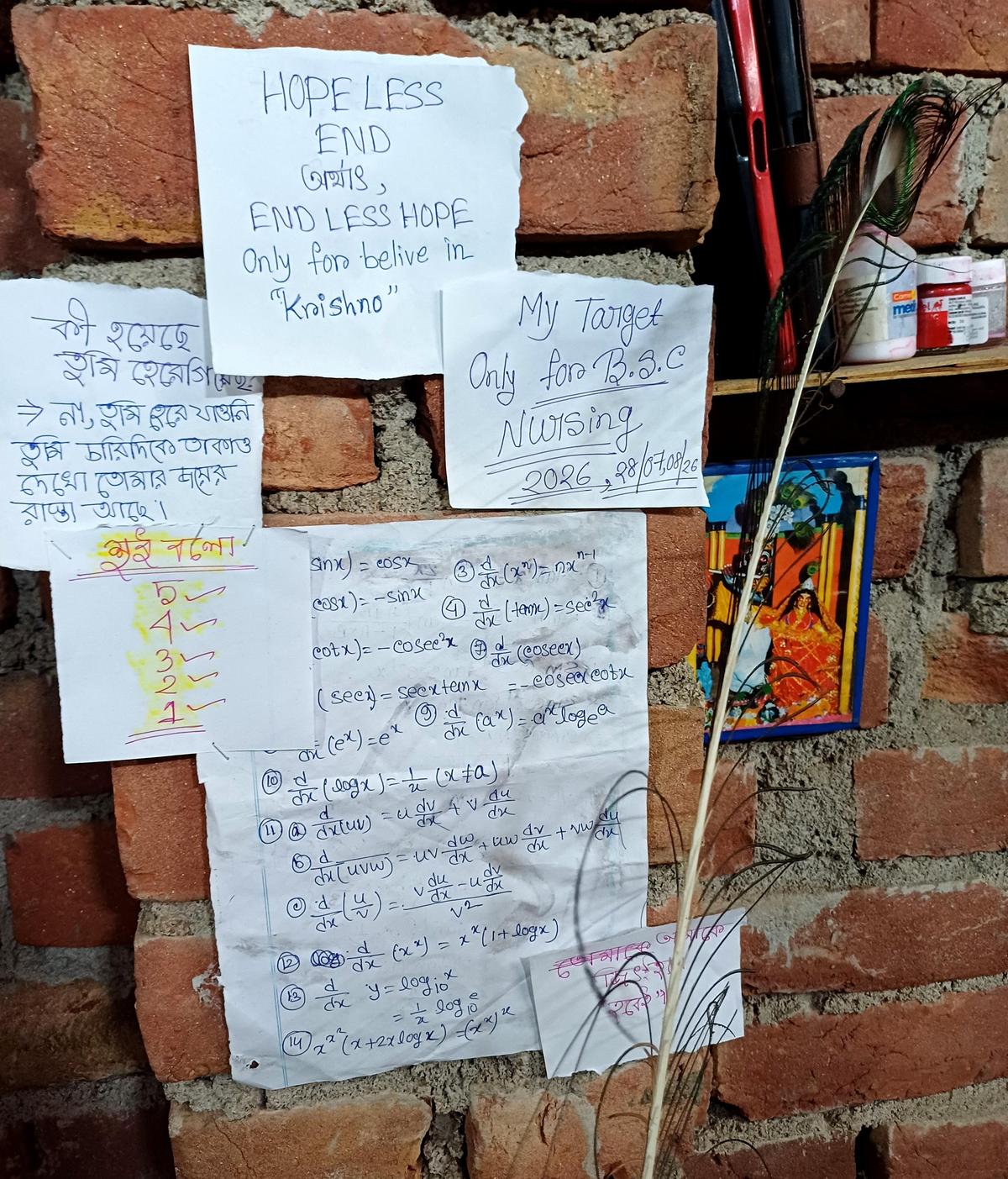
The wall in front of the reading desk of Nupur Biswas, a Class XII student and Kanyashree Warrior. A paper on the wall says Hopeless End to Endless Hope. 18 girls have been honoured as Kanyashree Warriors by the Murshidabad District Administration.
| Photo Credit:
Shiv Sahay Singh
India has committed to ending child marriage by 2030 through the United Nations’ Sustainable Development Goals (SDG).
shivsahay.s@thehindu.co.in
Edited by Sunalini Mathew