
- Biotic homogenisation is a phenomenon that is altering ecological communities around the world at an alarming rate.
- Despite its ecological and human impacts there is a lack of research or awareness on the phenomenon in India.
- The article proposes that there is a need to broaden conservation strategies from focusing on species level conservation to include community level conservation.
- The views in this commentary are that of the authors.
Imagine walking through different ecosystems across the world, only to find that species inhabiting them look strikingly similar. This is the reality of biotic homogenisation, a process where diverse biological communities become increasingly similar as unique endemic species, highly sensitive to environmental changes, are replaced by common generalist species, which are insensitive to such perturbations.
Natural drivers
It is important to recognise that biotic homogenisation can be a natural process. The drivers can be placed into two broad categories, disturbance and connectivity. Disturbance refers to changes over time in environmental conditions that can drive homogenisation by favouring species that thrive under altered conditions, such as hurricanes, floods, and volcanic eruptions. However, when the environment is constantly disturbed, specialist species that thrive under a narrow set of environmental conditions find it tough to keep up, leaving only generalists that can survive under a broad set of environmental conditions.
Climate change can cause ecological disturbances at a global scale. Earth’s climate has naturally fluctuated over geological timescales, and fossil records show that there were past instances of biotic homogenisation, particularly following mass extinction events. For example, the Palaeozoic mass extinction, which wiped out nearly 90% of species, resulted in a global biota dominated by a few generalist species.
Changes in landscape connectivity, such as land bridges and river networks, influence species compositions by facilitating species movement and increasing species overlap in previously distinct regions. Natural mechanisms can also facilitate global connectivity, ocean currents, for example, can facilitate long-distance movement of marine species contributing to homogenisation at global scales.
Anthropogenic drivers
While biotic homogenisation can occur naturally, human activities have accelerated the rate and scale at which it is taking place. In terrestrial communities, a major driver of homogenisation is habitat modification due to land use change. Agriculture, through large-scale monoculture, and clearing of diverse natural vegetation, results in homogeneous ecosystems dominated by a few species. Other mechanisms, like deforestation, also alter natural habitats that are used by specialists, thus altering community structure.
The overexploitation of natural resources can also disrupt diversity of ecosystems and allow only a handful of species to flourish. Overfishing, for example, depletes the number of large, predatory fish, allowing smaller, fast reproducing species to dominate, leading to the same cohort of species across aquatic communities.
Climate change amplifies these local effects by altering environmental conditions at a global scale by changes such as shifting precipitation patterns, rising temperatures and increasing extreme weather events favouring climate tolerant generalists while driving local extinctions of specialists, a phenomenon seen at a global scale.
Anthropogenic activities increased connectivity by accelerating the spread of species across previously distinct biogeographical regions through global trade and transportation. This has accelerated the spread of non-native invasive species which can occur accidently (e.g. transportation networks and hitchhiking) and intentionally (e.g. aquaculture, agriculture and pet trade). Once introduced to a new place, non-native species can displace native species, leading to a decline in the uniqueness of local communities.
Ecological impacts
Biotic homogenisation acts at the community level, and understanding it is crucial because it affects the stability of ecosystems worldwide.
It alters food web dynamics by modifying predator prey relationships and competitive interactions, and impacts essential ecosystem services such as seed dispersal and pollination by reducing functional diversity. For example, the loss of diverse pollinator species can disrupt plant reproduction, leading to a decline in native plant populations. Homogenised plant communities can drive low soil microbial diversity, thereby reducing nutrient cycling and soil fertility.
Ecosystems with high diversity are more capable of withstanding environmental disturbances such as extreme weather events, climate change, and disease outbreaks. However, as species composition in communities become more uniform, ecosystems lose their resilience making them more vulnerable to environmental stressors. For example, tropical forests experiencing homogenisation have reduced species diversity and the loss of drought-resistant tree species reduces the ability of these ecosystems to cope with changing precipitation patterns.


Impacts on humans
Biotic homogenisation reduces functional diversity, undermining human livelihoods, food security, economic stability, and health. The decline of native pollinators and loss of functionally diverse plant communities can lead to degradation of soil quality and reduction of crop yields, thus threatening agricultural production. The spread of non-native species can also lead to an increase in costs for pest control and habitat management. By replacing native fish populations with a few widespread, invasive species can also lead to declines in commercial fish stocks.
This also has implications for human health by favouring generalist species such as rodents and bats, which are more abundant, live near humans and carry zoonotic diseases such as Lyme disease and Hantan virus. Additionally, it can lead to the loss of traditional ecological knowledge and practices which indigenous and local communities rely on for subsistence and identity.
Homogenisation of communities can also reduce the recreational and aesthetic value of landscapes, impacting tourist activities as tourists seek unique and diverse natural landscapes. This has economic consequences, as tourism is one of the world’s largest industries, with nature-based tourism accounting for about 20% of international travel.
Ecosystems’ lower resilience to disturbances makes human communities more vulnerable to extreme weather events. For example, coastal ecosystems dominated by non-native species may be less effective at buffering against erosion and storms, increasing the risk of property damage and displacement.

Implications
Biotic homogenisation presents significant challenges for conservation, since it alters biodiversity patterns, disrupts ecosystem functions and reduces resilience to environmental change. There is clear evidence of it in both natural and urban environments in India, but research on it remains limited. Addressing it requires shifting conservation from a species focused approach to one that prioritises community-level changes.
One of the first studies we came across found that alien plants are reducing regional uniqueness in the Indian Himalayan Region, a significant biodiversity hotspot. We also found multiple papers focusing on how urbanisation causes a monotony of species instead of harbouring biodiversity, affecting bird diversity and community structure in central India. This includes farmland bird communities, loss of functionally important insectivores, and degradation of freshwater ecosystems by reducing native snail diversity.
Concerningly, we found only one news article highlighting how urbanisation is driving biotic homogenisation in Indian cities, by creating environments in which species such as rats, Parthenium (an invasive species) and alligator weed can survive. It highlighted the Mula Mutha riverfront in Pune where structures such as promenades are reducing habitat complexity and diversity.
Conventional conservation metrics, like extinction rates and species richness may not fully capture these impacts. Instead, conservationists need to incorporate metrics that can measure biotic homogenisation when carrying out biodiversity assessments. For example, a region may retain the same number of species over time, increasing similarity in species composition across sites signals the loss of ecological distinctiveness, which may require intervention.
While we found that there is significant research on the subject, we were unable to find proper evidence indicating that it is being applied in conservation as a measure of community structure and function. Additionally, research on biotic homogenisation in India is lacking, as well as popular media or articles. This not only means that this issue is not being communicated to the general public, but also that we have limited understanding of the rate and scale of it in India, which may prove to be devastating when considering the overall resilience of ecosystems.
Addressing biotic homogenisation requires conservation strategies that go beyond simply focusing on individual species and focus on preserving the ecological functions that sustain life on Earth. If left unchecked, not only India’s, but the world’s landscapes may continue to lose their unique character, making nature’s rich tapestry far more uniform, and far less resilient.
Trisha Putturaya is a student currently pursuing her Master’s degree in Environmental Science at Victoria University of Wellington. Her interests primarily lie in ecology and climate change. Guha Dharmarajan is Professor of Biology at Krea University. His research primarily focuses on disease ecology and ecosystem health.
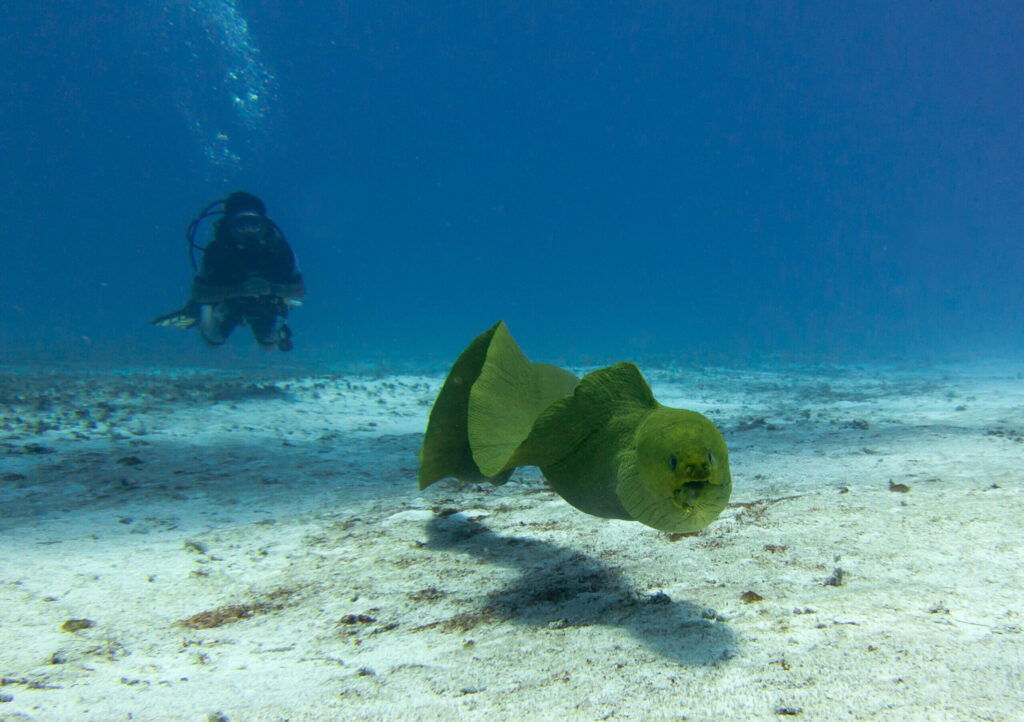
Banner image: A green moray eel. Image by P. Lindgren via Wikimedia Commons (CC BY-SA 3.0).

