Veteran linguist, author and activist Ganesh Narayan Devy has urged the Centre to grant the Denotified and Nomadic Tribes (DNTs) their own separate entry in the forthcoming Census of India.
A year from now, in February 2027, India will be conducting an enumeration on the basis of caste for the first time since 1931. “It has entries for identifying as Scheduled Caste (SC) and Scheduled Tribe (ST). But there is nothing for DNTs. This would be a grave injustice,” Devy, who is in Delhi, told Down To Earth (DTE) on February 8, 2026.
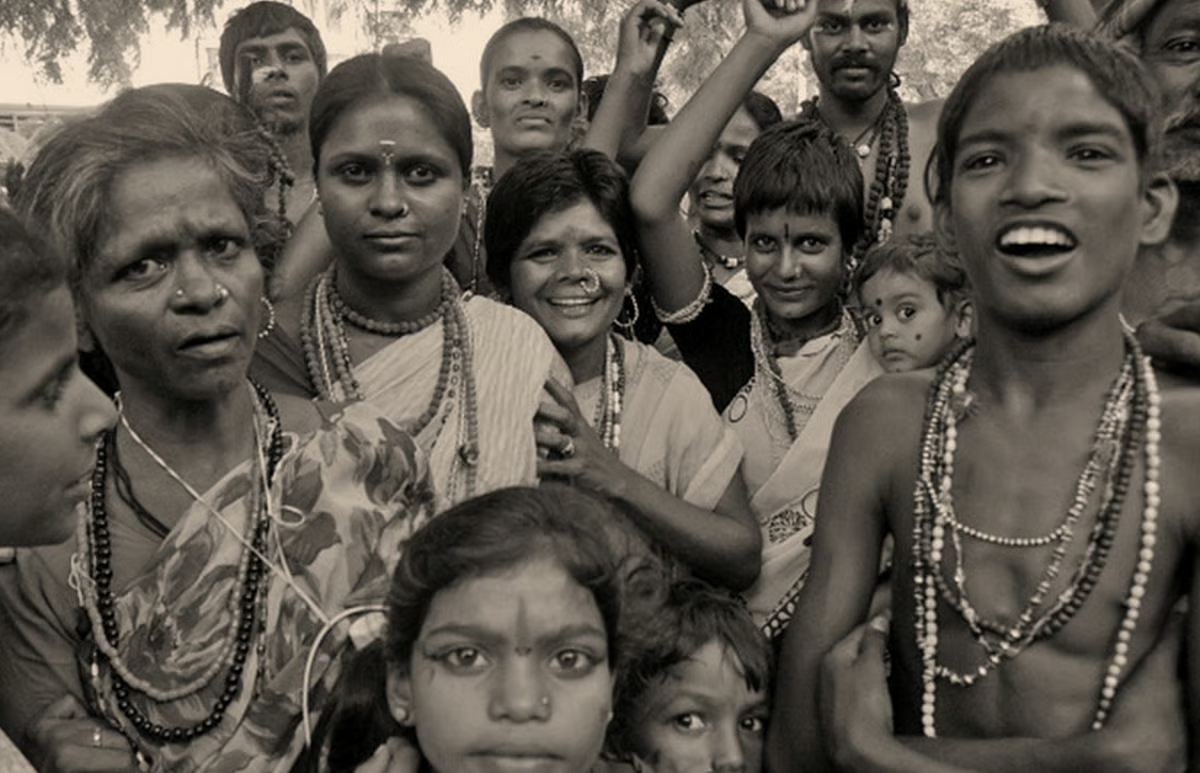
“Many DNTs are identified as SCs, STs or Other Backward Classes. But they continue to remain poor, marginalised and downtrodden as their problems differ from the other three groups. They may not necessarily be born into a life of constant fear of being questioned by police, being arrested and thrown in jail and being looked upon with suspicion of being ‘criminals’ and engaging in ‘criminal activities’. Only formal recognition of these people can lead to an honest and sincere redressal of their issues,” the noted activist added.
Who are the DNTs?
The debate over the roots and origins of the DNTs has several strands.
India’s vast hinterland, with its forests, mountains, roads and highways, harboured dangers for travellers in the form of robbers, bandits, dacoits and highwaymen. They were beyond the pale of Brahmanical society.
The story of the Buddha and Angulimala tells of the serial killer and robber being reformed by the founder of Buddhism to reintegrate into society.
The Chinese Buddhist monk-pilgrim, Xuanzang, who came to India during the 7th century with his companions is said to have been robbed of his clothes and belongings near Sakala (modern-day Sialkot in Pakistan).
One of the most famous incidents in the life of Guru Nanak, the founder of Sikhism, is how he reformed Sajjan the Thug near Delhi.
So yes, robbery, thievery and banditry were very much part of life in ancient and medieval India.
However, most sources point to the early 19th century as the time when the genesis of today’s DNT issue took place.
Aurangzeb, the last of the six Great Mughal Emperors of the subcontinent, had died in 1707, a century earlier. The subsequent collapse of the Mughal administration and the advance of the British East India Company is the time when the legend of the Thug rose in much of the subcontinent.
The Thugs have been termed several things by different authors and analysts: organised crime syndicate. Underworld. Serial killers. Highwaymen. Robbers. Dacoits. Bandits. Practitioners of human sacrifice. Cult members.
While views may differ, the menace of the Thugs or Phanseegars (for their act of killing their victims by strangulation with handkerchiefs) was such that the British Indian state came down with full force on this perceived enemy of ‘law’, ‘order’ and ‘civilisation’.
Under officials like William Sleeman, the British aimed to eradicate ‘thuggee’, defined as ritualised robbery and murder on highways by organised, often hereditary groups.
They brought in the Thuggee Act of 1836, which effectively ended the practice.
The era of suppression of Thuggee was followed the 1857 Revolt against the British. According to experts, this and the fact that the British wanted to ‘civilise’ the ‘Uncivilised East’ (India) and stamp their authority on it, led to them extending the ‘thug’ narrative to every group they thought was suspicious: Nomads. Pastoralists. Gypsies. Performers. Blacksmiths. Political prisoners.
In came the notorious Criminal Tribes Act of 1871, influenced by the Thuggee Act of 1836. The British branded over 200 communities as ‘born criminals’ who led a ‘criminal way of life’ with this piece of legislation. Their movement was restricted, requiring them to register and report to police.
After Independence
Since Independence, there have been constant efforts to shine a light on those groups who were branded ‘criminals’ by the 1871 Act.
The Criminal Tribes Act of 1871 was finally repealed by the government of the independent Republic of India on August 31, 1952. This date is now commemorated as Vimukti Divas or Liberation Day by these groups.
However, undoing more than 150 years of damage has taken a lot of time. For one, DNTs continue to live a life of stigma as noted above. They still do not have access to basic amenities. But most importantly, no one, including many DNTs themselves, know how many of them are really there in India, according to Devy.
He himself has led from the front to right the wrongs done to the DNTs. In 1998, he co-founded the Denotified and Nomadic Tribes Rights Action Group (DNT-RAG) with late noted author, Mahashweta Devi to highlight the travesty of justice.
“By our own estimate, the number of these people then was 6 crore (60 million),” Devy told DTE.
His efforts and the work of the DNT-RAG were instrumental in the appointment of the National Commission for Denotified, Nomadic, and Semi-Nomadic Communities (NCDNT) in 2005.
The NCNDT was headed by Balkrishna Sidram Renke and submitted its report in 2008. It held that “It is an irony that these tribes somehow escaped the attention of our Constitution makers. They are deprived of Constitutional support unlike Scheduled Castes and Scheduled Tribes.”
“The Renke commission estimated the DNT population to be around 10.74 crore (107.4 million),” said Devy.
He also talked about how a new National Commission for DNTs was constituted in February 2014 to identify and recommend welfare measures for these communities. It was chaired by Bhiku Ramji Idate and submitted its report in 2017.
Idate later also chaired the Development and Welfare Board for De-notified, Nomadic and Semi-Nomadic Communities (DWBDNC).
The DWBDNC’s report identified 1,262 communities as de-notified, nomadic and semi-nomadic.
“Till today, we do not know what the exact number of DNT communities is as well as what is the exact population of each of them as well as all of them combined. If we do not know this, how can we implement welfare measures for these people?” asked Devy.
The separate entry in the Census would help in identifying such people, he added.
Devy also questioned the timing of the Census. “Of course, 2021 was the year of the pandemic. But 184 of the 200-odd countries of the world have already completed their decadal census exercise by 2023. Why have we pushed it to 2027? It beats the very goal of social justice,” he noted.