Controversy and opposition are growing about plans to fell 6,800 trees for widening the Gangotri National Highway in Uttarakhand. A new proposal from the state forest department proposes to relocate 4,366 trees and cut the remaining 2,456. Meanwhile, the Border Roads Organisation (BRO) has cast further doubt on the entire plan by stating that only 1,400 trees are planned to be felled.
Raj Kishore, Commandant Engineer, BRO, Uttarkashi, told Down To Earth (DTE), “The highway will be widened by 11 metres. We are identifying corridors where the highway can be extended towards the river, and the mountain needs to be cut to the minimum. The plan covers 1,400 trees, including pine and other species. The earlier plan included two bypasses whose increasing width has been reduced.”
The numbers
Earlier, on November 12, 2025, the then Chief Conservator of Forests, Samir Sinha, in a proposal sent to Uttarakhand’s forest secretary, recommended that 41,9240 hectares of forest land, approximately 20 kilometres between Jhala and Bhaironghati, be given to the BRO for non-forestry purposes. A total of 6,822 trees will be affected under this plan.
According to the forest department’s proposal, 4,366 of the 6,822 trees are proposed to be translocated, meaning they will be uprooted and planted at another place. These include 3,262 trees of 0 to 20 diameter category and 1,103 trees of 20 to 30 diameter category. This process is estimated to cost Rs 323.44 lakh. The remaining 2,456 trees are proposed to be cut. To compensate for this loss, compensatory afforestation is proposed to be done in an area of 76.924 hectares in Naugaon, Barkot, Yamunotri Range and Mugarsanti Range.
DTE has a copy of this proposal.
But questions have been raised about this plan since the Dharali disaster of August 5, 2025. The matter was also raised in the National Green Tribunal. This project is part of the Indian government’s ambitious Char Dham All Weather Road Project, which has already raised controversial several times.
The road widening project from Gangotri to Uttarkashi has been divided into five sections:
1. Gangotri to Jhala;
2. Jhala to Gangnani via the mountain in front, bypassing Sukkitop, as Sukkitop itself is a sinking area;
3. Gangnani to Hina;
4. Hina to Tekla, bypassing the Netala slide or sinking area to reach Tekla;
5. Tekla to Badethi Chungi.
The latest controversy concerns the 20-kilometre eco-sensitive zone from Sukki to Bhaironghati. Initially, the highway between Gangotri and Dharasu in this area was proposed to be widened to 24 metres. However, following scientific studies and opposition, the width was reduced to 12 metres (11 metres of road). Nevertheless, approximately 6,822 trees were identified for felling.
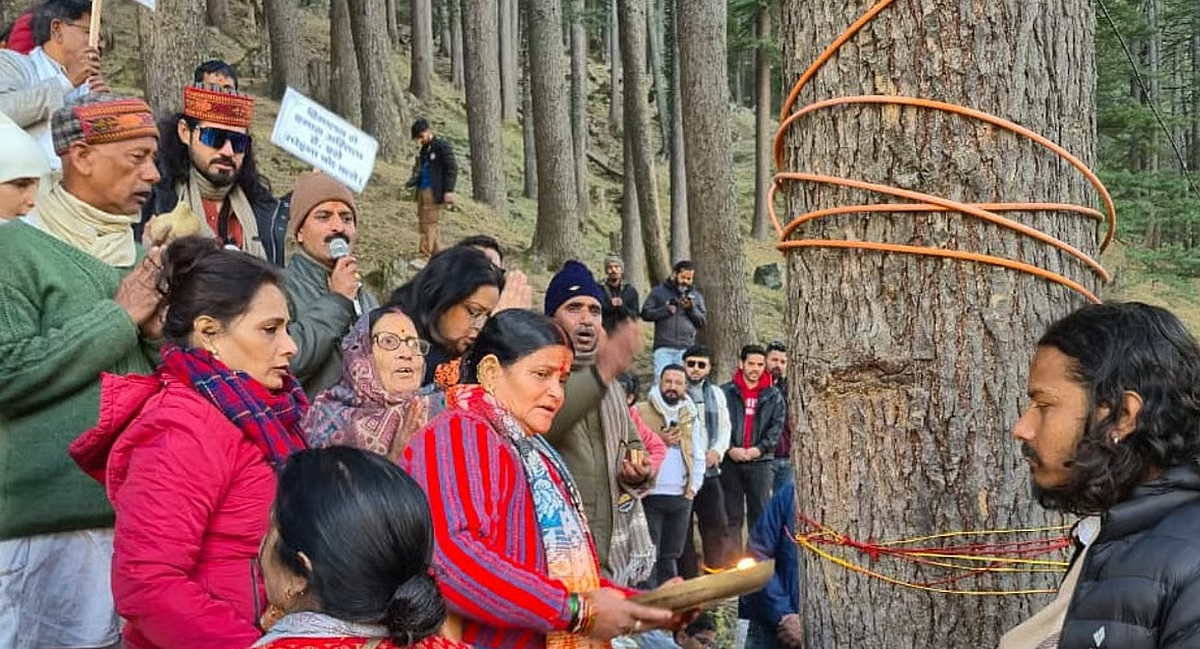
On December 6, 2025, local people tied sacred threads around these trees in protest. The campaign received open support from former Union Minister Murli Manohar Joshi, former Ambassador Karan Singh, and numerous scientists and environmental organisations. Chhattisgarh Member of Parliament Ranjit Ranjan further fuelled the controversy by raising it in Parliament.
Hemant Dhyani, a member of the Char Dham project’s high-powered committee and an environmental activist, launched a Raksha Sutra campaign against the cutting of cedar trees in the Gangotri Valley. Dhyani says that under the 900-kilometre all-weather road project in Uttarakhand, approximately 800 kilometres of mountain has been cut, causing significant damage to the state and its environment. New landslide zones are constantly forming in the Uttarakhand Himalayas.
According to a 2024 report, approximately 200 new landslide-prone areas have developed. Recently, the cracking of mountains in the Tota Valley, just before Devprayag on the Char Dham route, has become a major concern. This all-weather road is crumbling even during light rains. If erosion occurs in the remaining approximately 100 kilometres from Uttarkashi to Harsil, it will be disastrous for this eco-sensitive region.
What experts say
According to Naveen Juyal, a senior scientist who proposed an alternative to this plan, this is a matter of intermediate road width, which, according to the Indian Road Congress, is defined as a 5.5-metre blacktop. A road of this width could require cutting of approximately 12 metres, and in some places, even more than 20 metres.
Juyal says the comparison is actually with a two-lane road with paved shoulders. Its total width is approximately 12 metres, including a 7-metre carriageway (blacktop) and 2.5-2.5 metres of paved shoulders on either side. If a two-lane road is built with paved shoulders, approximately 6,000 trees will be affected.
The BRO has reduced the road width from 12 metres to 11 metres along the approximately 20-kilometre stretch between Jhala and Jangla. “This won’t make much of a difference, whereas our recommendation is for an intermediate road width of 5.5 metres. This will be wide enough to allow large vehicles to pass easily.”
What people want
Some locals protested against the Raksha Sutra ceremony. Ajay Negi, the village head of Dharali, which suffered a natural disaster just four months ago, said, “Our ancestors have cared for the environment and trees in our area for hundreds of years. Deodars are sacred trees for us, but the times also demand development.”
According to Negi, the BRO initially proposed a 12-metre-wide road, which was opposed throughout the valley. “We also don’t want a four-lane highway here. We just want the road widened enough to facilitate tourists and residents and eliminate traffic congestion. We don’t know the scientists’ recommendations, but according to the BRO, they are building an 8-metre-wide road here. We opposed the Raksha Sutra programme because they are completely against the road. We have expressed our protest to the district magistrate, Uttarkashi.”
Possible solution
Geologist SP Sati said, “Everyone agrees that building good roads is essential, but we also need safe roads that facilitate movement. Scientists have already submitted a low-damage detailed project report on this subject, which focused on road safety along with environmental concerns. Therefore, scientific recommendations should not be ignored.”
Sati added that the Harsil Valley is a technically extremely fragile Himalayan zone. “The slopes here rest on loose glacial debris, which can slide under slight pressure or rainfall. Extensive cutting or blasting weakens the slope’s grip and increases the risk of landslides.”
According to Sati, old trees like deodar hold soil together. Hence, excessive felling directly impacts slope stability. “Road widening will increase the pressure of machinery, vibration, and additional soil removal, which, if not managed scientifically, can impact rivers, streams, and groundwater. Therefore, it is technically necessary to limit the width of the road, manage debris scientifically, and ensure slope protection through anchoring, bio-engineering, and drainage. Scientific evaluation and long-term monitoring are essential for sustainable decisions.”