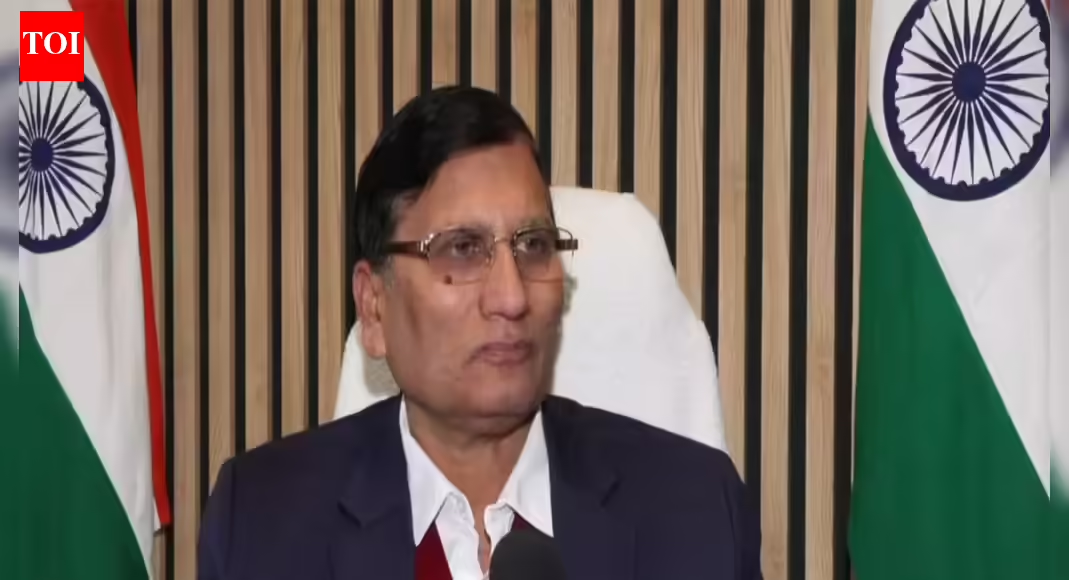
Consumers using CNG for transport and piped natural gas for household cooking are set to see lower fuel bills from January 1, 2026, after the petroleum regulator approved a rationalised pipeline tariff structure aimed at cutting costs, ANI reported.The Petroleum and Natural Gas Regulatory Board (PNGRB) has announced a unified tariff framework that will translate into a price reduction of Rs 2–3 per unit for CNG and domestic PNG consumers, depending on location and state taxes, according to a senior official.Explaining the change, PNGRB Member A K Tiwari said the regulator has simplified the existing distance-based pipeline tariff system by reducing the number of zones from three to two, with the benefit mandated to be passed on to consumers.“We have rationalised the tariff. Instead of three zones, there will be two zones, and the first zone will be applicable for CNG and domestic PNG customers on a pan-India basis,” Tiwari said in an interview to ANI.Under the earlier tariff regime notified in 2023, pipeline charges were split into three distance slabs — Rs 42 for up to 200 km, Rs 80 for 300–1,200 km, and Rs 107 for distances beyond 1,200 km.The revised structure fixes a single Zone-1 tariff of Rs 54, replacing the higher slabs of Rs 80 and Rs 107 that applied to many city gas networks earlier.According to Tiwari, the new framework will benefit consumers across 312 geographical areas served by 40 City Gas Distribution (CGD) companies operating nationwide.“This will benefit consumers in the transport sector who use CNG and households that use PNG in their kitchens,” he said.The PNGRB has also made it mandatory for CGD companies to pass on the tariff benefit to end-users, with the regulator monitoring compliance closely.“Our role is to balance the interest of consumers as well as the operators in this business,” Tiwari said.The regulator said it is actively facilitating the expansion of CNG and PNG infrastructure across the country. Licences have already been issued to cover all regions, with participation from public sector undertakings, private players and joint ventures.Tiwari added that PNGRB has been working with state governments to ease operational bottlenecks for CGD firms, resulting in several states lowering Value Added Tax (VAT) on natural gas and streamlining approval processes.“We are supporting them not just as a regulator but as a facilitator,” he said.
Gas prices: CNG and domestic PNG tariffs to fall from January 1; PNGRB flags Rs 2–3 per unit savings