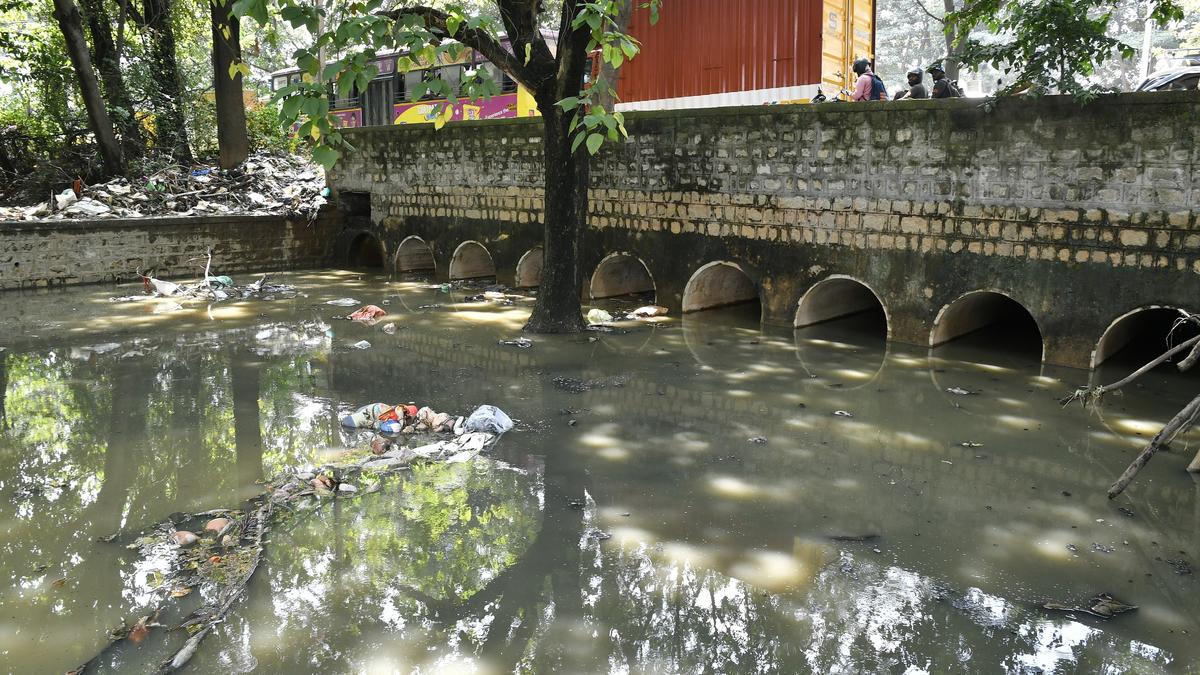
GBA Chief Commissioner M. Maheswar Rao says efforts are under way to prevent sewage from entering storm-water drains, strengthen underground drainage networks, create additional storm-water capacity, and make better use of Bengaluru’s lake system by enhancing storage.
| Photo Credit: ALLEN EGENUSE J.
The Greater Bengaluru Authority (GBA) aims to transform storm-water drains from sewage-carrying channels into public and ecological spaces, Chief Commissioner M. Maheshwar Rao, said on Thursday, underscoring the need for nature-based solutions to address Bengaluru’s recurring flooding and rapidly declining groundwater levels.
Mr. Rao was speaking at a multi-stakeholder dialogue titled ‘Nature-based Solutions for Bengaluru: Reflections on Drainage’, convened by the Jana Urban Space Foundation (JUSF) in the city.
The convention brought together senior government officials, urban practitioners, researchers, civil society organisations, and industry stakeholders to deliberate on reimagining the city’s drainage systems through ecological approaches, according to a release.
Outlining the GBA’s priorities, Mr. Rao said, “Efforts were under way to prevent sewage from entering storm-water drains, strengthen underground drainage networks, create additional storm-water capacity, and make better use of Bengaluru’s lake system by enhancing storage.”
He further stressed that restoring the ecological function of drains and lakes was critical to improving the city’s flood resilience.
Mr. Rao also released a draft working paper titled “Rebuilding Urban Drainage Systems: Learnings from Nallurahalli Nallah Rejuvenation in Bengaluru”. The paper gains insights from a nature-based solutions-led pilot project and outlines pathways to integrate such approaches across storm-water drains, nallahs, lakes, and groundwater recharge systems at scale. The draft has been shared to invite informed critique and inputs before finalisation, a release stated.
The dialogue featured five thematic discussions examining urban drainage and nallahs, lake rejuvenation and community stewardship, rainwater harvesting, institutional and financing frameworks, and best practices from other Indian cities.
Participants noted that Bengaluru’s water challenges marked by flooding during monsoons and groundwater depletion despite significant rainfall stem from systemic gaps in planning, governance, and coordination rather than isolated infrastructure failures.
According to the release, speakers emphasised the need to break departmental silos and move away from fragmented, project-based engineering responses towards integrated, catchment-based approaches that combine ecological design with resilient grey infrastructure. There was broad consensus that accelerating run-off by widening drains often shifts flood risks downstream while worsening groundwater depletion.
Published – December 18, 2025 07:38 pm IST