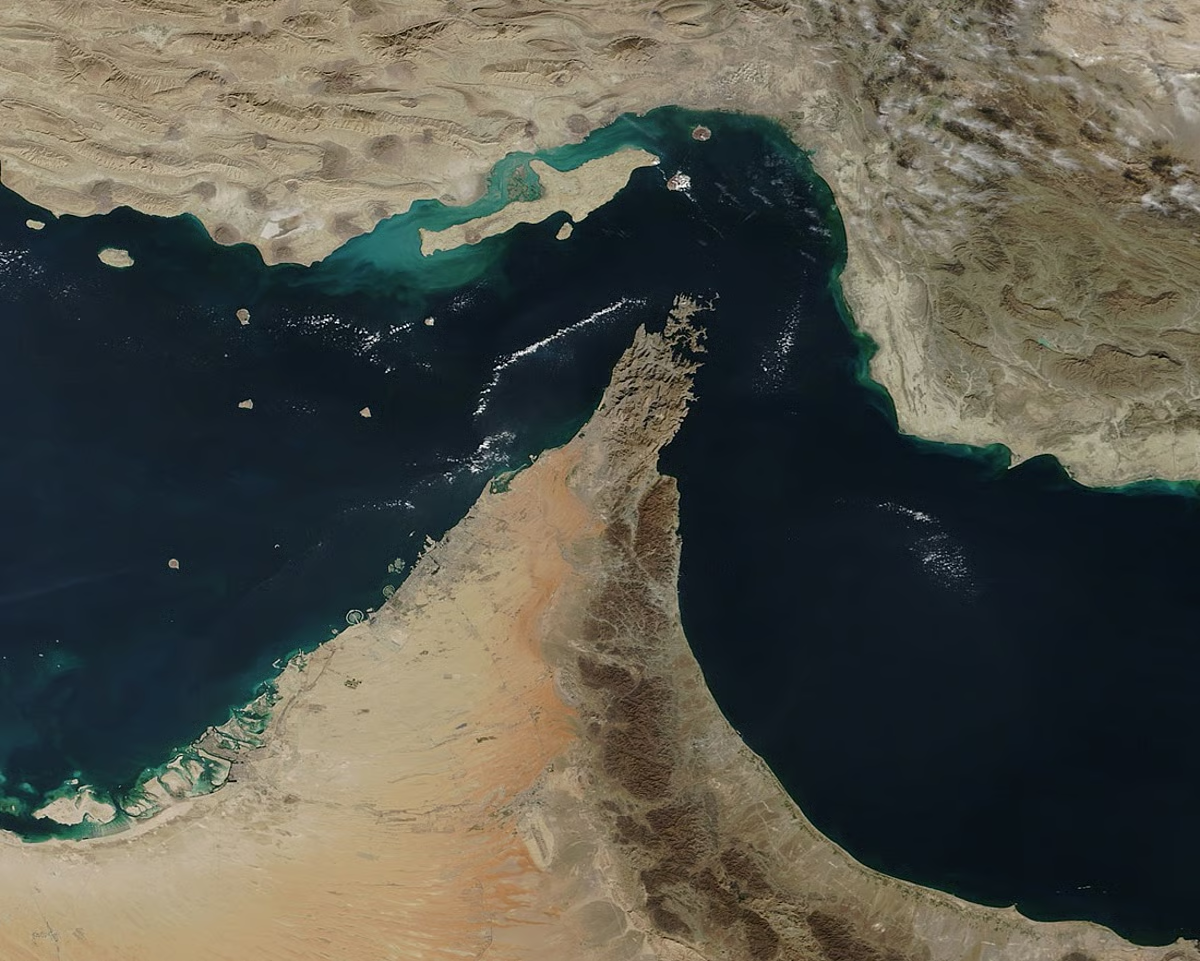
The world, and India, today are in the grip of a mounting crisis. All because of a waterway that is just 20 nautical miles wide. The Strait of Hormuz is today on the lips of the entire globe as countries face a growing shortage of oil and gas, most of which are transported through this body of water that has been blocked by Iran as a result of the attacks on it by Israel and the United States beginning on February 28, 2026.
The state of affairs once again highlights an important truth: humanity may have made innumerable advancements and brought changes to planet Earth that are irrevocable in several cases. But that does not mean nature is beaten.
Indeed, as this case underlines, nature, or should we say geography in this case, has its own way of getting even.
For centuries, it is human history, culture, economy and politics that have been influenced by the geography people live in. Not the other way round.
Here, Down To Earth recounts how geographical relief has, over the centuries, influenced human life.
Geographical features, whether pertaining to land or the sea, both have influenced human history. We, however, must begin with maritime geographic features, one of which is in the news right now.
“Man’s natural habitat is land, and land dominates his conscious endeavor—social, economic, political, and military. Yet, almost three quarters of his world is ocean. It is the original source of life for all earth’s species; it is the essential means of global transport for man’s produce, commerce, and military strength. While the world ocean is beyond sight of much of mankind, its influence is ubiquitous,” Lieutenant Colonel Reynolds B Peele quoted Colonel James E. Toth, in his 1997 article, The Importance of Maritime Chokepoints.
Strait to the point
Let us begin with ‘Strait’, for that is what the world is talking about. What exactly is a strait?
According to the Merriam-Webster dictionary, a strait is ‘a comparatively narrow passageway connecting two large bodies of water, often used in plural but singular in construction’.
Several important straits around the world not just connect bodies of water but also separate landmasses. Besides Hormuz, these include:
1.The Strait of Malacca, which separates the Malay Peninsula from the Indonesian island of Sumatra and connects the Andaman Sea (part of the Indian Ocean) and the South China Sea (part of the Pacific Ocean).
2. Taiwan Strait, which separates mainland China from the island of Taiwan and connects the South China Sea to the East China Sea.
3. Palk Strait which separates India from Sri Lanka and connects the Bay of Bengal to the Laccadive Sea.
4. The Strait of Tartary, which separates mainland Russia from the island of Sakhalin and connects the Sea of Okhotsk to the Sea of Japan.
5. Tsushima Strait, part of the Korea Strait, which separates the Japanese home islands from the Korean Peninsula. It connects the Sea of Japan to the Yellow and East China Seas.
6. Bering Strait, which separates Alaska from Russia and connects the Chukchi Sea to the Bering Sea.
7. Strait of Bab-el-Mandeb, which separates Yemen from Eritrea and Djibouti and connects the Red Sea to the Gulf of Aden and the Indian Ocean.
8. Strait of the Bosporus and Strait of the Dardanelles, which connect the Black Sea to the Aegean and Mediterranean Sea.
9. Strait of Gibraltar, which separates Europe from Africa and connects the Mediterranean Sea to the Atlantic Ocean.
10. Strait of Dover, which connects the North Sea to the English Channel and separates the United Kingdom from France.
11. Skagerrak and Kattegat, which connect the North Sea to the Baltic Sea.
12. Strait of Magellan, which separates mainland South America from Tierra del Fuego.
All these straits have had and (still have) their important roles in the history of humanity.
The International Date Line slices through the Bering Strait. You can be 21 hours ahead or behind depending on whether you are west or east of the Line.
The Battle of Tsushima Strait in May 1905 announced the arrival of Japan as a power on the world stage as its navy crushed the Russian navy in the final engagement of the Russo-Japanese War.
The Bosporus and Dardanelles are the gateway for produce from Russian and Ukraine to global markets, something which has been highlighted ever since the Russian invasion of Ukraine began in February 2022.
The Strait of Malacca, like Hormuz, is a global ‘chokepoint’. It serves as “the shortest maritime route between the Indian and Pacific Oceans, facilitating the movement of an estimated 82,000 vessels annually”.
The Strait of Bab-el-Mandeb, or ‘The Gate of Tears’ is another critical ‘chokepoint’ sitting at the head of the Red Sea, where ships headed for the Suez Canal and the Mediterranean can be stopped. This has happened in the past few years since the war in Houthi-controlled Yemen broke out.
The Strait of Gibraltar (‘The Rock of Tariq’) has historical significance, with it serving as the spring board for the Umayyad Conquest of Visigothic Spain in 711 CE. It is also in the news frequently for migrant boats trying to get across from Morocco to EU member Spain, besides serving as a vital conduit between the Mediterranean and the Atlantic.
The Strait of Dover and the English Channel are why England could never be conquered by sea (except by William the Conqueror in 1066). The Spanish Armada, Napoleon Bonaparte and Adolf Hitler did try, but failed.
The Skagerrak and Kattegat played a vital role during the Viking Age and later during the Hanseatic League, connecting ports in northern Europe between the North Sea and the Baltic Sea, facilitating raiding (during the former) as well as trade and even monopoly (during the latter).
The Strait Magellan was famously discovered by explorer Ferdinand Magellan during his famous voyage with five ships that circumnavigated the globe but of which, only one returned back to Spain.
But straits are just part of the story. Let us look at more maritime geographical features.
Isthmus: Connecting continents
An isthmus is the opposite of a strait as it is a strip of land that connects two great landmasses. Examples that instantly come to mind are the isthmuses of Panama (connecting North, Central and South America) and Suez (connecting Africa with Eurasia).
There is also the famous isthmus of Corinth, which connects mainland Greece to the Peloponnese peninsula.
In all these three instances, humans have been able to use agency and advancement in technology to dig ‘canals’ across these ‘land bridges’ to connect bodies of water surrounding the isthmus.
While Frenchman Ferdinand de Lesseps was able to build the Suez Canal, he was unable to repeat his feat in Panama, which was later achieved by the US. Both, the Suez and Panama Canals, were constructed with the aim of shortening sea routes: The Suez Canal reduced time ships would have had to otherwise spend to round the Cape of Good Hope while travelling between Europe and Asia. The Panama Canal reduced the same for ships travelling between the east and west coasts of the US rounding off Cape Horn at the tip of South America.
The Corinthian Canal makes it easy for vessels to travel from the Saronic Gulf to the Gulf of Corinth, instead of rounding the Peloponnese.
Peninsula, promontory, headland and cape
These four terms have similarities. In simple language, they are coastal landforms that are basically jutting out into the ocean.
A peninsula is a landmass that is surrounded on three sides by water but is connected on the fourth side to a larger landmass. Think our own country, the southern part of which is a peninsula. There is also Korea, Kamchatka, the Malay Peninsula, Florida, Iberia, Italy, Baja California and the Balkans. And the largest peninsula of all: Arabia.
A peninsula is usually defined as a large promontory or headland. A cape is also quite similar but a key feature is that it often signifies a change in the direction of the coastline.
Think the Cape of Good Hope, from where, ships round off going either side between the Atlantic and the Indian Ocean. Similarly for Cape Horn between the Atlantic and the Pacific. Or even Cape Comorin, between the Arabian Sea and the Bay of Bengal.
The rounding of the Cape of Good Hope signalled progress for European explorers who had been trying since the days of Prince Henry the Navigator to get to India. Rounding it and Cape Horn often involved very stormy weather and treacherous seas during the Age of Sail.
Bay, gulf, cove and fjord
These can be considered as inlets or arms of the sea protruding into the land. While a cove is small, a fjord is long, formed by glacial processes. Bays and gulfs are almost the same except that gulfs are bigger than bays. Both are surrounded on three sides by land. Think Hudson Bay, the Gulf of Mexico, Gulf of California, the Persian Gulf, the Gulf of Carpentaria and the largest bay of all: our very own, Bay of Bengal.
Bays, gulfs and coves have been crucial in history as they have provided shelter to ships during storms or for handling cargo or dropping anchor. No wonder then that some of the greatest port cities have been near bays, gulfs or natural harbours. Think New York, Sydney, Mumbai, San Francisco, Trincomalee and Rio de Janeiro.
Of course, human civilisation has not just been influenced by coastal geography. Humanity is terrestrial and it is on land that we usually reside.
River, plain and plateau
The first ‘cradles of civilisation’ were river valleys in Egypt, Mesopotamia, the Indian Subcontinent and China. A perennial supply of water and good soil enriched by riverine sediment afforded people to farm crops, raise livestock and then, build kingdoms and empires.
Plains, most of which were around rivers, have been fundamental to human history. Whether the Indo-Gangetic Plain of the subcontinent, the valley of the Nile, the plains of Mesopotamia or the North China Plain, these fertile flatlands were where humans first thrived.
Humans also domesticated horses in the Eurasian Steppe as well as the Great Plains of North America. The animals provided connectivity, opportunities for trade like in the case of the Silk Road and finally conquest, like the Mongol Empire, which remains the largest land-based contiguous empire in human history.
Plateaus or tablelands are where some of the earliest humans lived. Think the Ethiopian Highlands. Or the largest of them all, the Tibetan Plateau. They are also where biodiversity has been preserved to this day, like the plateaus of the Western Ghats.
Conquering geography
As can be seen, humans have, for millennia, been influenced by their geography. Whether coastal or land-based, geographical relief has influenced our lives. And continues to do so.
Has geography been superior to humans then? Or is it the other way round? After all, we did make those canals. We did travel across the seas and across the continents making use of straits, isthmuses, peninsulas, promontories, headlands, capes, bays, gulfs, coves, fjords, rivers, plains and plateaus. We did trade and build kingdoms and empires.
Who controlled whom, then? The answer is an evolving one in academia. Today, there is broad consensus that humans cannot ‘conquer’ geography in an absolute sense. However, they do dynamically interact with and modify it, often creating new possibilities while facing environmental limitations.
If anything, the Strait of Hormuz fiasco should teach us more humility.