
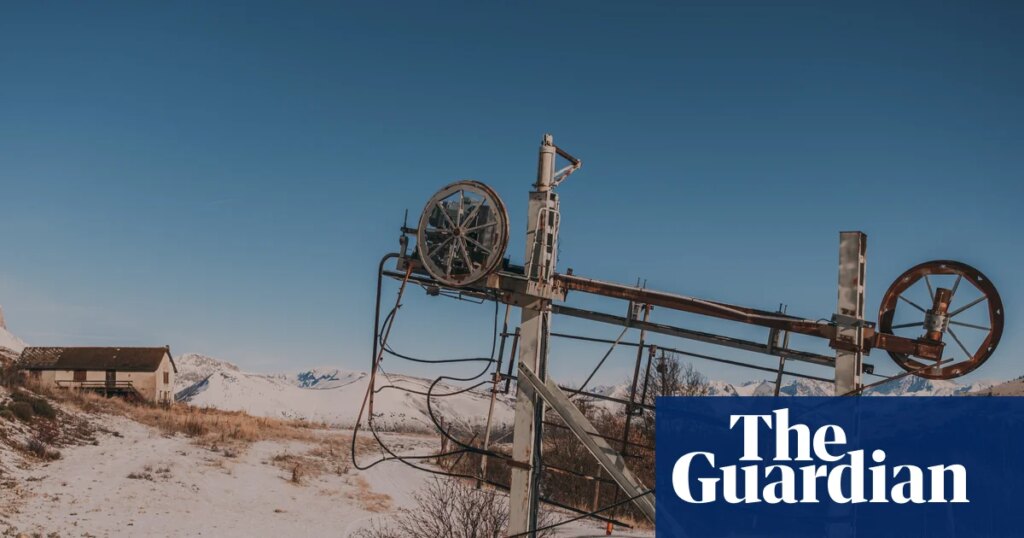
When Céüze 2000 ski resort closed at the end of the season in 2018, the workers assumed they would be back the following winter. Maps of the pistes were left stacked beside a stapler; the staff rota pinned to the wall.
Six years on, a yellowing newspaper dated 8 March 2018 sits folded on its side, as if someone has just flicked through it during a quiet spell. A half-drunk bottle of water remains on the table.
The Céüze resort in the southern French Alps had been open for 85 years and was one of the oldest in the country. Today, it is one of scores of ski resorts abandoned across France – part of a new landscape of “ghost stations”.
More than 186 have been permanently closed already, raising questions about how we leave mountains – among the last wild spaces in Europe – once the lifts stop running.
As global heating pushes the snow line higher across the Alps, thousands of structures are being left to rot – some of them breaking down and contaminating the surrounding earth, driving debate about what should happen to the remnants of old ways of life – and whether to let nature reclaim the mountains.
Snowfall at Céüze started becoming unreliable in the 1990s. To be financially viable, the resort needed to be open for at least three months. In that last winter, it only managed a month and a half. For the two years before that it had not been able to operate at all.
Opening the resort each season cost the local authority as much as €450,000 (£390,000). As the season got shorter, the numbers no longer added up. To avoid a spiral of debt, the decision was made to close.
“It was costing us more to keep it open than to keep it closed for the season,” says Michel Ricou-Charles, president of the local Buëch‑Dévoluy community council, which oversees the site. Even under the most optimistic projections, the future looked bleak. “We looked into using artificial snow, but realised that would delay the inevitable,” he says.
It was seven years before the trucks and helicopters came in to begin removing the pylons. Still, the local community grieved for the small, family-oriented resort, which was host to generations of memories. As demolitions began, they came to take nuts, bolts and washers as mementoes of what they had lost.
Degrading wild terrain
In France, there are today 113 ski lifts totalling nearly 40 miles (63km) in length that have been abandoned, nearly three-quarters of them in protected areas. It is not just ski infrastructure. The Mountain Wilderness association estimates that there are more than 3,000 abandoned structures dotted around French mountains, slowly degrading Europe’s richest wild terrain. This includes military, industrial and forestry waste, such as old cables, bits of barbed wire, fencing and old machinery.
Céüze ski resort is fast becoming one of these pollutants. The little wooden cabin at the bottom of the first button lift is shedding insulation. Ropes once used to mark out the piste hang in tatters and bits of plastic are falling off a pylon. The old sheds at each end of the ski lifts often still contain transformers, asbestos, motor oils and greases. Over time, these substances seep into the soil and water.
Corrosion and rust from metal structures left over from the second world war, such as anti-tank rails and metal spikes, have led to changes in plant species in the surrounding area, potentially offering a vision of what could happen if pylons are left to rust over the coming decades.
“In Latin, we say memento mori – remember that you are mortal. Don’t think that you are making eternal things; they will end up becoming obsolete,” says Nicolas Masson, from Mountain Wilderness, which is campaigning for old ski infrastructure to be dismantled to make space for nature. “When you make them, ask yourself the question: what will remain?”
Some believe the resorts should remain memorialised landscapes, honouring generations of people who lived and skied here; others believe they should be returned to wild landscapes with their disintegrating machinery removed.
Nature’s recovery
Céüze’s deconstruction started on 4 November 2025, a month before the ski season would once have kicked off. The resort’s ski lifts were airlifted out using a helicopter to minimise environmental disturbance and compression of the earth.
French law requires ski lifts to be removed and dismantled if they are no longer in use. The law only applies to ski lifts built after 2017, however. Most last for 30 years, so no lifts would be considered obsolete until at least 2047. The process is also expensive: dismantling Céüze will cost €123,000. This means most abandoned ski infrastructure is left to disintegrate in situ. What is happening in Céüze is rare.
With pylons cleared and the resort already closed for seven years, early signs of ecological recovery are already visible. A red haze floats over the white snow: winter berries of the dog rose are sprouting where the piste is no longer mown.
The berries are important winter food for birds such as the rare red-billed chough, and their thorny stems are used for nest-building come spring. In the summer, orchids and yellow gentians bloom over these hillsides. The hills surrounding the site are classed as Natura 2000, meaning they are home to Europe’s rarest and most protected wildlife.
The trees are coming back too. “I don’t know if it would take 10, 20 or 50 years, but this is becoming a forest,” says Masson.
Wild boar and roe deer living in these forests will benefit from quieter winters. Birds such as grouse shelter from severe cold in winter by digging into the snow, and prefer deep powdery snow – just like skiers. The species is endangered in all the mountain ranges of France.
The dismantling of Céüze comes at a time when many spaces for nature are shrinking. Pierre-Alexandre Métral, a geographer at the University of Grenoble Alpes, who studies abandoned ski resorts, says: “There is a lot of debate about the nature of this dismantling – is it just removing mechanical stuff, or are we attempting to put mountains back into a kind of original state?”
Ecological recovery can be filled with surprises, he says, noting that the maintenance of pistes can be beneficial to some alpine flowers. “If we let nature come back spontaneously – in a wild, uncontrolled way – there are also risks that some invasive species that tend to be stronger could colonise faster,” says Métral.
There is scant research in this area, but studies from the Valcotos ski resort closure in Madrid’s Sierra de Guadarrama in 1999 show it led to significant recovery of native vegetation and cleaner waterways, while reducing soil erosion.
“These are laboratories of what the mountain could be like in the future with new closures,” says Métral.
On the brink
The question of what to do with these places will play out across Europe’s mountains, and around the world. Skiing is disappearing from many alpine landscapes. “Many lower ones are already closed,” says Masson. “A fraction of a degree changes everything in the mountain environment. It’s the difference between having snow and no snow.”
Research suggests that with 2C (3.6F) of global heating, more than half of existing resorts risk having too little snow. Higher altitude resorts are vulnerable to the loss of permafrost, threatening pylons that have been drilled into it. Some resorts, such as St-Honoré 1500, were abandoned before construction was even completed. Even bigger resorts, which typically have funds to invest in new pistes and artificial snow, are struggling to survive.
For some, the loss of Céüze feels premature. Richard Klein,who lives in Roche des Arnauds, near Céüze, feels the ski resort could – and should – have been saved. “It’s a wonderful place to learn to ski – it’s the best. I think it’s really stupid they closed it,” he says. “There were always loads of people.” Klein believes the local authority should have begun using artificial snow, adding: “Now it’s too late.”
Yet life has not disappeared from Céüze. In October 2025, the resort’s Hotel Galliard is being sold to a developer looking to open it for events, according to Ricou-Charles. A property developer has bought the children’s holiday residence, and a carpenter has moved into the building where the old ticket office was. The rooms used as a holiday camp for children have cracks appearing down the side, but might open again in the future.
“Céüze will continue to live, despite the loss of the resort,” says Ricou-Charles. “We are not mourning Céüze because it is not dead.”
On winter weekends dozens of cars still gather in the car park, with people enjoying quieter activities on the hillside, such as walking, snow-shoeing, cross-country skiing and sledging.
Masson does not like the term “ghost resort” because it suggests total abandonment when what is happening in his area is more complicated. “People continue to come,” he says. “We don’t need large machines to make mountains attractive.”
What happens at Céüze is a glimpse into a future that faces dozens of other small resorts, and mountain landscapes, across Europe. “What is our heritage that we will want to keep,” asks Masson. “And what is just a ruin we want to dismantle? That is a question we have to ask every time, and it requires some reflection.”