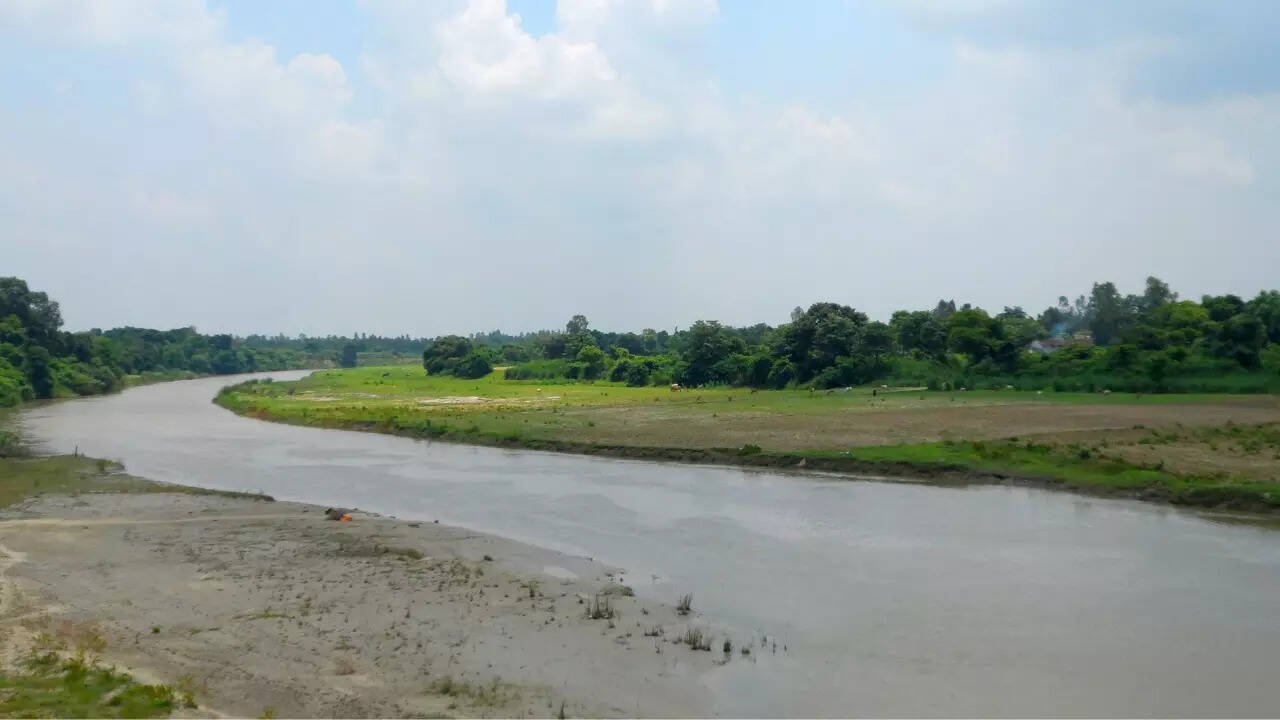
India has some of the most famous rivers in the world, such as the Ganga, Yamuna, and Brahmaputra, most of which travel across several states, before finally merging into larger river systems. However, did you know that there is a major river in India that lies entirely within the boundaries of a single state? The Gomti River is a large tributary of the Ganga River and remains entirely within the state of Uttar Pradesh, where it flows its entire length of 940 km before finally merging into the Ganges near the Varanasi district.The river originates from Gomat Taal, near Madhotanda in Pilibhit district. Initially a narrow stream, it gathers volume as it moves south and west, fed by monsoon rainfall and groundwater sources. About 20 km from its origin, it meets a small tributary called the Gaihaaee. As it flows further, tributaries such as the Sukheta, Choha and Andhra Choha strengthen its channel near Lakhimpur Kheri. Later, the Kathina and Sarayan rivers join it before it continues toward central Uttar Pradesh. One of its most significant tributaries, the Sai River, merges with the Gomti near Jaunpur.
Travels through the heart of Lucknow
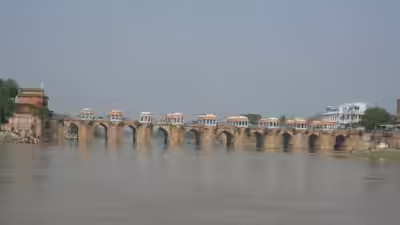
After travelling nearly 190 km, the Gomti enters Lucknow, the capital city of Uttar Pradesh. However, it needs to be noted that the expansion of the city has significantly affected the river. In Lucknow alone, there are over 20 major drains that pour untreated sewage into the Gomti River. At the end of the city, there is a barrage that converts a part of the river into a lake-like stretch. Further downstream, the river passes towns such as Gola Gokaran Nath, Lakhimpur Kheri, Sultanpur, Kerakat, Zafarabad and Jaunpur. The Mughal-era Shahi Bridge still stands across the Gomti in Jaunpur, reflecting the river’s long-standing historical importance.Read more: TSA’s $45 fee for travellers without a REAL ID is now in effect: What it means and what IDs are accepted
Religious and cultural significance
According to Hindu belief, the Gomti is considered the daughter of sage Vashishtha. Bathing in the river on Ekadashi (the 11th day of the lunar fortnight) is believed to cleanse sins. The river is also mentioned in the Bhagavata Purana as one of the sacred rivers of India. A rare fossilised shell stone known as the Gomti Chakra is found along its banks and holds religious value in Hindu households.
Pollution and environmental stress
The Gomti River, a river of profound importance, is grappling with severe environmental issues. A major source of worry is the pollution stemming from sugar factories, distilleries, and the influx of domestic sewage. Further, other contributory factors include the Kukrail drainage system, which pours waste into the Gomti. The Gomti River basin is home to approximately 18 million people, further straining the river’s water quality and aquatic life. The high levels of pollution have resulted in a decrease in biodiversity and water quality. Despite the fact that sewage treatment plants, such as the one at Bharwara, were intended to resolve the problem, it was also a failure.Read more: India Young Professionals Scheme 2026: UK Visa ballot opens today; 3,000 spots available
Controversy over riverfront development
Recently, the Gomti Riverfront Development Project in Lucknow has been at the center of controversy. The plan, inspired by the Sabarmati Riverfront in Ahmedabad, was to develop the Gomti Riverfront through the construction of embankments and environmental development. However, the apprehensions expressed by experts, as well as research studies conducted by the Indian Institute of Technology Roorkee, have shown that the decrease in the width of the river would increase the speed of the water and result in floods. Moreover, environmental activists expressed that the change in the natural floodplain would further deteriorate the environment. The Gomti is known to rise by 10–12 metres during heavy monsoon seasons. Flooding has historically reshaped its course and affected settlements along its banks. Unlike many major Indian rivers that cross state boundaries, the Gomti remains entirely within Uttar Pradesh, geographically, culturally and politically.