Helen Catt,Political correspondentand
Ian Aikman
 Reuters
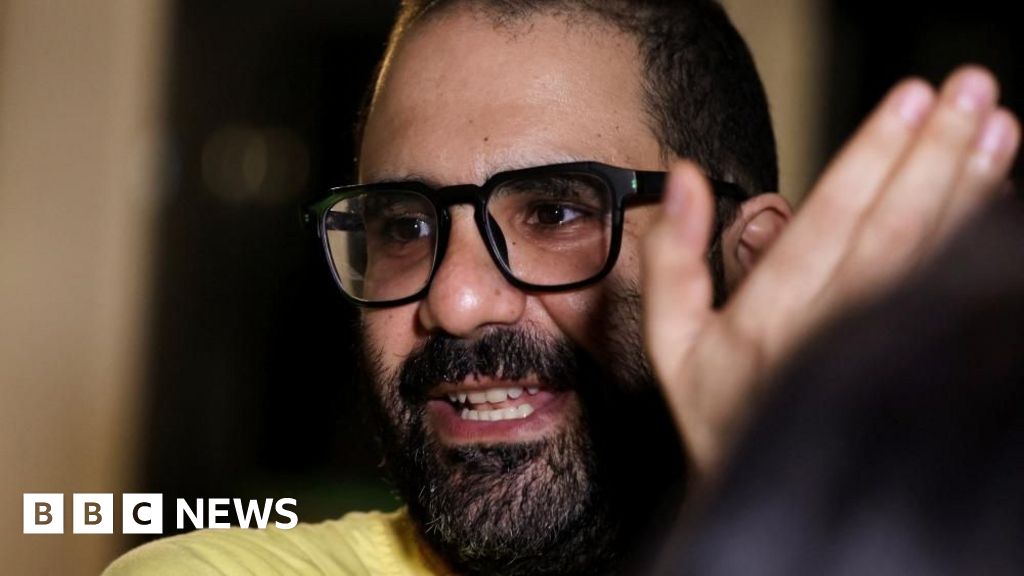
Foreign Secretary Yvette Cooper has launched a review into what she calls “serious information failures” in the case of British-Egyptian activist Alaa Abd El Fattah.
In a letter to the Foreign Affairs Select Committee, Cooper said she, Sir Keir Starmer and Deputy Prime Minister David Lammy “were all unaware” of Mr Abd El Fattah’s historical tweets, which they consider to be “abhorrent”.
It comes after the Conservatives and Reform UK called for the activist to be stripped of UK citizenship and deported after social media posts emerged in which he called for Zionists to be killed.
Mr Abd El Fattah has apologised, saying he understood “how shocking and hurtful” the posts were.
Sir Keir Starmer has been criticised for saying he was “delighted” by Mr Abd El Fattah’s arrival in the UK on Friday, three months after the democracy activist was freed from prison in Egypt.
On Monday, Sir Keir said the resurfaced tweets were “absolutely abhorrent” and said the government was “taking steps to review the information failures in this case”.
“With the rise of antisemitism, and recent horrific attacks, I know this has added to the distress of many in the Jewish community in the UK,” he added.
Conservative shadow justice secretary Robert Jenrick, who led the criticism of Sir Keir’s welcome for Mr Abd El Fattah, swiftly responded by renewing his call for the activist to be removed from the UK.
In her letter to the Foreign Affairs committee, Cooper said work started over the weekend revealed that previous foreign secretaries and prime ministers had made public statements on Mr Abd El Fattah’s case “without all relevant information”.
She added that current and former ministers were “never briefed on these tweets when they spoke publicly about the case”, and the civil servants in charge of the case “were also unaware” of them.
Cooper said it was clear there had been an “unacceptable failure” and that longstanding due diligence procedures had been “completely inadequate for this situation”.
The foreign secretary added she was “deeply concerned” that the re-emergence of these tweets, alongside social media posts welcoming Mr Abd El Fattah’s return posted by her and other members of the government, had “added to the distress felt by Jewish communities in the UK and I very much regret that”.
She told the committee she had asked the most senior civil servant in the Foreign Office to review the “serious information failures in this case” and the broader systems that were in place in the department for carrying out due diligence on high-profile consular and human rights cases to make sure they were working properly and that “all necessary lessons are learned”.
In one resurfaced tweet, from 2012, Mr Abd El Fattah appears to say: “I am a racist, I don’t like white people”. In another, he appears to say he considers “killing any colonialists and specially Zionists heroic, we need to kill more of them”.
He is also accused of saying police do not have rights and “we should kill them all”.
Earlier on Monday, Mr Abd El Fattah “unequivocally” apologised for the tweets.
He said he took allegations of antisemitism “very seriously” while arguing some of the posts had been “completely twisted out of their meaning”.
He added: “I am shaken that, just as I am being reunited with my family for the first time in 12 years, several historic tweets of mine have been republished and used to question and attack my integrity and values, escalating to calls for the revocation of my citizenship.”
The Foreign Office said it had been “a long-standing priority under successive governments” to work for Mr Abd El Fattah’s release.
The 44-year-old was convicted in 2021 of “spreading fake news” in Egypt for sharing a Facebook post about torture in the country following a trial that human rights groups said was grossly unfair.
He was granted British citizenship in December 2021 through his London-born mother, when the Conservatives were in power.
Conservative leader Kemi Badenoch and Reform UK leader Nigel Farage have both said the home secretary should look at whether Mr Abd El Fattah’s citizenship could be revoked to enable his swift removal from the UK.
A government source said Mr Abd El Fatteh arrived in the country as a British citizen and there were no legal avenues available to block his entry, even if officials had been aware of his previous social media posts.
It is understood that Downing Street believes there is a high bar to someone having their citizenship revoked because they must have either obtained citizenship by fraud or be deemed to pose a significant national security threat – a test unlikely to be met in this case.
A writer, intellectual and software developer, Mr Abd El Fattah rose to prominence during a 2011 uprising that forced the former Egyptian president, Hosni Mubarak, to resign.
He has spent more than a decade of his life behind bars and his release in September after a presidential pardon followed a long campaign by his family and lobbying by the British government.